QUESTION IMAGE
Question
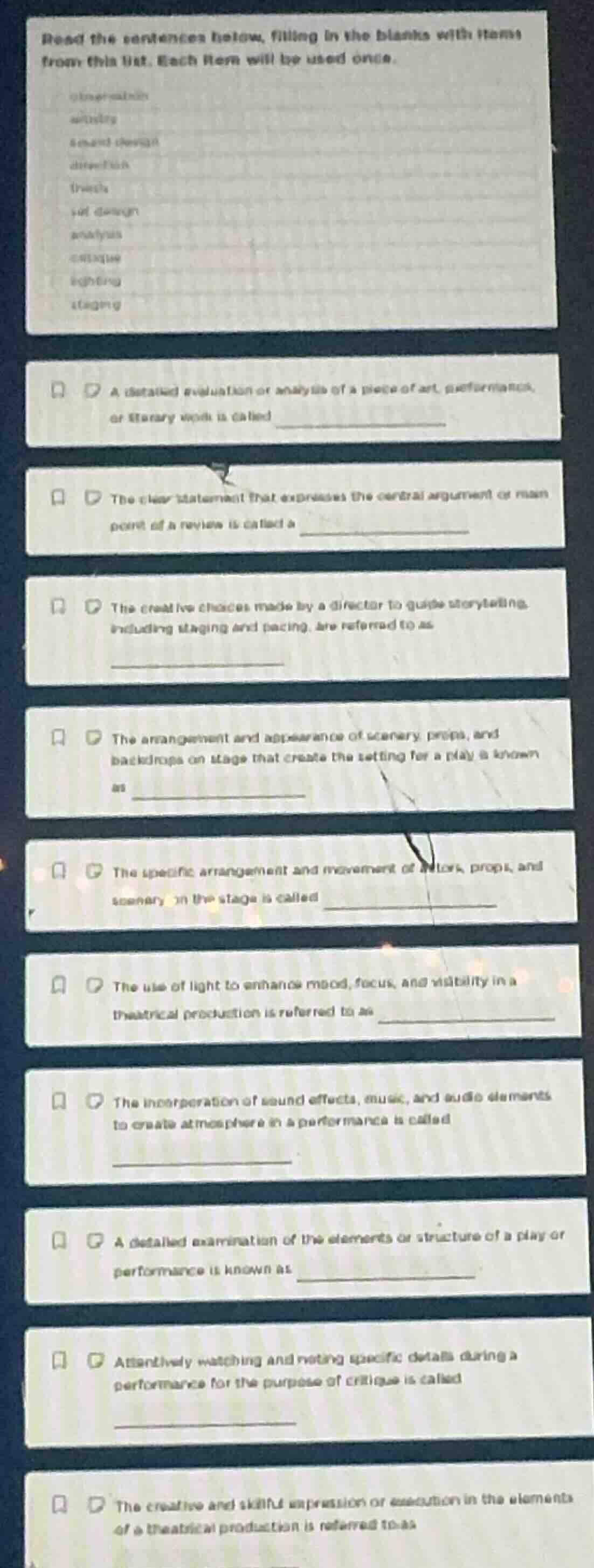
read the sentences below, filling in the blanks with items from this list. each item will be used once.observationeditingsound designdirectionthesisset designanalysiscritiquelightingstaging1. a detailed evaluation or analysis of a piece of art, performance, or literary work is called ______________________2. the clear statement that expresses the central argument or main point of a review is called a ____________________3. the creative choices made by a director to guide storytelling, including staging and pacing, are referred to as ____________________4. the arrangement and appearance of scenery, props, and backdrops on stage that create the setting for a play is known as ____________________5. the specific arrangement and movement of actors, props, and scenery on the stage is called ____________________6. the use of light to enhance mood, focus, and visibility in a theatrical production is referred to as ____________________7. the incorporation of sound effects, music, and audio elements to create atmosphere in a performance is called ____________________8. a detailed examination of the elements or structure of a play or performance is known as ____________________9. attentively watching and noting specific details during a performance for the purpose of critique is called ______________________10. the creative and skillful expression or execution in the elements of a theatrical production is referred to as
Each term is matched to its definition based on theatrical and literary criticism terminology, with each term used exactly once as instructed.

Snap & solve any problem in the app
Get step-by-step solutions on Sovi AI
Photo-based solutions with guided steps
Explore more problems and detailed explanations
- A detailed evaluation or analysis of a piece of art, performance, or literary work is called critique
- The clear statement that expresses the central argument or main point of a review is called a thesis
- The creative choices made by a director to guide storytelling, including staging and pacing, are referred to as directing
- The arrangement and appearance of scenery, props, and backdrops on stage that create the setting for a play is known as set design
- The specific arrangement and movement of actors, props, and scenery on the stage is called staging
- The use of light to enhance mood, focus, and visibility in a theatrical production is referred to as lighting
- The incorporation of sound effects, music, and audio elements to create atmosphere in a performance is called sound design
- A detailed examination of the elements or structure of a play or performance is known as analysis
- Attentively watching and noting specific details during a performance for the purpose of critique is called observation
- The creative and skillful expression or execution in the elements of a theatrical production is referred to as artistry