QUESTION IMAGE
Question
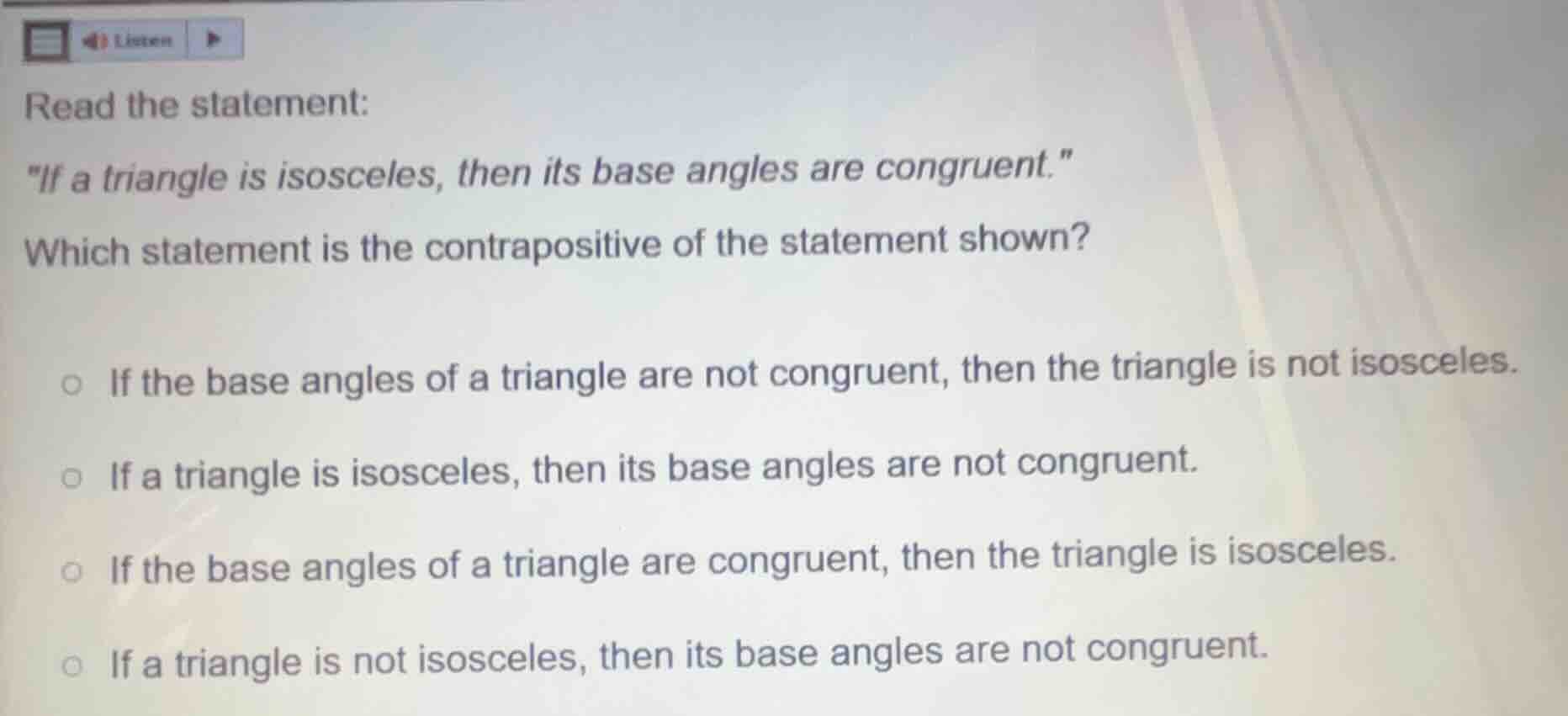
read the statement:
\if a triangle is isosceles, then its base angles are congruent.\
which statement is the contrapositive of the statement shown?
- if the base angles of a triangle are not congruent, then the triangle is not isosceles.
- if a triangle is isosceles, then its base angles are not congruent.
- if the base angles of a triangle are congruent, then the triangle is isosceles.
- if a triangle is not isosceles, then its base angles are not congruent.
To find the contrapositive of a conditional statement \( p \to q \), we negate both the hypothesis and the conclusion and then reverse their order, resulting in \(
eg q \to
eg p \).
The original statement is "If a triangle is isosceles (\( p \)), then its base angles are congruent (\( q \))", so \( p \): "a triangle is isosceles", \( q \): "its base angles are congruent".
Negating \( p \) gives \(
eg p \): "a triangle is not isosceles", and negating \( q \) gives \(
eg q \): "its base angles are not congruent".
Reversing the order of the negated statements gives the contrapositive \(
eg q \to
eg p \), which translates to "If the base angles of a triangle are not congruent (\(
eg q \)), then the triangle is not isosceles (\(
eg p \))".

Snap & solve any problem in the app
Get step-by-step solutions on Sovi AI
Photo-based solutions with guided steps
Explore more problems and detailed explanations
A. If the base angles of a triangle are not congruent, then the triangle is not isosceles.