QUESTION IMAGE
Question
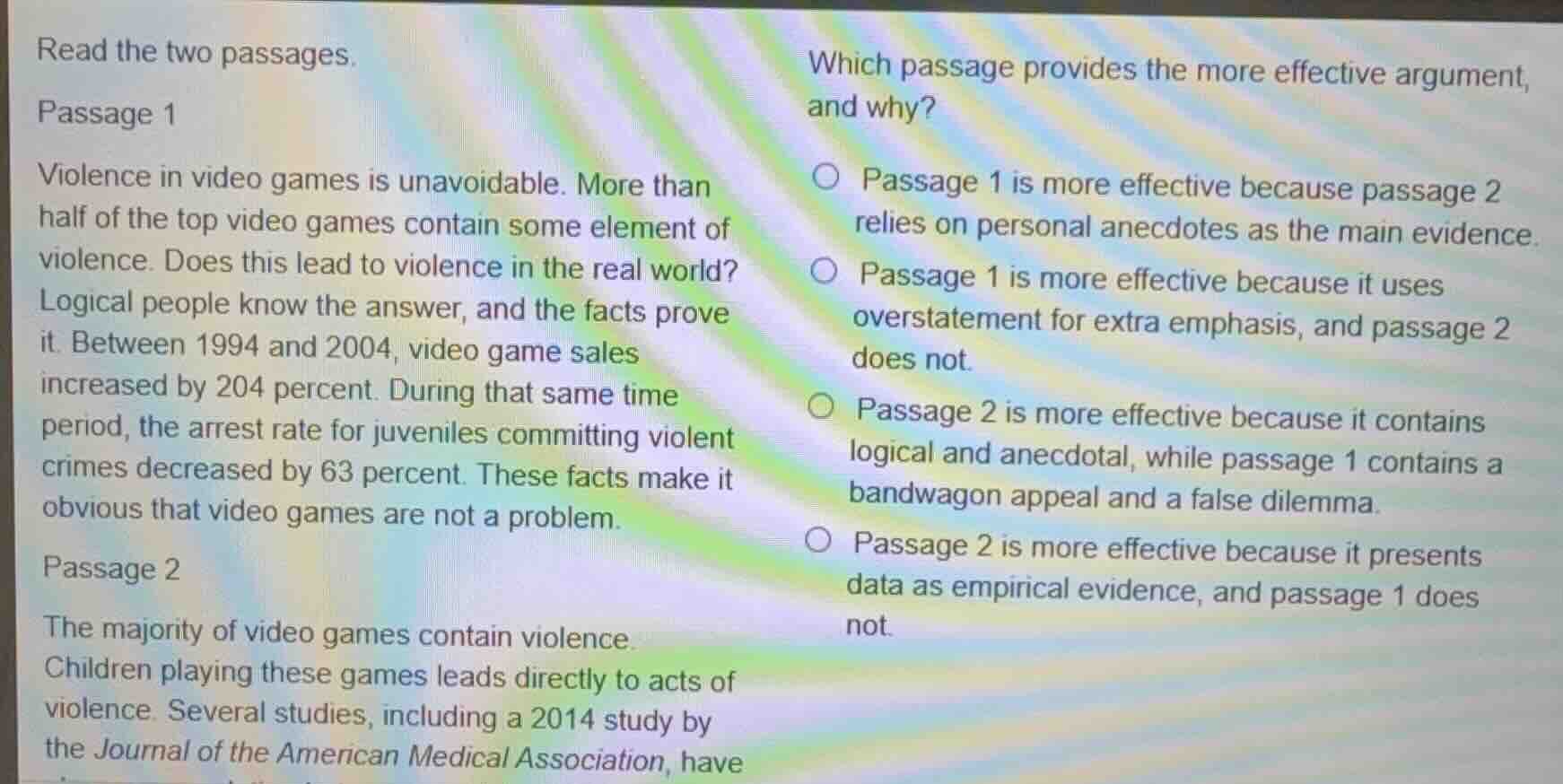
read the two passages.
passage 1
violence in video games is unavoidable. more than half of the top video games contain some element of violence. does this lead to violence in the real world? logical people know the answer, and the facts prove it. between 1994 and 2004, video game sales increased by 204 percent. during that same time period, the arrest rate for juveniles committing violent crimes decreased by 63 percent. these facts make it obvious that video games are not a problem.
passage 2
the majority of video games contain violence. children playing these games leads directly to acts of violence. several studies, including a 2014 study by the journal of the american medical association, have
which passage provides the more effective argument, and why?
○ passage 1 is more effective because passage 2 relies on personal anecdotes as the main evidence.
○ passage 1 is more effective because it uses overstatement for extra emphasis, and passage 2 does not.
○ passage 2 is more effective because it contains logical and anecdotal, while passage 1 contains a bandwagon appeal and a false dilemma.
○ passage 2 is more effective because it presents data as empirical evidence, and passage 1 does not.
To determine the more effective argument, we analyze each option:
- Option 1: Passage 1 uses data (sales increase, arrest rate decrease) as evidence. Passage 2 (from the visible part) starts with a claim and mentions studies, but the first option's reasoning about Passage 2 relying on personal anecdotes is incorrect as we don't see personal anecdotes yet. Wait, no—wait, the visible Passage 2 has "Several studies..." but maybe the full Passage 2 (not fully shown) might have anecdotes? Wait, no, the first option says Passage 2 relies on personal anecdotes. But the given Passage 1 has data (video game sales +204%, juvenile violent crime arrest rate -63%), while if Passage 2 (as per the first option's reasoning) uses personal anecdotes (which we don't see in the given Passage 2, but maybe the full Passage 2 does? Wait, no, the options: Let's re - evaluate.
Wait, the first option: "Passage 1 is more effective because passage 2 relies on personal anecdotes as the main evidence." Let's check Passage 1: it has data (video game sales increase, juvenile violent crime arrest rate decrease) to support its claim. If Passage 2 (even if the full text has personal anecdotes, but from the visible part, it has "Several studies...", but maybe the rest of Passage 2 has personal stories). But the other options:
Option 2: Overstatement is not a good argumentative technique, so Passage 1 using overstatement would not make it more effective.
Option 3: Passage 1 does not have a bandwagon appeal ("logical people know the answer" is more of an appeal to logic, not bandwagon) or false dilemma. And saying Passage 2 has logical and anecdotal is not clear, and the reasoning is flawed.
Option 4: Passage 1 does present data (video game sales, arrest rate), so this is wrong.
So the first option is correct because Passage 1 uses data (empirical evidence) and if Passage 2 relies on personal anecdotes (which are less reliable than empirical data for an argument), then Passage 1 is more effective.

Snap & solve any problem in the app
Get step-by-step solutions on Sovi AI
Photo-based solutions with guided steps
Explore more problems and detailed explanations
A. Passage 1 is more effective because passage 2 relies on personal anecdotes as the main evidence.