QUESTION IMAGE
Question
reading activity
- read the following test and complete.
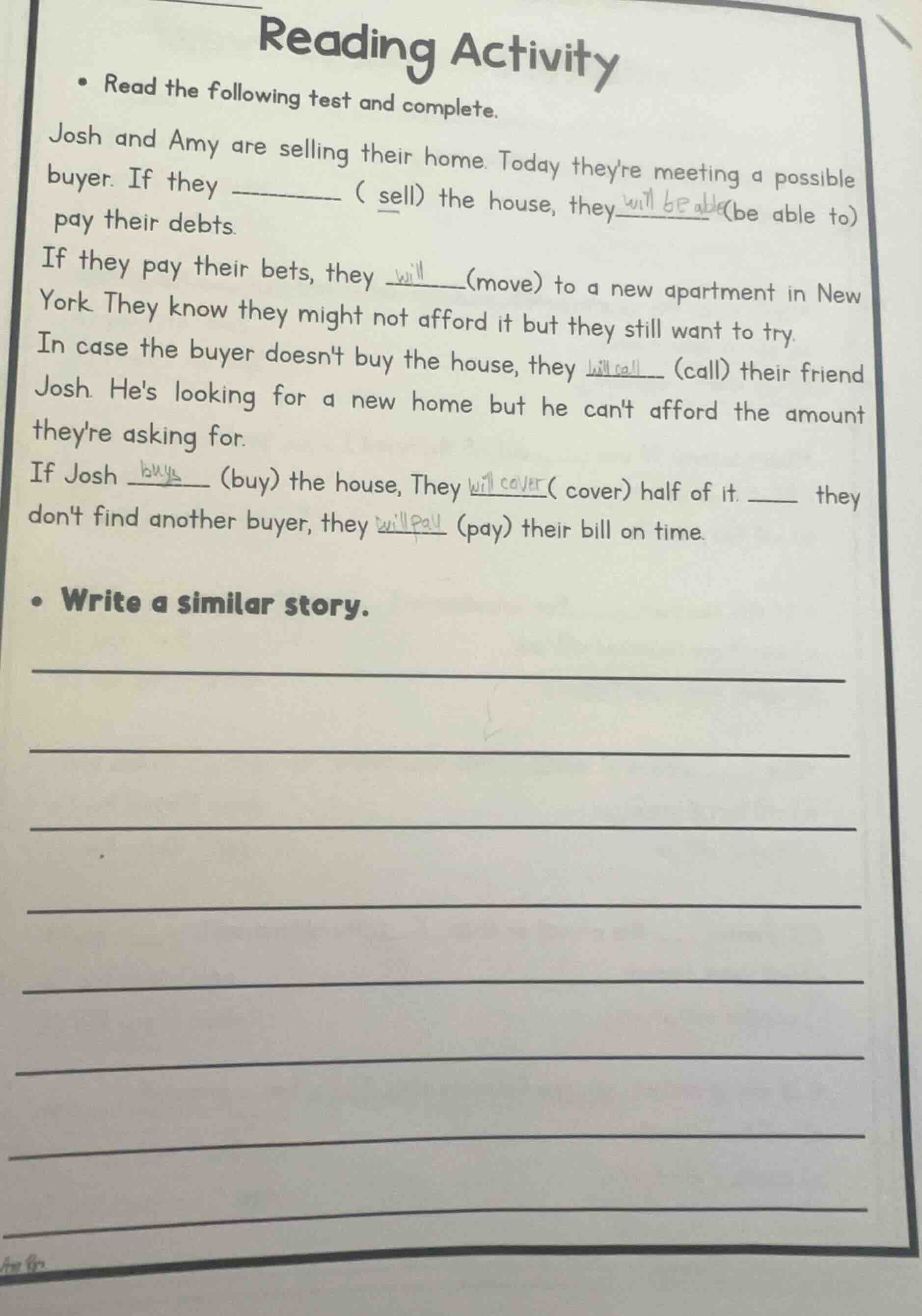
josh and amy are selling their home. today theyre meeting a possible buyer. if they ____ ( sell) the house, they ____ (be able to) pay their debts.
if they pay their bets, they ______ (move) to a new apartment in new york. they know they might not afford it but they still want to try.
in case the buyer doesnt buy the house, they ______ (call) their friend josh. hes looking for a new home but he cant afford the amount theyre asking for.
if josh ____ (buy) the house, they __ ( cover) half of it. __ they dont find another buyer, they ____ (pay) their bill on time.
- write a similar story.
_____________________________________________________________________
_____________________________________________________________________
_____________________________________________________________________
_____________________________________________________________________
_____________________________________________________________________
_____________________________________________________________________
Writing a Similar Story:
First, we'll follow the structure of the original story, which uses conditional sentences (if - then) to describe a situation involving selling an item, paying debts, and alternative plans. We'll choose a different scenario, like selling a car, to create a parallel story.
- Set the main action and characters: Let's use two characters, say, Tom and Lisa, who are selling their car.
- First conditional: Describe what happens if they sell the car.
- Subsequent conditionals: Add more consequences (paying debts, moving, alternative buyer) using the same conditional structure.
Here's the similar story:
Tom and Lisa are selling their car. Today they're meeting a possible buyer. If they \underline{sell} (sell) the car, they \underline{will be able to} (be able to) pay their loans.
If they pay their loans, they \underline{will move} (move) to a new city in California. They know they might not afford the new rent but they still want to try.
In case the buyer doesn't buy the car, they \underline{will call} (call) their friend Mike. He's looking for a new car but he can't afford the price they're asking for.
If Mike \underline{buys} (buy) the car, they \underline{will cover} (cover) half of his insurance. If they don't find another buyer, they \underline{will pay} (pay) their loan installment on time.
This story mirrors the original structure: selling an asset → paying debts/loans → moving → alternative buyer (friend) → backup plan if no buyer is found. The conditional verb tenses (present simple in “if” clauses, future simple in main clauses) are also consistent with the original.

Snap & solve any problem in the app
Get step-by-step solutions on Sovi AI
Photo-based solutions with guided steps
Explore more problems and detailed explanations
Writing a Similar Story:
First, we'll follow the structure of the original story, which uses conditional sentences (if - then) to describe a situation involving selling an item, paying debts, and alternative plans. We'll choose a different scenario, like selling a car, to create a parallel story.
- Set the main action and characters: Let's use two characters, say, Tom and Lisa, who are selling their car.
- First conditional: Describe what happens if they sell the car.
- Subsequent conditionals: Add more consequences (paying debts, moving, alternative buyer) using the same conditional structure.
Here's the similar story:
Tom and Lisa are selling their car. Today they're meeting a possible buyer. If they \underline{sell} (sell) the car, they \underline{will be able to} (be able to) pay their loans.
If they pay their loans, they \underline{will move} (move) to a new city in California. They know they might not afford the new rent but they still want to try.
In case the buyer doesn't buy the car, they \underline{will call} (call) their friend Mike. He's looking for a new car but he can't afford the price they're asking for.
If Mike \underline{buys} (buy) the car, they \underline{will cover} (cover) half of his insurance. If they don't find another buyer, they \underline{will pay} (pay) their loan installment on time.
This story mirrors the original structure: selling an asset → paying debts/loans → moving → alternative buyer (friend) → backup plan if no buyer is found. The conditional verb tenses (present simple in “if” clauses, future simple in main clauses) are also consistent with the original.