QUESTION IMAGE
Question
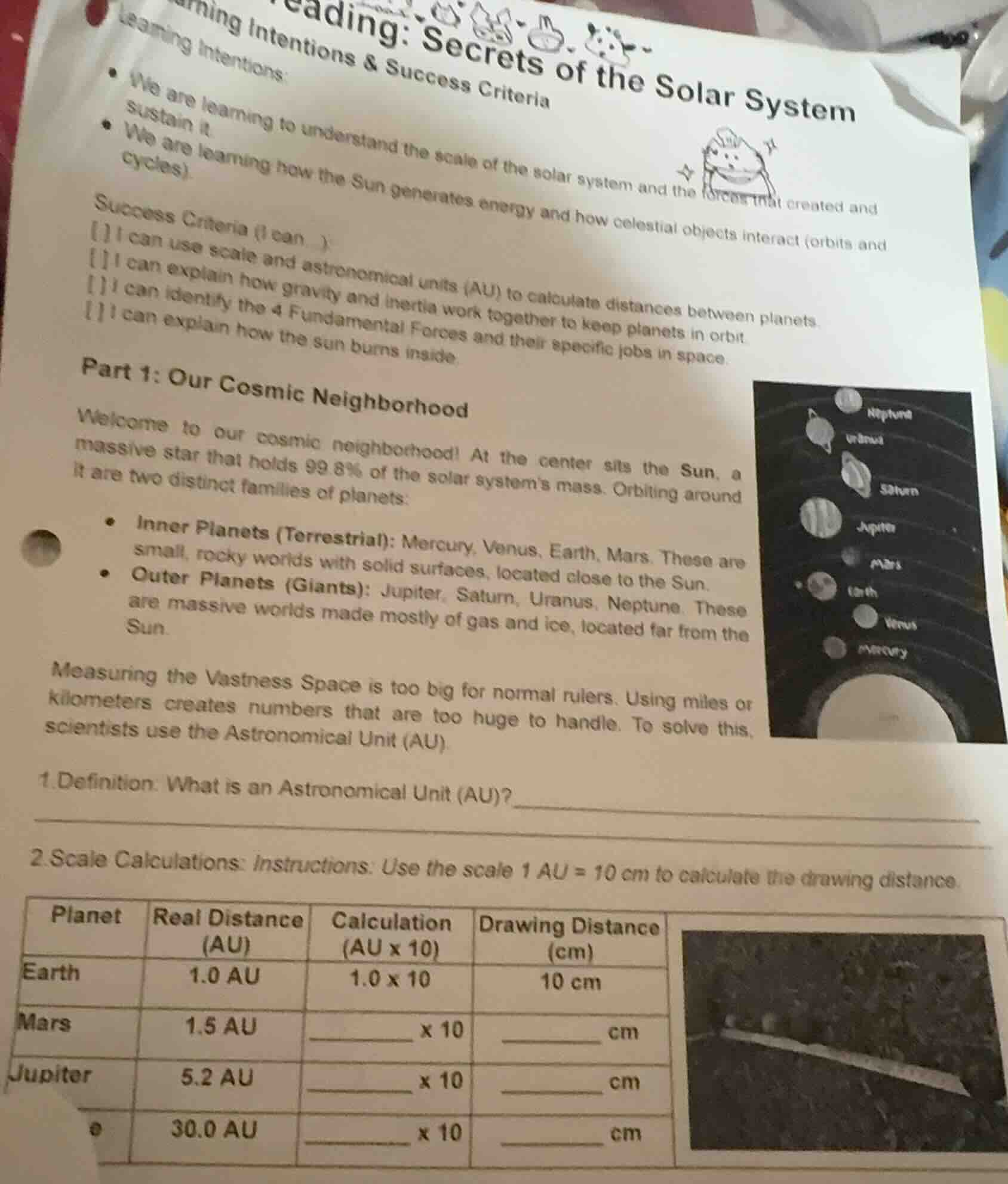
reading: secrets of the solar system
learning intentions & success criteria
learning intentions:
- we are learning to understand the scale of the solar system and the forces that created and sustain it.
- we are learning how the sun generates energy and how celestial objects interact (orbits and cycles).
success criteria (i can...):
- i can use scale and astronomical units (au) to calculate distances between planets.
- i can explain how gravity and inertia work together to keep planets in orbit.
- i can identify the 4 fundamental forces and their specific jobs in space.
- i can explain how the sun burns inside.
part 1: our cosmic neighborhood
welcome to our cosmic neighborhood! at the center sits the sun, a massive star that holds 99.8% of the solar system’s mass. orbiting around it are two distinct families of planets:
- inner planets (terrestrial): mercury, venus, earth, mars. these are small, rocky worlds with solid surfaces, located close to the sun.
- outer planets (giants): jupiter, saturn, uranus, neptune. these are massive worlds made mostly of gas and ice, located far from the sun.
measuring the vastness space is too big for normal rulers. using miles or kilometers creates numbers that are too huge to handle. to solve this, scientists use the astronomical unit (au).
- definition: what is an astronomical unit (au)?
_____________________________________________________________________
_____________________________________________________________________
- scale calculations: instructions: use the scale 1 au = 10 cm to calculate the drawing distance.
| planet | real distance (au) | calculation (au × 10) | drawing distance (cm) |
|---|---|---|---|
| mars | 1.5 au | _______ × 10 | _______ cm |
| jupiter | 5.2 au | _______ × 10 | _______ cm |
| * | 30.0 au | _______ × 10 | _______ cm |
Step1: Define Astronomical Unit
An Astronomical Unit (AU) is a standard unit of measurement for solar system distances, defined as the average distance between the Earth and the Sun, approximately 149.6 million kilometers.
Step2: Calculate Mars' drawing distance
Substitute Mars' real distance into the scale formula.
$1.5 \times 10 = 15$
Step3: Calculate Jupiter's drawing distance
Substitute Jupiter's real distance into the scale formula.
$5.2 \times 10 = 52$
Step4: Calculate Neptune's drawing distance
Substitute Neptune's real distance into the scale formula.
$30.0 \times 10 = 300$

Snap & solve any problem in the app
Get step-by-step solutions on Sovi AI
Photo-based solutions with guided steps
Explore more problems and detailed explanations
- An Astronomical Unit (AU) is the average distance between Earth and the Sun, used to measure distances within our solar system (≈149.6 million km).
2.
| Planet | Calculation (AU x 10) | Drawing Distance (cm) |
|---|---|---|
| Jupiter | $5.2 \times 10$ | 52 |
| Neptune | $30.0 \times 10$ | 300 |