QUESTION IMAGE
Question
ready
topic: are you ready for a test on module 5?
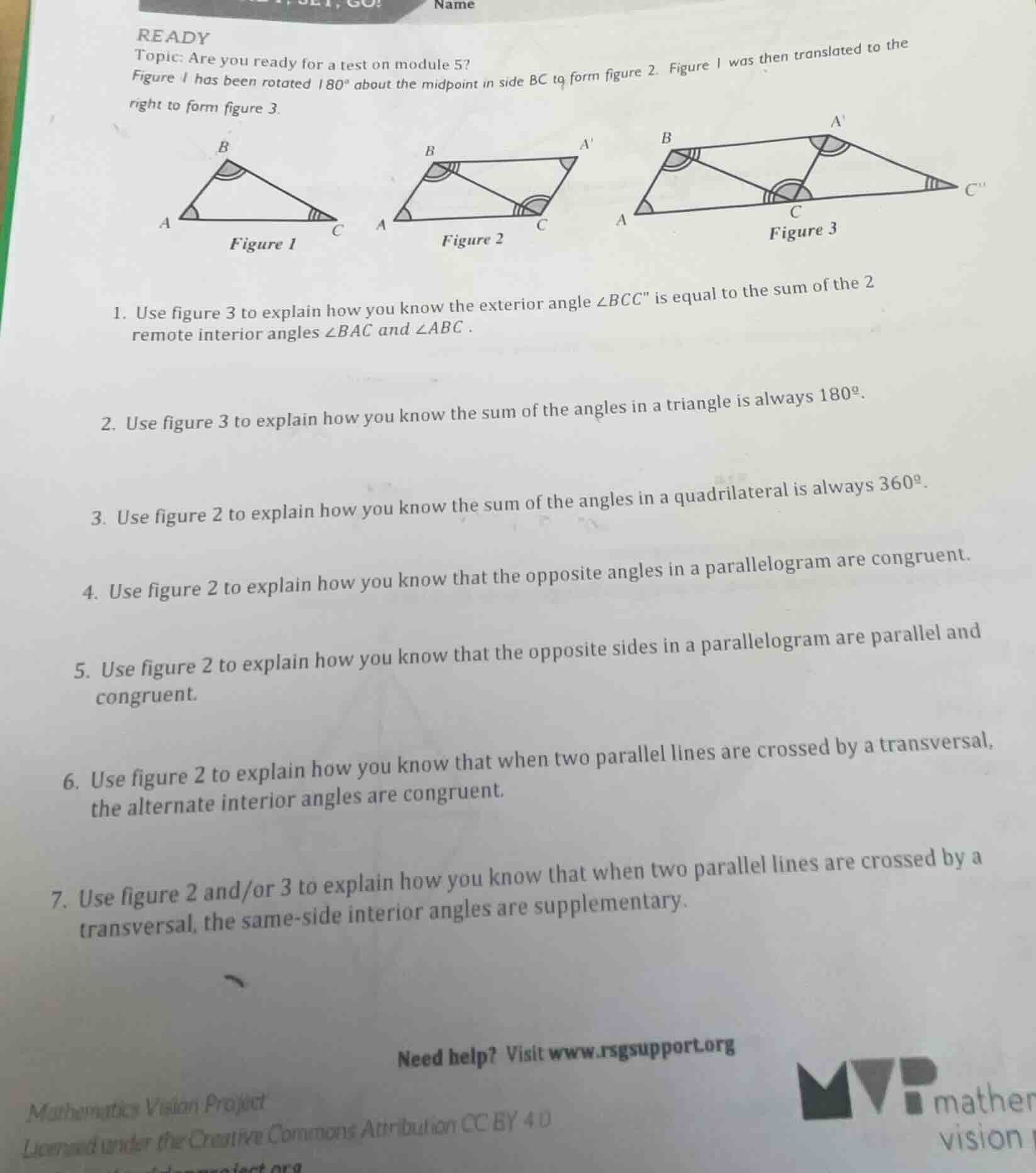
figure 1 has been rotated 180° about the midpoint in side bc to form figure 2. figure 1 was then translated to the right to form figure 3.
- use figure 3 to explain how you know the exterior angle ∠bcc\ is equal to the sum of the 2 remote interior angles ∠bac and ∠abc.
- use figure 3 to explain how you know the sum of the angles in a triangle is always 180°.
- use figure 2 to explain how you know the sum of the angles in a quadrilateral is always 360°.
- use figure 2 to explain how you know that the opposite angles in a parallelogram are congruent.
- use figure 2 to explain how you know that the opposite sides in a parallelogram are parallel and congruent.
- use figure 2 to explain how you know that when two parallel lines are crossed by a transversal, the alternate interior angles are congruent.
- use figure 2 and/or 3 to explain how you know that when two parallel lines are crossed by a transversal, the same - side interior angles are supplementary.
need help? visit www.rsgsupport.org
mathematics vision project
licensed under the creative commons attribution cc by 4.0
Question 2 Explanation:
To determine the sum of the angles in a triangle using Figure 3:
Step 1: Analyze Figure 3
Figure 3 is formed by translating Figure 1 to the right. This creates a straight line \( AC C' \), meaning \( \angle ACC' = 180^\circ \) (a straight angle).
Step 2: Identify Angles in Figure 3
In Figure 3, the angles at \( A \), \( B \), and \( C \) of the original triangle (Figure 1) are arranged along the straight line \( AC C' \). Specifically, \( \angle BAC \), \( \angle ABC \), and \( \angle ACB \) (the three angles of the triangle) combine to form the straight angle \( \angle ACC' \).
Step 3: Sum of Angles
Since \( \angle BAC + \angle ABC + \angle ACB = \angle ACC' \) and \( \angle ACC' = 180^\circ \) (straight line), we conclude that the sum of the interior angles of a triangle is \( 180^\circ \).

Snap & solve any problem in the app
Get step-by-step solutions on Sovi AI
Photo-based solutions with guided steps
Explore more problems and detailed explanations
The sum of the angles in a triangle is \( 180^\circ \) because the three interior angles of the triangle ( \( \angle BAC \), \( \angle ABC \), and \( \angle ACB \)) form a straight angle (\( 180^\circ \)) along the line \( ACC' \) in Figure 3.