QUESTION IMAGE
Question
real - world application: replication crisis part 3
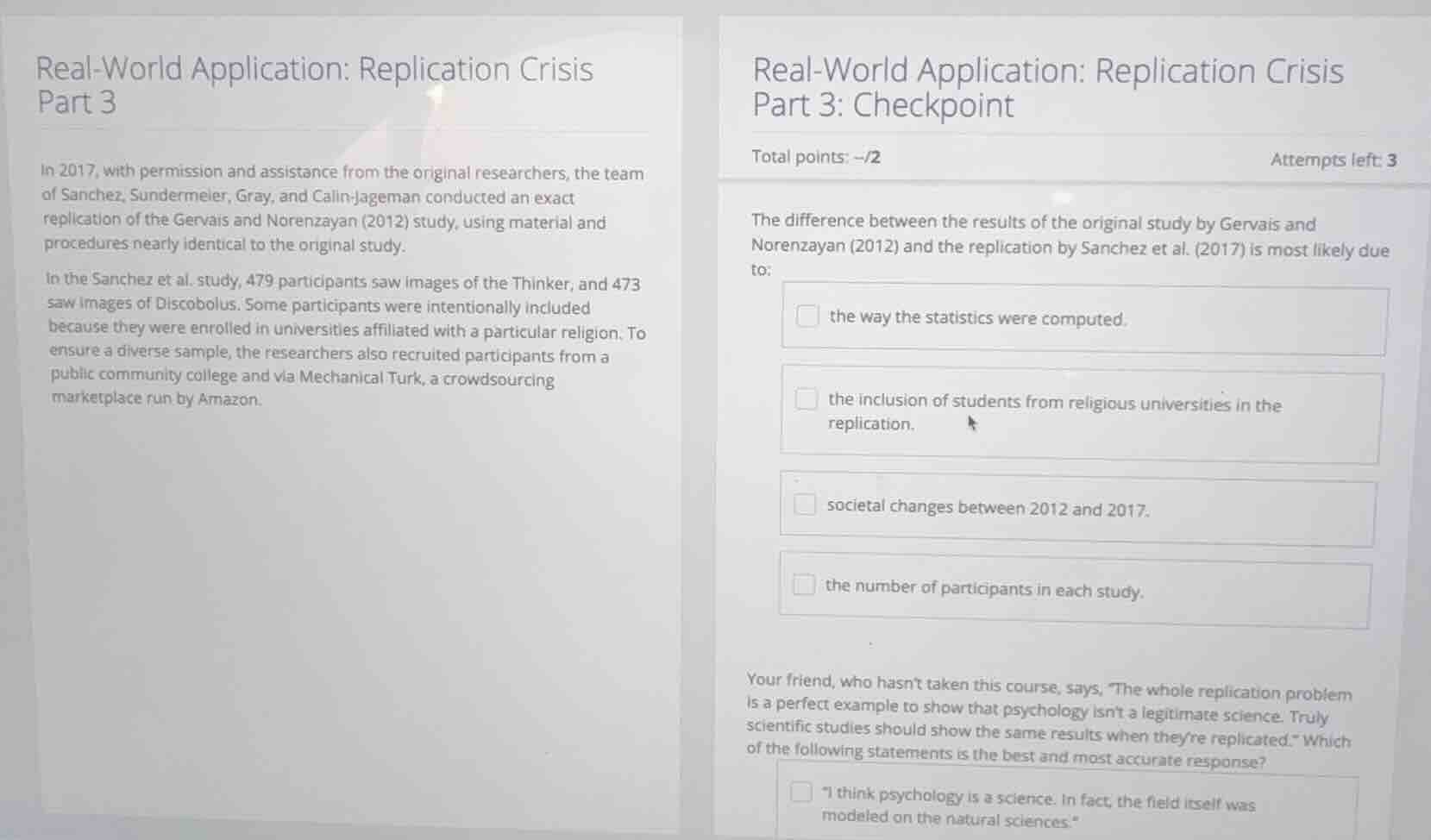
in 2017, with permission and assistance from the original researchers, the team of sanchez, sundermeier, gray, and calin - jageman conducted an exact replication of the gervais and norenzayan (2012) study, using material and procedures nearly identical to the original study.
in the sanchez et al. study, 479 participants saw images of the thinker, and 473 saw images of discobolus. some participants were intentionally included because they were enrolled in universities affiliated with a particular religion. to ensure a diverse sample, the researchers also recruited participants from a public community college and via mechanical turk, a crowdsourcing marketplace run by amazon.
real - world application: replication crisis part 3: checkpoint
total points: -/2
attempts left: 3
the difference between the results of the original study by gervais and norenzayan (2012) and the replication by sanchez et al. (2017) is most likely due to:
- the way the statistics were computed.
- the inclusion of students from religious universities in the replication.
- societal changes between 2012 and 2017.
- the number of participants in each study.
your friend, who hasnt taken this course, says, “the whole replication problem is a perfect example to show that psychology isnt a legitimate science. truly scientific studies should show the same results when theyre replicated.” which of the following statements is the best and most accurate response?
- “i think psychology is a science. in fact, the field itself was modeled on the natural sciences.”
For the first question: The replication used nearly identical materials/procedures to the original, so statistical computation methods were not the issue. The replication had a large, diverse sample including religious university students, while the original study's participant pool likely lacked this specific group, making this the key difference in samples that would drive result discrepancies. Societal changes over 5 years are unlikely to be the primary cause for such a replication difference, and both studies had large participant counts, so sample size is not the issue.
For the second question (partial): The core issue with the friend's claim is that replication challenges are common across all sciences, not just psychology, and psychology uses rigorous scientific methods. The provided option is insufficient, but the best response would address that replication issues are widespread in science, and psychology adheres to scientific principles. However, based on the visible option, it is a start, but a more complete correct response would note that replication failures occur in all sciences and do not negate psychology's scientific status.

Snap & solve any problem in the app
Get step-by-step solutions on Sovi AI
Photo-based solutions with guided steps
Explore more problems and detailed explanations
- the inclusion of students from religious universities in the replication.
- (Note: The full set of options for the second question is not visible. The visible option is a partial correct start, but a fully accurate response would be along the lines of: "Replication challenges exist across all scientific fields, not just psychology, and psychology uses systematic, empirical scientific methods to study phenomena, so it is a legitimate science.")