QUESTION IMAGE
Question
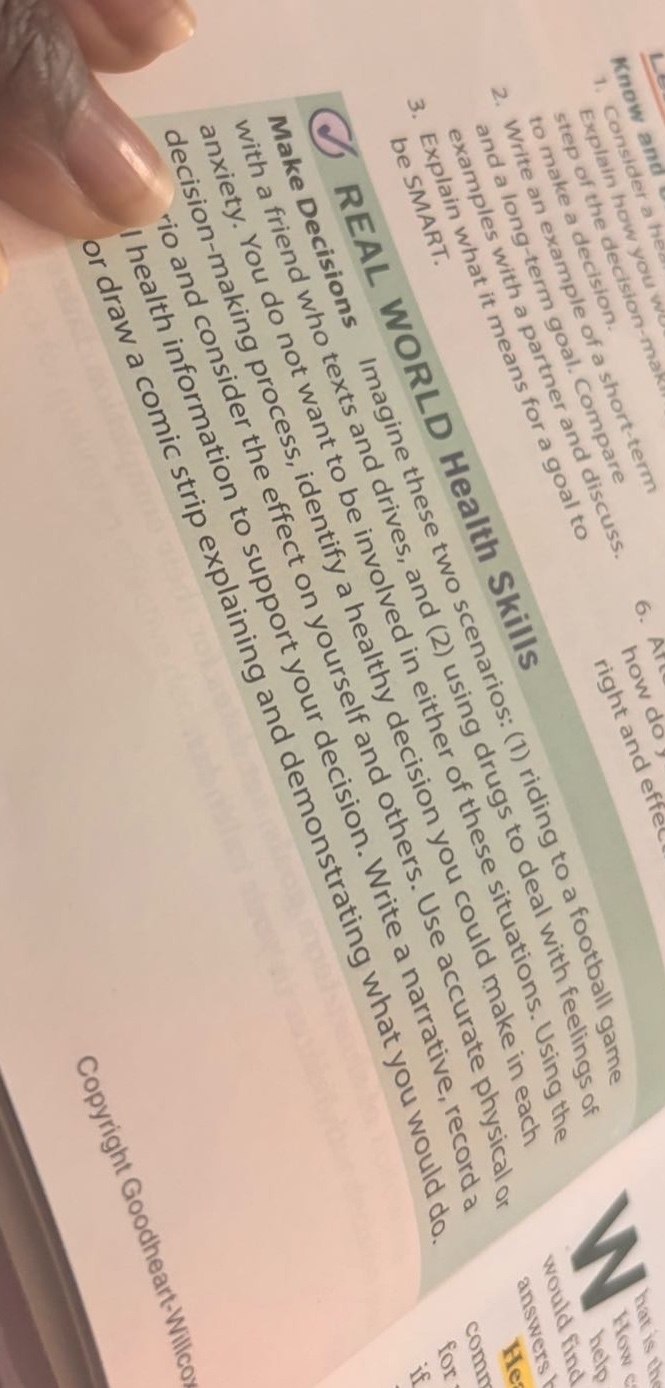
real world health skills
make decisions imagine these two scenarios: (1) riding to a football game with a friend who texts and drives, and (2) using drugs to deal with feelings of anxiety. you do not want to be involved in either of these situations. using the decision-making process, identify a healthy decision you could make in each scenario and consider the effect on yourself and others. use accurate physical or health information to support your decision. write a narrative, record a video, or draw a comic strip explaining and demonstrating what you would do.
- know and
consider a hea
explain how you wou
step of the decision-maki
to make a decision.
- write an example of a short-term
and a long-term goal. compare
examples with a partner and discuss.
- explain what it means for a goal to
be smart.
- aft
how do y
right and effect
Scenario 1: Riding to a football game with a friend who texts and drives
- Identify the problem: Distracted driving is unsafe and puts me, my friend, and other people on the road at risk of injury or death.
- Gather health information: Distracted driving is a leading cause of motor vehicle crashes; taking a phone away from a driver removes the distraction.
- Weigh options: I can either ask my friend to stop texting, offer to take their phone to hold for them, or ask to pull over and switch drivers if I am licensed.
- Make the decision: Politely but firmly ask my friend to hand over their phone, explaining that texting while driving is dangerous for everyone in the car and other drivers.
- Act on the decision: Say, "Hey, texting while driving is really unsafe—can I hold your phone for you until we get to the game? I don't want us to get hurt."
- Evaluate the outcome: My friend hands over the phone, we drive safely to the game, and no one is put in harm's way.
Scenario 2: Using drugs to deal with feelings of anxiety
- Identify the problem: Using drugs to cope with anxiety is harmful to my physical and mental health, and can lead to addiction and long-term health issues.
- Gather health information: Drugs can worsen anxiety over time, cause organ damage, and lead to legal consequences. Healthy coping strategies include talking to a trusted adult, mindfulness, or speaking to a school counselor.
- Weigh options: I can either use drugs (harmful), talk to a school counselor, or open up to my parent/guardian about my anxiety.
- Make the decision: Schedule a meeting with my school counselor to talk about my anxiety and learn healthy coping skills.
- Act on the decision: Visit the school counseling office and say, "I've been feeling really anxious lately, and I want to learn safe ways to handle it. Can we talk about this?"
- Evaluate the outcome: I learn healthy coping techniques like deep breathing and journaling, my anxiety starts to improve, and I avoid the negative effects of drug use.

Snap & solve any problem in the app
Get step-by-step solutions on Sovi AI
Photo-based solutions with guided steps
Explore more problems and detailed explanations
Narrative for Scenario 1 (Texting and Driving):
It was Friday afternoon, and my best friend Jake had picked me up to drive to the high school football game. We were 10 minutes from the stadium when I noticed Jake’s eyes darting between the road and his phone, typing out a text to his girlfriend. My stomach dropped—I’d seen a video in health class about how texting while driving makes you 23 times more likely to crash.
“Jake, put the phone down,” I said, my voice sharper than I meant it to be. He rolled his eyes. “Relax, it’s just one text.”
“One text is all it takes to swerve into someone,” I replied. “I don’t want to end up in the hospital because you wanted to send an emoji. Can I hold your phone for you? I’ll give it back as soon as we park.”
Jake hesitated, then sighed and handed over his phone. “Fine, you’re such a buzzkill.” But as we pulled into the stadium parking lot, he mumbled, “Thanks, though. I guess you’re right.” We walked into the game together, and I knew we’d made the safe choice—for us, and for everyone else on the road.
Narrative for Scenario 2 (Using Drugs for Anxiety):
I’d been feeling stuck for weeks. Every time I thought about upcoming exams, my chest tightened, my hands shook, and I could barely breathe. My cousin had mentioned that smoking marijuana “calmed him right down,” and when he offered me a hit after school one day, I almost said yes. But then I remembered what my health teacher had said: drugs don’t fix anxiety—they just cover it up, and make it worse in the long run.
Instead of taking the joint, I told my cousin, “I’m not feeling it today. Thanks, though.” I walked home, and after dinner, I sat down with my mom. “I’ve been really anxious lately,” I said, my voice cracking. “I don’t know how to make it stop.”
My mom pulled me into a hug. “We can talk to the school counselor tomorrow,” she said. “She helps kids with this all the time.” The next day, I met with Ms. Lopez, the school counselor. She taught me deep breathing exercises to use when I felt anxious, and we made a study schedule to help me feel more prepared for exams. After a few weeks, the tightness in my chest started to fade. I was so glad I’d chosen to ask for help instead of turning to drugs.