QUESTION IMAGE
Question
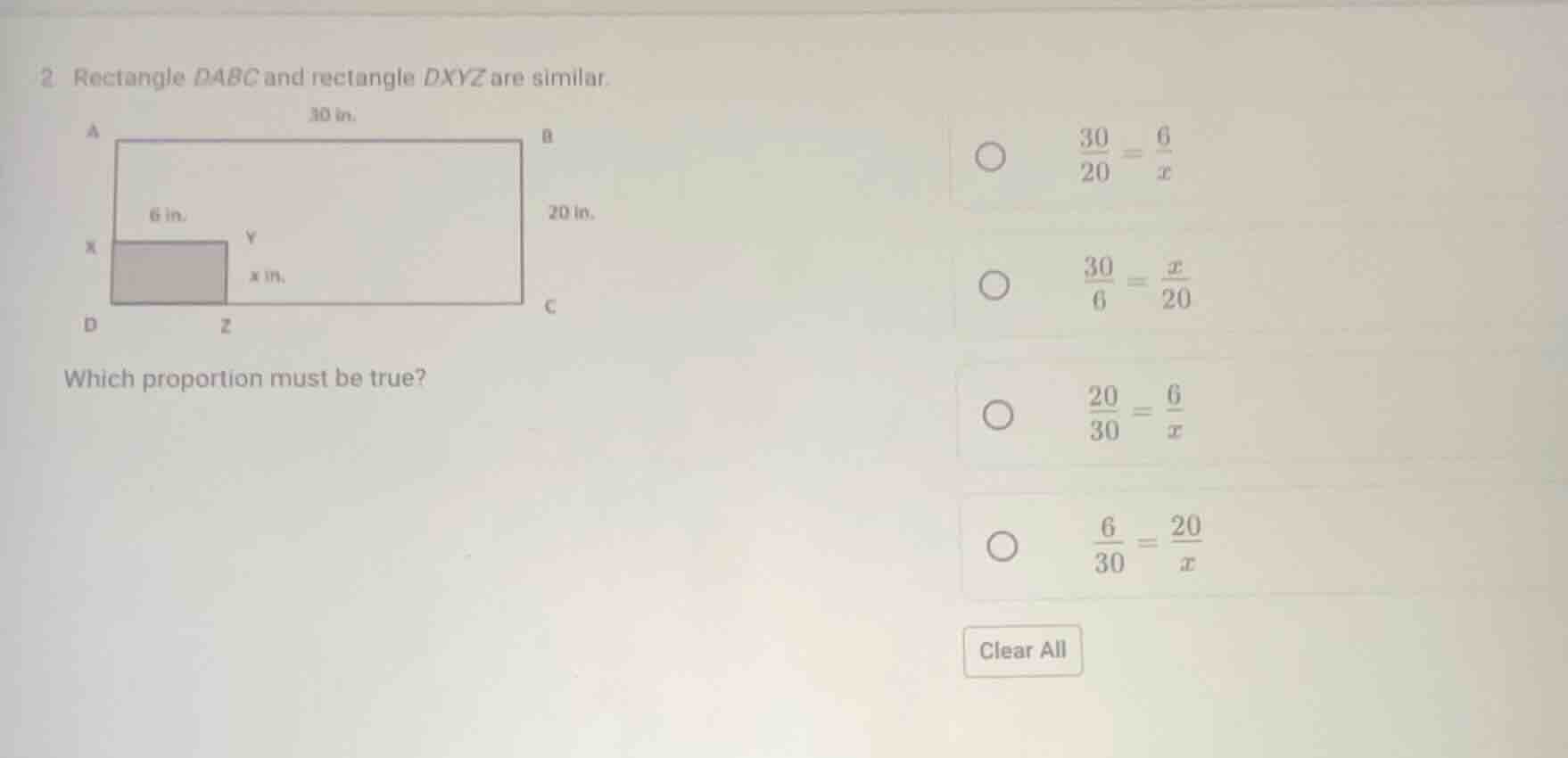
2 rectangle dabc and rectangle dxyz are similar.
which proportion must be true?
\\(\frac{30}{20} = \frac{6}{x}\\)
\\(\frac{30}{6} = \frac{x}{20}\\)
\\(\frac{20}{30} = \frac{6}{x}\\)
\\(\frac{6}{30} = \frac{20}{x}\\)
Step1: Recall similar figures property
For similar rectangles, corresponding sides are proportional. Rectangle \(DABC\) has length \(30\) in and height \(20\) in. Rectangle \(DXYZ\) has length \(6\) in and height \(x\) in. So, \(\frac{\text{length of } DABC}{\text{length of } DXYZ}=\frac{\text{height of } DABC}{\text{height of } DXYZ}\), which is \(\frac{30}{6}=\frac{20}{x}\) (or equivalent proportion). Let's check each option:
- Option 1: \(\frac{30}{20}=\frac{6}{x}\) → Cross - multiply: \(30x = 120\) → \(x = 4\). But let's see proportion logic. Length of big rectangle is \(30\), height \(20\); length of small is \(6\), height \(x\). So \(\frac{30}{6}=\frac{20}{x}\) (length ratio = height ratio). Option 1 has \(\frac{30}{20}=\frac{6}{x}\) (length/height of big = length/height of small), which is incorrect.
- Option 2: \(\frac{30}{6}=\frac{x}{20}\) → Cross - multiply: \(30\times20=6x\) → \(600 = 6x\) → \(x = 100\). Incorrect proportion.
- Option 3: \(\frac{20}{30}=\frac{6}{x}\) → Cross - multiply: \(20x=180\) → \(x = 9\). Wait, let's re - express the correct proportion. The ratio of height of big to length of big should equal ratio of height of small to length of small? No, for similar rectangles, \(\frac{\text{length}_1}{\text{length}_2}=\frac{\text{height}_1}{\text{height}_2}\). So \(\frac{30}{6}=\frac{20}{x}\) can be rewritten as \(\frac{20}{30}=\frac{6}{x}\) (by cross - multiplying and rearranging: \(30\times6 = 20x\) → \(180 = 20x\) → \(x = 9\)? Wait, no, let's do it properly. If rectangle \(DABC\) (length \(30\), height \(20\)) and \(DXYZ\) (length \(6\), height \(x\)) are similar, then \(\frac{\text{length of } DABC}{\text{height of } DABC}=\frac{\text{length of } DXYZ}{\text{height of } DXYZ}\) is wrong. Correct is \(\frac{\text{length of } DABC}{\text{length of } DXYZ}=\frac{\text{height of } DABC}{\text{height of } DXYZ}\), so \(\frac{30}{6}=\frac{20}{x}\), which is equivalent to \(\frac{20}{30}=\frac{6}{x}\) (by taking reciprocals of both sides: \(\frac{6}{30}=\frac{x}{20}\) no, wait \(\frac{30}{6}=\frac{20}{x}\) → cross - multiply \(30x = 120\) → \(x = 4\)? Wait, I think I messed up the sides. Wait, in rectangle \(DABC\), the horizontal side (length) is \(AB = 30\) in, vertical side (height) is \(BC = 20\) in. In rectangle \(DXYZ\), horizontal side (length) is \(DZ = 6\) in, vertical side (height) is \(YZ=x\) in. So for similar rectangles, \(\frac{\text{length of } DABC}{\text{length of } DXYZ}=\frac{\text{height of } DABC}{\text{height of } DXYZ}\), so \(\frac{30}{6}=\frac{20}{x}\). Now let's check option 3: \(\frac{20}{30}=\frac{6}{x}\) → cross - multiply \(20x = 180\) → \(x = 9\). No, that's not right. Wait, maybe I mixed length and height. Wait, maybe the height of \(DABC\) is \(20\) (vertical), length is \(30\) (horizontal). The small rectangle \(DXYZ\): horizontal length is \(6\), vertical height is \(x\). So the ratio of horizontal to vertical in \(DABC\) is \(\frac{30}{20}\), and in \(DXYZ\) is \(\frac{6}{x}\). Since they are similar, \(\frac{30}{20}=\frac{6}{x}\) (option 1). Wait, now I'm confused. Let's use cross - multiplication for each option:
- Option 1: \(\frac{30}{20}=\frac{6}{x}\) → \(30x=20\times6 = 120\) → \(x = 4\)
- Option 3: \(\frac{20}{30}=\frac{6}{x}\) → \(20x = 30\times6=180\) → \(x = 9\)
- Let's think about the rectangles. The big rectangle has length \(30\) and width \(20\). The small rectangle has length \(6\) and width \(x\). Since they are similar, the ratio of length to width should be the same. So \(\frac{30}{20}=\frac{6}{x}\) (length/width of big = length/width of small). So option 1 is…

Snap & solve any problem in the app
Get step-by-step solutions on Sovi AI
Photo-based solutions with guided steps
Explore more problems and detailed explanations
\(\boldsymbol{\frac{30}{20}=\frac{6}{x}}\) (the first option: \(\frac{30}{20}=\frac{6}{x}\))