QUESTION IMAGE
Question
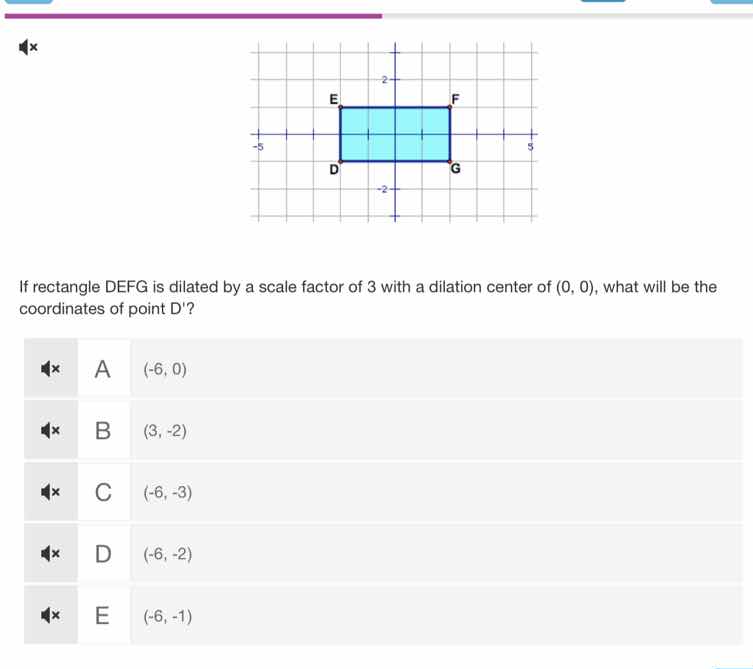
if rectangle defg is dilated by a scale factor of 3 with a dilation center of (0, 0), what will be the coordinates of point d?
a (-6, 0)
b (3, -2)
c (-6, -3)
d (-6, -2)
e (-6, -1)
Step1: Find original coordinates of D
From the grid, original coordinates of D are \((-2, -1)\).
Step2: Apply dilation formula
Dilation with center \((0,0)\) and scale factor \(k\) transforms \((x,y)\) to \((kx, ky)\). Here, \(k = 3\), \(x=-2\), \(y = -1\). So new coordinates: \(x'=3\times(-2)=-6\), \(y'=3\times(-1)=-3\)? Wait, no, wait. Wait, looking at the grid again. Wait, maybe I misread D's coordinates. Wait, let's check the grid. The rectangle DEFG: E is at (-2,1), F at (2,1), G at (2,-1), D at (-2,-1)? Wait no, maybe the grid lines. Wait, the x-axis: from -5 to 5, y-axis from -2 to 2? Wait, the original D: let's see, the rectangle is between x from -2 to 2 (since E is at (-2,1), F at (2,1), D at (-2,-1), G at (2,-1)? Wait, no, maybe the grid has each square as 1 unit. Wait, the problem: when dilated by scale factor 3 with center (0,0), the formula is \((x,y)\to(kx,ky)\). Let's find original D's coordinates. Looking at the graph, D is at (-2, -1)? Wait no, maybe the original D is (-2, -1)? Wait, no, let's check the options. Wait, option C is (-6, -3), but maybe I made a mistake. Wait, no, let's re-express. Wait, maybe the original D is (-2, -1)? Then scaling by 3: (-23, -13)=(-6, -3). But option C is (-6, -3). Wait, but let's check again. Wait, maybe the original D is (-2, -1). So dilation: multiply each coordinate by 3. So (-23, -13)=(-6, -3), which is option C? Wait, but let's confirm. Wait, the rectangle DEFG: E is at (-2,1), F at (2,1), D at (-2,-1), G at (2,-1). So original D: (-2, -1). Dilation center (0,0), scale factor 3: new coordinates (3(-2), 3(-1))=(-6, -3). So option C.
Wait, but let's check the options. Option C is (-6, -3). So that's the answer.

Snap & solve any problem in the app
Get step-by-step solutions on Sovi AI
Photo-based solutions with guided steps
Explore more problems and detailed explanations
C. (-6, -3)