QUESTION IMAGE
Question
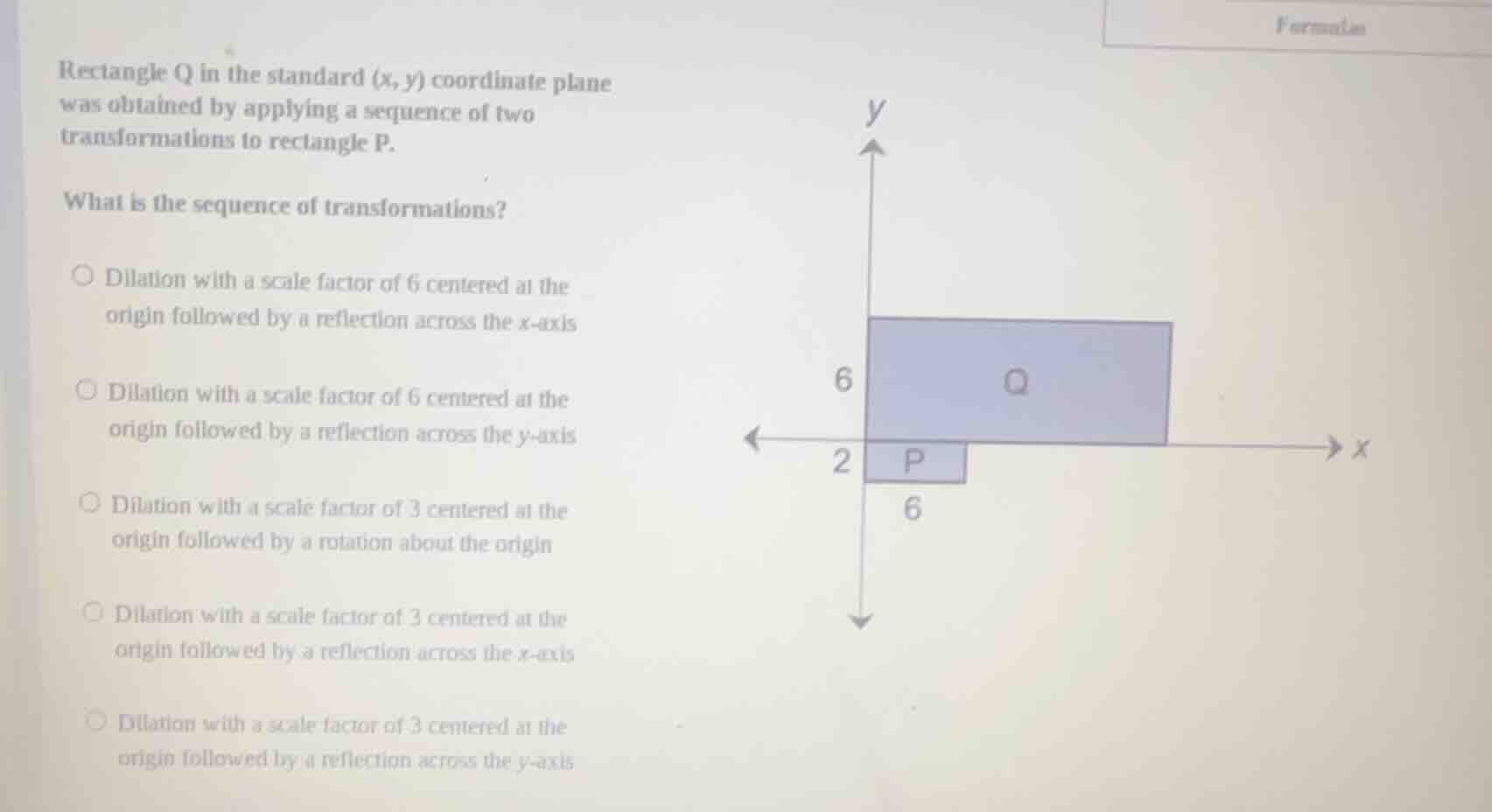
rectangle q in the standard (x, y) coordinate plane was obtained by applying a sequence of two transformations to rectangle p. what is the sequence of transformations? \bigcirc dilation with a scale factor of 6 centered at the origin followed by a reflection across the x - axis \bigcirc dilation with a scale factor of 6 centered at the origin followed by a reflection across the y - axis \bigcirc dilation with a scale factor of 3 centered at the origin followed by a rotation about the origin \bigcirc dilation with a scale factor of 3 centered at the origin followed by a reflection across the x - axis \bigcirc dilation with a scale factor of 3 centered at the origin followed by a reflection across the y - axis
Step1: Analyze the size change (dilation)
First, we look at the dimensions of rectangle P and Q. Let's assume the original rectangle P has some length and width. From the graph, we can see that the vertical side of P is 2 and of Q is 6, and the horizontal side of P is 6 (wait, no, let's check coordinates. Wait, the y - axis: P is from y = 2 to y = 0? No, the graph shows P is near the origin, and Q is larger. Let's check the scale factor. The height of P (vertical) is 2 units (from y = 0 to y = 2) and the height of Q is 6 units (from y = 0 to y = 6). So the scale factor for dilation is $\frac{6}{2}=3$. Similarly, the horizontal length: if P has a horizontal length, and Q is 3 times that. So dilation with scale factor 3 centered at the origin.
Step2: Analyze the reflection
Now, we look at the horizontal position. Rectangle P is on the right - hand side (or maybe left? Wait, the original P: looking at the x - axis, P is near the origin, and Q is to the left? Wait, no, wait the graph: P is at the bottom, and Q is above? Wait, no, the y - axis: P is from y = 0 to y = 2, and Q is from y = 0 to y = 6. The horizontal direction: P is from x = 0 to x = 6? No, wait the x - axis: P is at x from 0 to 6? No, the graph shows P is a small rectangle, and Q is a large rectangle. Wait, the key is the reflection. After dilation with scale factor 3, we need to see the reflection. If we reflect across the x - axis, the y - coordinates would change sign, but Q is above the x - axis, same as P (wait, no, P is from y = 0 to y = 2, Q is from y = 0 to y = 6). Wait, maybe the vertical and horizontal. Wait, the correct reflection: after dilation with scale factor 3, we reflect across the x - axis? No, wait the last option: dilation with scale factor 3, then reflection across the x - axis? Wait, no, let's check the options. Wait, the fifth option: dilation with scale factor 3 centered at the origin followed by a reflection across the y - axis? No, wait the fourth option: dilation with scale factor 3 centered at the origin followed by a reflection across the x - axis? Wait, no, let's think about the orientation. Wait, the y - coordinate: P is at lower y (y = 0 to y = 2) and Q is at y = 0 to y = 6. Wait, no, maybe the reflection is across the x - axis? Wait, no, when we reflect across the x - axis, the y - coordinates change sign. But Q is above the x - axis, same as P? Wait, maybe I made a mistake. Wait, the first, let's re - examine the options.
Wait, the height of P (vertical) is 2, Q is 6, so scale factor 3. Now, the horizontal direction: if we reflect across the x - axis, no. Wait, the correct option: dilation with scale factor 3 centered at the origin followed by a reflection across the x - axis? No, wait the fourth option: "Dilation with a scale factor of 3 centered at the origin followed by a reflection across the x - axis" – no, wait, wait the y - axis: P is below Q? No, wait the graph: P is at the bottom (y from 0 to 2) and Q is at the top (y from 0 to 6). Wait, no, the reflection: if we reflect across the x - axis, the y - coordinates would be negated, but Q is above the x - axis, same as P? Wait, maybe the vertical direction. Wait, no, let's check the options again.
Wait, the correct steps:
- Dilation: The ratio of the corresponding sides. The vertical side of P is 2, vertical side of Q is 6. So scale factor $k=\frac{6}{2} = 3$. So dilation with scale factor 3 centered at the origin.
- Reflection: Now, looking at the horizontal position. Rectangle P is on the right - hand side (assuming P is at x>0) and Q is on the left - hand side? No, wai…

Snap & solve any problem in the app
Get step-by-step solutions on Sovi AI
Photo-based solutions with guided steps
Explore more problems and detailed explanations
Dilation with a scale factor of 3 centered at the origin followed by a reflection across the x - axis (the fourth option: Dilation with a scale factor of 3 centered at the origin followed by a reflection across the x - axis)