QUESTION IMAGE
Question
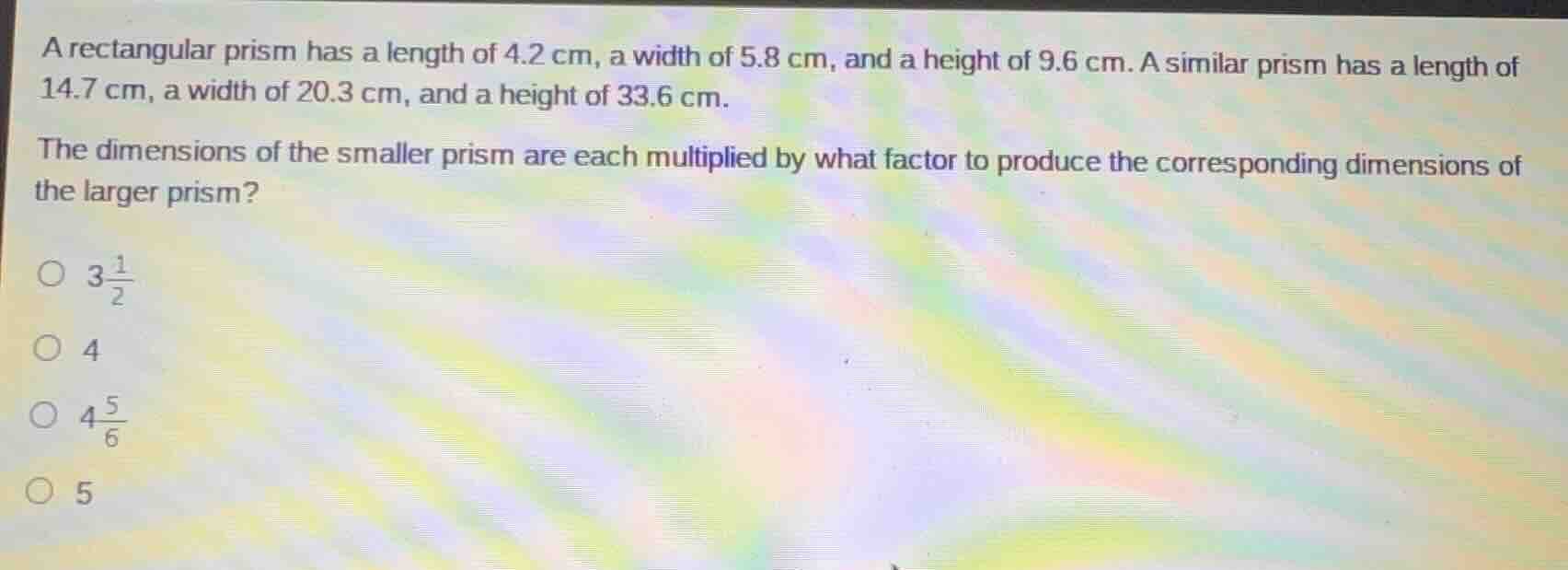
a rectangular prism has a length of 4.2 cm, a width of 5.8 cm, and a height of 9.6 cm. a similar prism has a length of 14.7 cm, a width of 20.3 cm, and a height of 33.6 cm. the dimensions of the smaller prism are each multiplied by what factor to produce the corresponding dimensions of the larger prism? \\( 3\frac{1}{2} \\) \\( 4 \\) \\( 4\frac{5}{6} \\) \\( 5 \\)
Step1: Divide larger length by smaller length
To find the scale factor, we divide the length of the larger prism by the length of the smaller prism. The length of the larger prism is \(14.7\) cm and the length of the smaller prism is \(4.2\) cm. So we calculate \(\frac{14.7}{4.2}\).
\[
\frac{14.7}{4.2}=3.5
\]
Step2: Convert 3.5 to a mixed number
We know that \(3.5 = 3+\frac{1}{2}=3\frac{1}{2}\). We can also check with the other dimensions (width and height) to confirm. For width: \(\frac{20.3}{5.8} = 3.5=3\frac{1}{2}\), and for height: \(\frac{33.6}{9.6}=3.5 = 3\frac{1}{2}\). So the scale factor is \(3\frac{1}{2}\).

Snap & solve any problem in the app
Get step-by-step solutions on Sovi AI
Photo-based solutions with guided steps
Explore more problems and detailed explanations
\(3\frac{1}{2}\) (corresponding to the option with \(3\frac{1}{2}\))