QUESTION IMAGE
Question
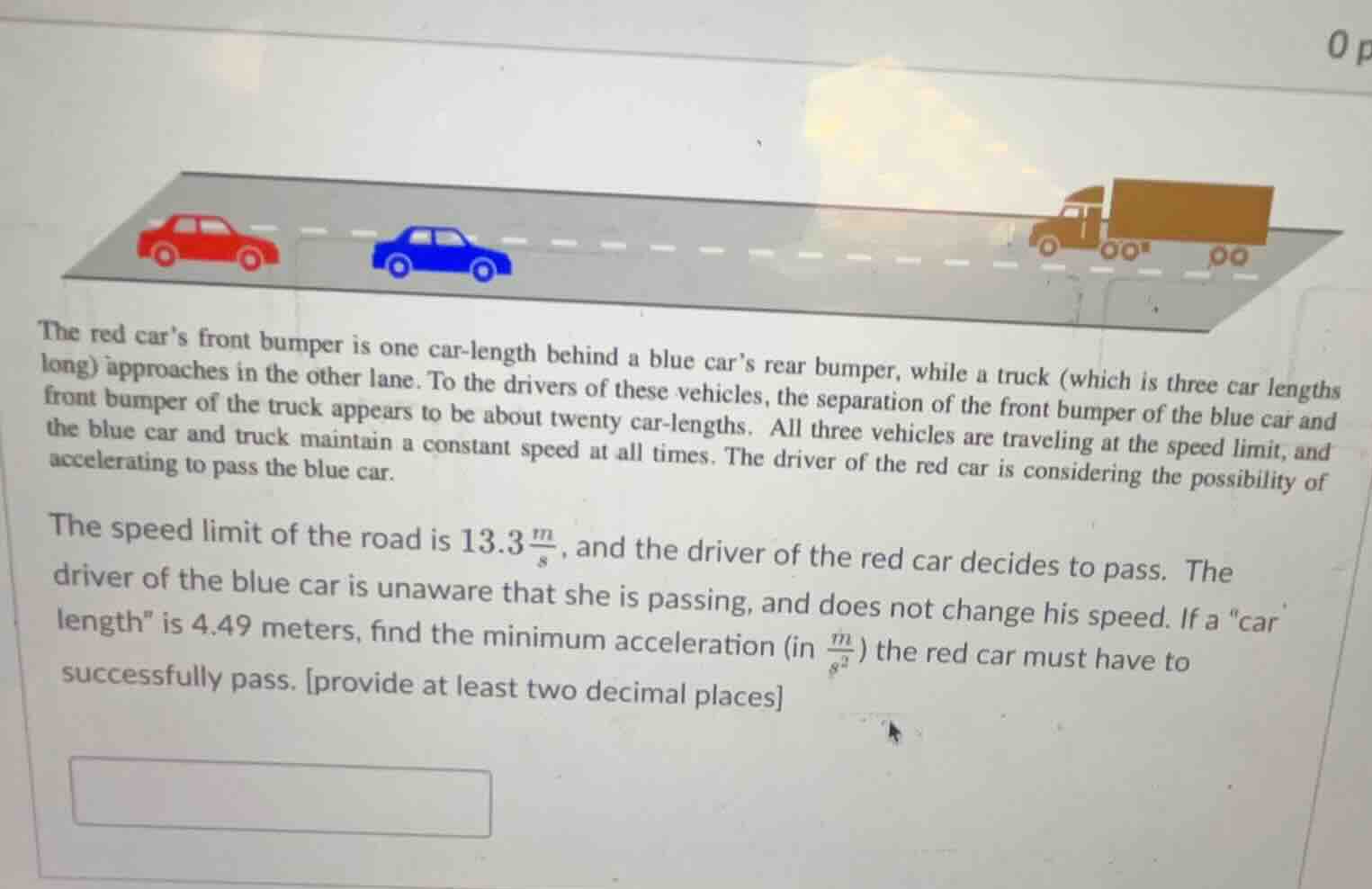
the red cars front bumper is one car - length behind a blue cars rear bumper, while a truck (which is three car lengths long) approaches in the other lane. to the drivers of these vehicles, the separation of the front bumper of the blue car and front bumper of the truck appears to be about twenty car - lengths. all three vehicles are traveling at the speed limit, and the blue car and truck maintain a constant speed at all times. the driver of the red car is considering the possibility of accelerating to pass the blue car.
the speed limit of the road is $13.3\frac{m}{s}$, and the driver of the red car decides to pass. the driver of the blue car is unaware that she is passing, and does not change his speed. if a \car length\ is 4.49 meters, find the minimum acceleration (in $\frac{m}{s^2}$) the red car must have to successfully pass. provide at least two decimal places
Step1: Define total distance needed
First, calculate the total distance the red car must cover relative to the blue car to pass safely.
- Initial gap: 1 car-length
- Length of blue car: 1 car-length
- Safe gap with truck: 20 car-lengths
- Length of truck: 3 car-lengths
Total relative distance $d = (1 + 1 + 20 + 3) \times 4.49$ m
$d = 25 \times 4.49 = 112.25$ m
Step2: Set up kinematic equations
Let $v_0 = 13.3 \frac{m}{s}$ (constant speed of blue car/truck), $a$ = acceleration of red car, $t$ = time to pass.
Distance of blue car: $x_b = v_0 t$
Distance of red car: $x_r = v_0 t + \frac{1}{2} a t^2$
Relative distance: $x_r - x_b = d = \frac{1}{2} a t^2$ --- (1)
Step3: Set time from truck's perspective
The truck travels the 20 car-length gap in time $t$, so:
$20 \times 4.49 = v_0 t$
$t = \frac{20 \times 4.49}{13.3} = \frac{89.8}{13.3} \approx 6.7519$ s
Step4: Solve for acceleration
Substitute $t$ into equation (1):
$a = \frac{2d}{t^2}$
$a = \frac{2 \times 112.25}{(6.7519)^2} = \frac{224.5}{45.588} \approx 4.92$

Snap & solve any problem in the app
Get step-by-step solutions on Sovi AI
Photo-based solutions with guided steps
Explore more problems and detailed explanations
$4.92 \frac{m}{s^2}$