QUESTION IMAGE
Question
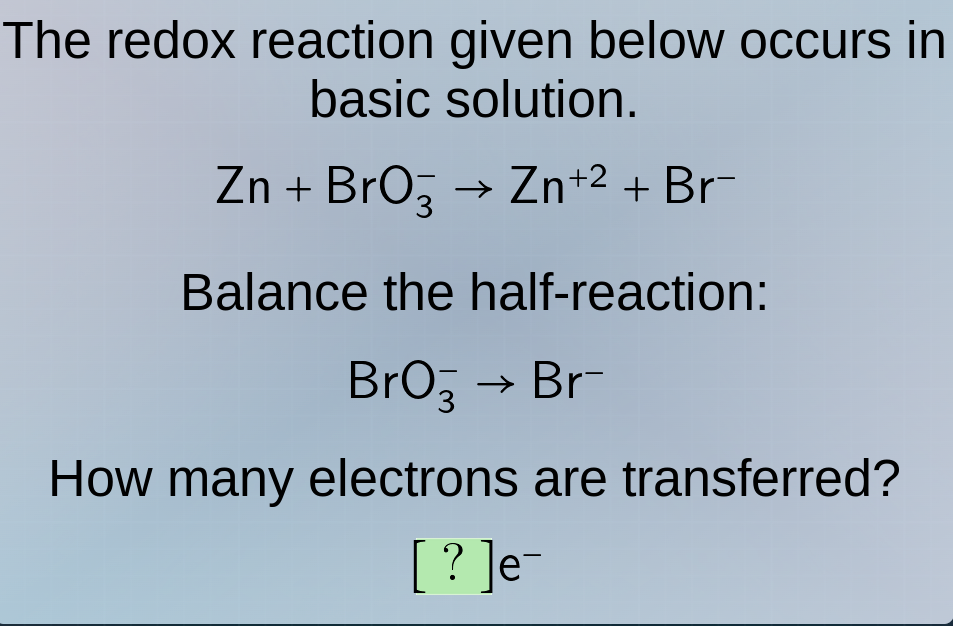
the redox reaction given below occurs in basic solution.
zn + bro₃⁻ → zn⁺² + br⁻
balance the half - reaction:
bro₃⁻ → br⁻
how many electrons are transferred?
?e⁻
Step1: Balance atoms other than O and H
The bromine atoms are already balanced: \( \text{BrO}_3^-
ightarrow \text{Br}^- \) has 1 Br on each side.
Step2: Balance O by adding \( \text{H}_2\text{O} \)
There are 3 O on the left, so add \( 3\text{H}_2\text{O} \) to the right:
\( \text{BrO}_3^-
ightarrow \text{Br}^- + 3\text{H}_2\text{O} \)
Step3: Balance H by adding \( \text{H}^+ \)
Now there are 6 H on the right (from \( 3\text{H}_2\text{O} \)), so add \( 6\text{H}^+ \) to the left:
\( \text{BrO}_3^- + 6\text{H}^+
ightarrow \text{Br}^- + 3\text{H}_2\text{O} \)
Step4: Since it's basic solution, add \( \text{OH}^- \) to neutralize \( \text{H}^+ \)
Add \( 6\text{OH}^- \) to both sides:
\( \text{BrO}_3^- + 6\text{H}^+ + 6\text{OH}^-
ightarrow \text{Br}^- + 3\text{H}_2\text{O} + 6\text{OH}^- \)
Simplify \( \text{H}^+ + \text{OH}^- = \text{H}_2\text{O} \):
\( \text{BrO}_3^- + 3\text{H}_2\text{O}
ightarrow \text{Br}^- + 3\text{H}_2\text{O} + 6\text{OH}^- \)
Cancel \( 3\text{H}_2\text{O} \) from both sides:
\( \text{BrO}_3^-
ightarrow \text{Br}^- + 6\text{OH}^- \) Wait, no, correction: Wait, after adding \( 6\text{OH}^- \) to both sides, the left side becomes \( \text{BrO}_3^- + 6\text{H}_2\text{O} \) (since \( 6\text{H}^+ + 6\text{OH}^- = 6\text{H}_2\text{O} \)), and the right side is \( \text{Br}^- + 3\text{H}_2\text{O} + 6\text{OH}^- \). Wait, I made a mistake earlier. Let's redo step 4 properly.
Correct step 4:
After step 3: \( \text{BrO}_3^- + 6\text{H}^+
ightarrow \text{Br}^- + 3\text{H}_2\text{O} \)
In basic solution, add \( 6\text{OH}^- \) to both sides:
Left: \( \text{BrO}_3^- + 6\text{H}^+ + 6\text{OH}^- = \text{BrO}_3^- + 6\text{H}_2\text{O} \)
Right: \( \text{Br}^- + 3\text{H}_2\text{O} + 6\text{OH}^- \)
So the equation becomes:
\( \text{BrO}_3^- + 6\text{H}_2\text{O}
ightarrow \text{Br}^- + 3\text{H}_2\text{O} + 6\text{OH}^- \)
Cancel \( 3\text{H}_2\text{O} \):
\( \text{BrO}_3^- + 3\text{H}_2\text{O}
ightarrow \text{Br}^- + 6\text{OH}^- \)
Now, balance charge by adding electrons. Let's find the charge on each side.
Left side: \( \text{BrO}_3^- \) has charge -1, \( 3\text{H}_2\text{O} \) is neutral, so total charge -1.
Right side: \( \text{Br}^- \) has charge -1, \( 6\text{OH}^- \) has total charge -6, so total charge -7.
Wait, no, wait: Wait, in the corrected step 4, after canceling \( 3\text{H}_2\text{O} \), the equation is \( \text{BrO}_3^- + 3\text{H}_2\text{O}
ightarrow \text{Br}^- + 6\text{OH}^- \)? No, that can't be. Wait, I messed up the balancing. Let's start over for charge balance.
Alternative approach: After step 3 (acidic), the equation is \( \text{BrO}_3^- + 6\text{H}^+
ightarrow \text{Br}^- + 3\text{H}_2\text{O} \)
Charge on left: \( -1 + 6(+1) = +5 \)
Charge on right: \( -1 + 0 = -1 \)
To balance charge, we need to add electrons to the left (since it's more positive) to make charges equal.
Let \( x \) be the number of electrons. So:
\( +5 - x = -1 \)
Solving for \( x \): \( x = 6 \)
So add 6 electrons to the left:
\( \text{BrO}_3^- + 6\text{H}^+ + 6e^-
ightarrow \text{Br}^- + 3\text{H}_2\text{O} \)
Now, for basic solution, we convert \( \text{H}^+ \) to \( \text{H}_2\text{O} \) by adding \( \text{OH}^- \), but the electron transfer is determined from the charge balance in the acidic step (or we can check the oxidation state).
Oxidation state of Br in \( \text{BrO}_3^- \): Let Br be \( x \), so \( x + 3(-2) = -1 \) → \( x -6 = -1 \) → \( x = +5 \)
Oxidation state of Br in \( \text{Br}^- \) is -1.
So the change in oxidation state is \( +5 \) to \( -1 \), which is a gain of 6 electrons (s…

Snap & solve any problem in the app
Get step-by-step solutions on Sovi AI
Photo-based solutions with guided steps
Explore more problems and detailed explanations
6