QUESTION IMAGE
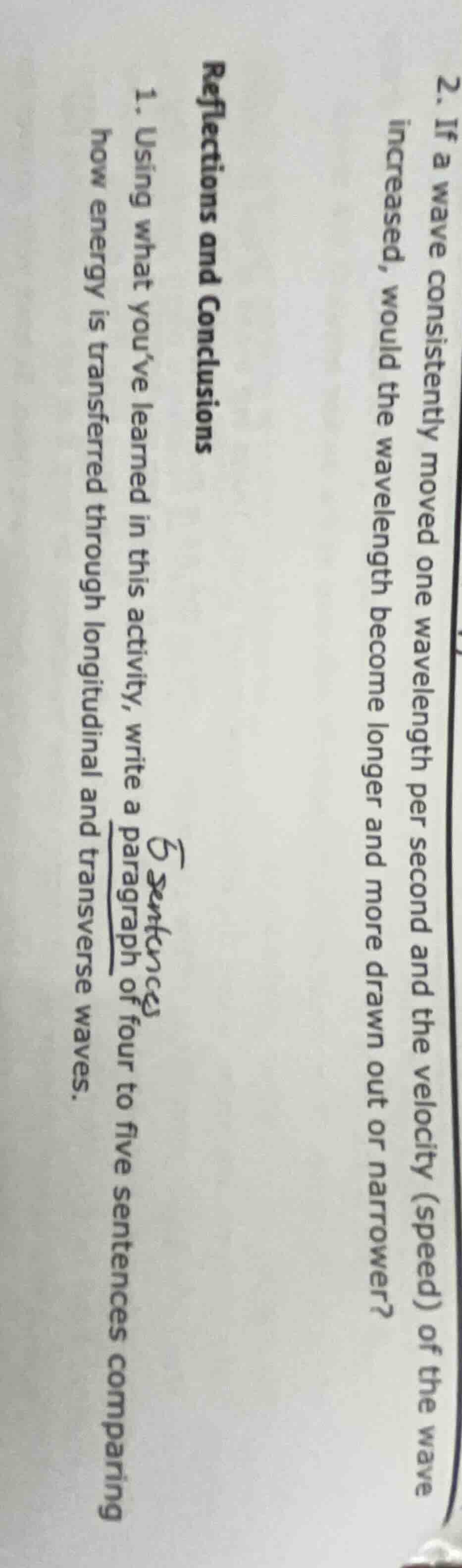
Question
reflections and conclusions
- using what you’ve learned in this activity, write a paragraph of four to five sentences comparing how energy is transferred through longitudinal and transverse waves.
- if a wave consistently moved one wavelength per second and the velocity (speed) of the wave increased, would the wavelength become longer and more drawn out or narrower?
Brief Explanations
- For the wavelength question: Use the wave speed formula $v = f\lambda$, rearranged to $\lambda = \frac{v}{f}$. Here, frequency $f=1$ wavelength per second (constant), so if wave speed $v$ increases, wavelength $\lambda$ must increase directly, making it longer.
- For the energy transfer paragraph: Contrasts particle motion direction relative to energy flow for each wave type, uses common examples, notes medium requirements, and ties both to core energy transfer function without matter transport, meeting the 4-5 sentence requirement.

Snap & solve any problem in the app
Get step-by-step solutions on Sovi AI
Photo-based solutions with guided steps
Explore more problems and detailed explanations
- The wavelength would become longer and more drawn out.
- (Paragraph) Both longitudinal and transverse waves transfer energy without transporting matter, but their particle motion differs: transverse waves have particles oscillating perpendicular to the direction of energy transfer, like the up-and-down motion of a shaken rope, while longitudinal waves have particles moving parallel to the energy flow, such as the back-and-forth compression of sound waves in air. In transverse waves, energy moves through crests and troughs that propagate outward, while longitudinal waves transfer energy via alternating regions of compression (high particle density) and rarefaction (low particle density). For transverse waves, examples like electromagnetic radiation can transfer energy through a vacuum, but longitudinal mechanical waves like sound require a medium (solid, liquid, or gas) to transmit energy, as they rely on particle interactions to carry the wave's energy forward. Ultimately, both wave types efficiently transfer energy over distance, but their distinct particle motion patterns dictate how they interact with different materials and environments.