QUESTION IMAGE
Question
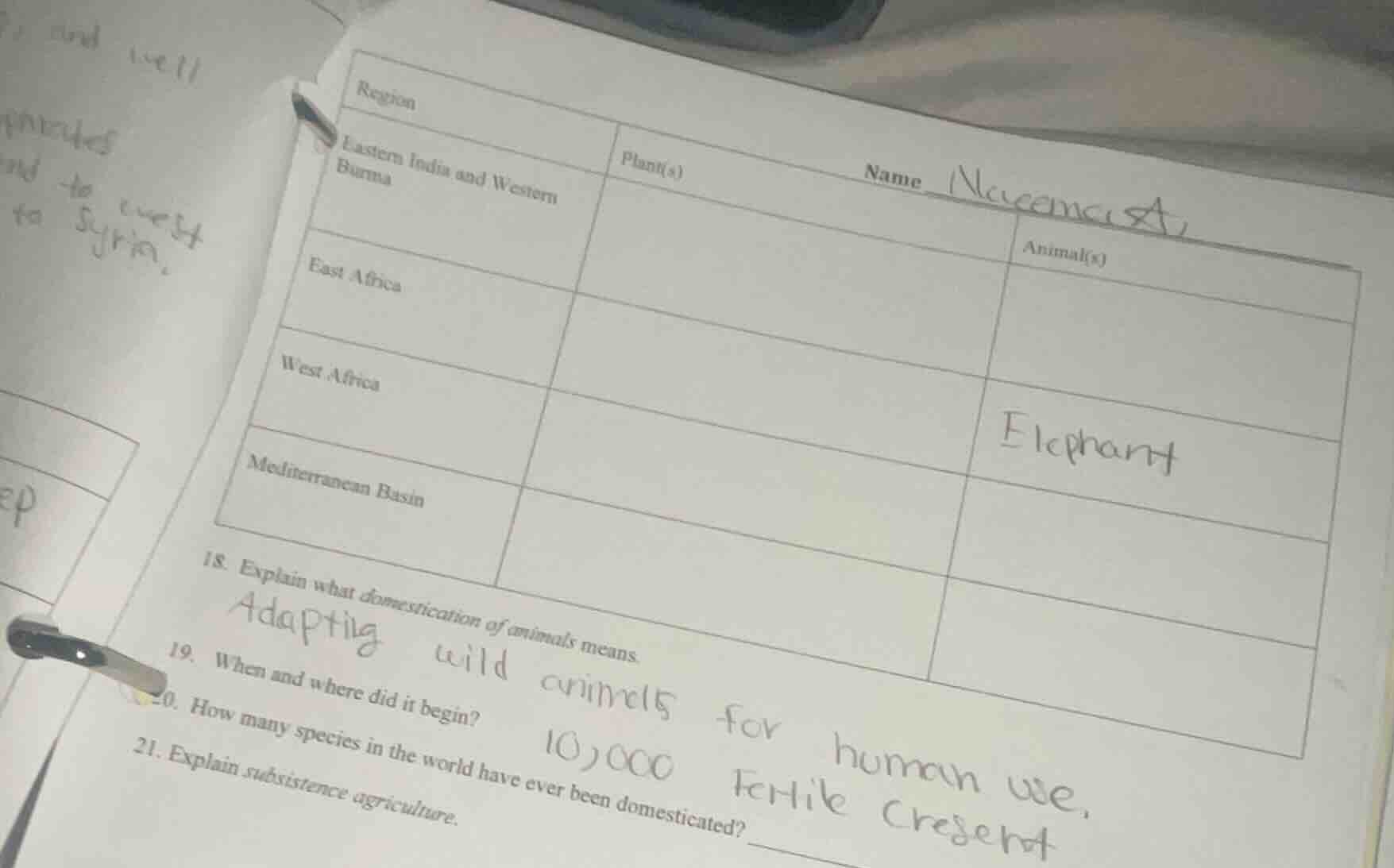
region | plant(s) | animal(s)
eastern india and western burma | |
east africa | |
west africa | | elephant
mediterranean basin | |
- explain what domestication of animals means.
- when and where did it begin?
- how many species in the world have ever been domesticated?
- explain subsistence agriculture.
Brief Explanations
- For the table: Matched each region with its historically prominent domesticated plants and animals.
- Q18: Defined animal domestication as the human-driven process of adapting wild animals.
- Q19: Cited the earliest confirmed origin of animal domestication.
- Q20: Stated the widely accepted number of fully domesticated animal species.
- Q21: Explained subsistence agriculture as a self-sufficient farming system.

Snap & solve any problem in the app
Get step-by-step solutions on Sovi AI
Photo-based solutions with guided steps
Explore more problems and detailed explanations
Region, Plant(s), Animal(s) Table:
| Region | Plant(s) | Animal(s) |
|---|---|---|
| East Africa | Teff, Sorghum | Cattle, Donkey |
| West Africa | Yams, Oil Palm | Guinea Fowl, Goat |
| Mediterranean Basin | Wheat, Olive | Sheep, Goat, Horse |
- Domestication of animals means selectively breeding and adapting wild animals over generations to live alongside humans, modifying their behavior and traits to serve human needs like food, labor, or companionship.
- Animal domestication began around 10,000 years ago in the Fertile Crescent (a region spanning parts of modern-day Iraq, Syria, Turkey, Israel, Jordan, and Lebanon).
- Approximately 40 species of animals in the world have ever been fully domesticated.
- Subsistence agriculture is a farming system where farmers grow crops and raise livestock primarily to meet the food and basic needs of their own household, with little to no surplus produced for trade or sale. It is typically small-scale and relies on traditional farming methods.