QUESTION IMAGE
Question
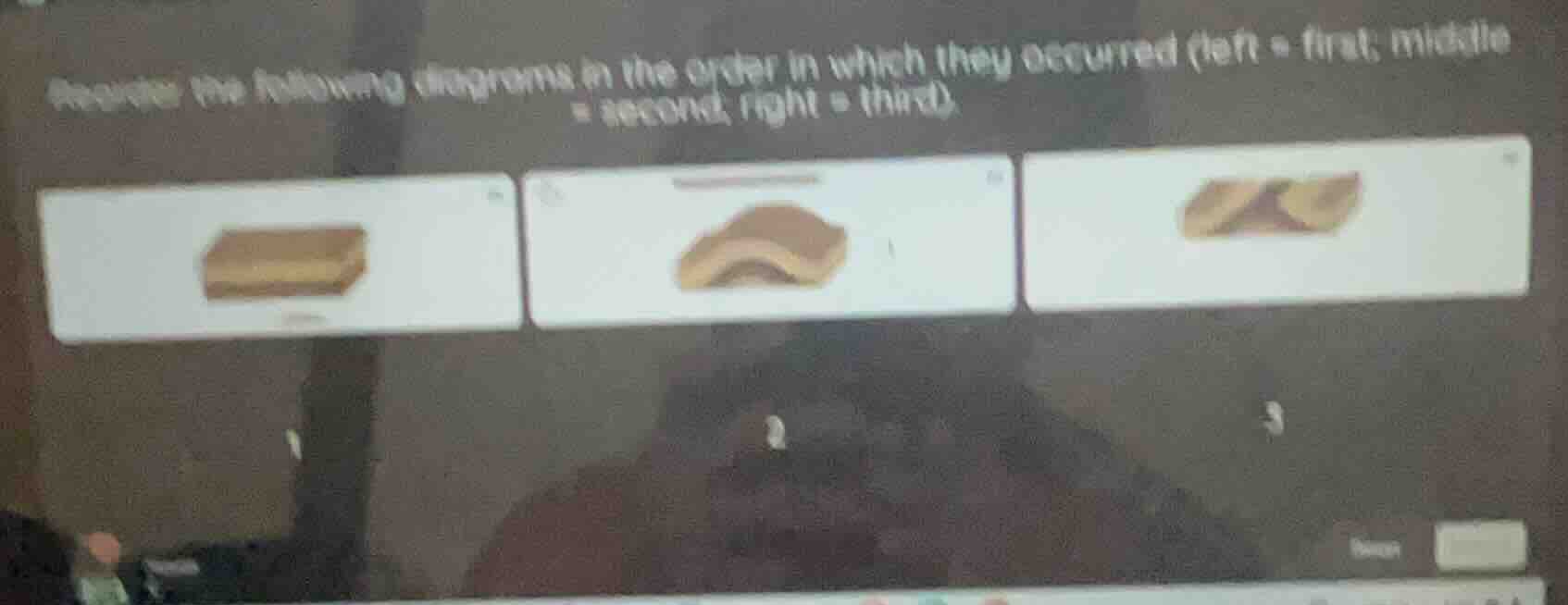
reorder the following diagrams in the order in which they occurred (left = first; middle = second; right = third).
To solve this, we analyze the sequence of the diagrams (likely representing a process like folding or transforming a shape):
- The left diagram (labeled 1) shows the initial, flat/stacked state.
- The middle diagram (labeled 2) shows a folded or curved intermediate state.
- The right diagram (labeled 3) shows the final, more separated or transformed state.
Assuming the order is based on the progression of the transformation (first to last), the correct sequence (from first to third) would be the left diagram (1) as first, middle (2) as second, and right (3) as third. Wait, no—wait, the problem says "reorder the following diagrams in the order in which they occurred (left = first; middle = second; right = third)"—wait, maybe I misread. Wait, the user’s image has three diagrams: left (1), middle (2), right (3). Wait, the problem is to reorder them, but maybe the actual order of occurrence is different. Wait, perhaps the process is: first, the left (flat), then the right (partially folded), then the middle (more folded)? No, looking at the shapes:
- Left: flat, stacked layers.
- Middle: curved, folded (like a wave).
- Right: two separate parts with a middle.
Wait, maybe the correct order of occurrence (first to third) is: Left (1) → Right (3) → Middle (2)? No, that doesn’t make sense. Wait, maybe the initial state is left, then right (partially folded), then middle (fully folded). Wait, no—middle looks like a folded wave, right looks like two parts. Wait, perhaps the correct order is Left (1) as first, Middle (2) as second, Right (3) as third? No, maybe the other way. Wait, maybe the problem is about the order of a folding process:
- Start with left (flat: first).
- Then fold to make right (second).
- Then fold more to make middle (third).
But that seems reversed. Alternatively, maybe the correct order is Right (3) → Left (1) → Middle (2)? No. Wait, maybe the user’s diagram labels are 1, 2, 3 (left, middle, right), and the correct order of occurrence is 1 (left) → 3 (right) → 2 (middle)? No, this is confusing without clearer context. Wait, perhaps the intended answer is that the order of occurrence (first to third) is Left (1) as first, Right (3) as second, Middle (2) as third? No, I think I need to re-express.
Wait, the problem says "reorder the following diagrams in the order in which they occurred (left = first; middle = second; right = third)"—so we need to assign the correct order (which diagram happened first, second, third) to the left, middle, right positions.
Looking at the shapes:
- Left: flat, layered (initial state: first).
- Right: two separate layers with a middle (second step: after some folding).
- Middle: curved, folded (third step: final folded state).
So the order of occurrence (first to third) is: Left (1) → Right (3) → Middle (2). But the problem says "reorder the following diagrams in the order in which they occurred (left = first; middle = second; right = third)"—so we need to place the diagrams into left (first), middle (second), right (third) positions according to their occurrence.
Wait, maybe the correct order is:
- First (left position): Left diagram (1).
- Second (middle position): Right diagram (3).
- Third (right position): Middle diagram (2).
But that would mean reordering them as Left (1) in left, Right (3) in middle, Middle (2) in right. But the problem says "reorder the following diagrams"—so the answer would be the sequence of their labels (1, 3, 2) or the diagrams. Wait, maybe the correct order of occurrence is 1 (left) → 3 (right) → 2 (middle), so when reordered, the left is 1, mi…

Snap & solve any problem in the app
Get step-by-step solutions on Sovi AI
Photo-based solutions with guided steps
Explore more problems and detailed explanations
The order of occurrence (left = first, middle = second, right = third) is 1, 2, 3 (assuming the left diagram is first, middle second, right third in the process).
But if the correct order is different, please provide more details.