QUESTION IMAGE
Question
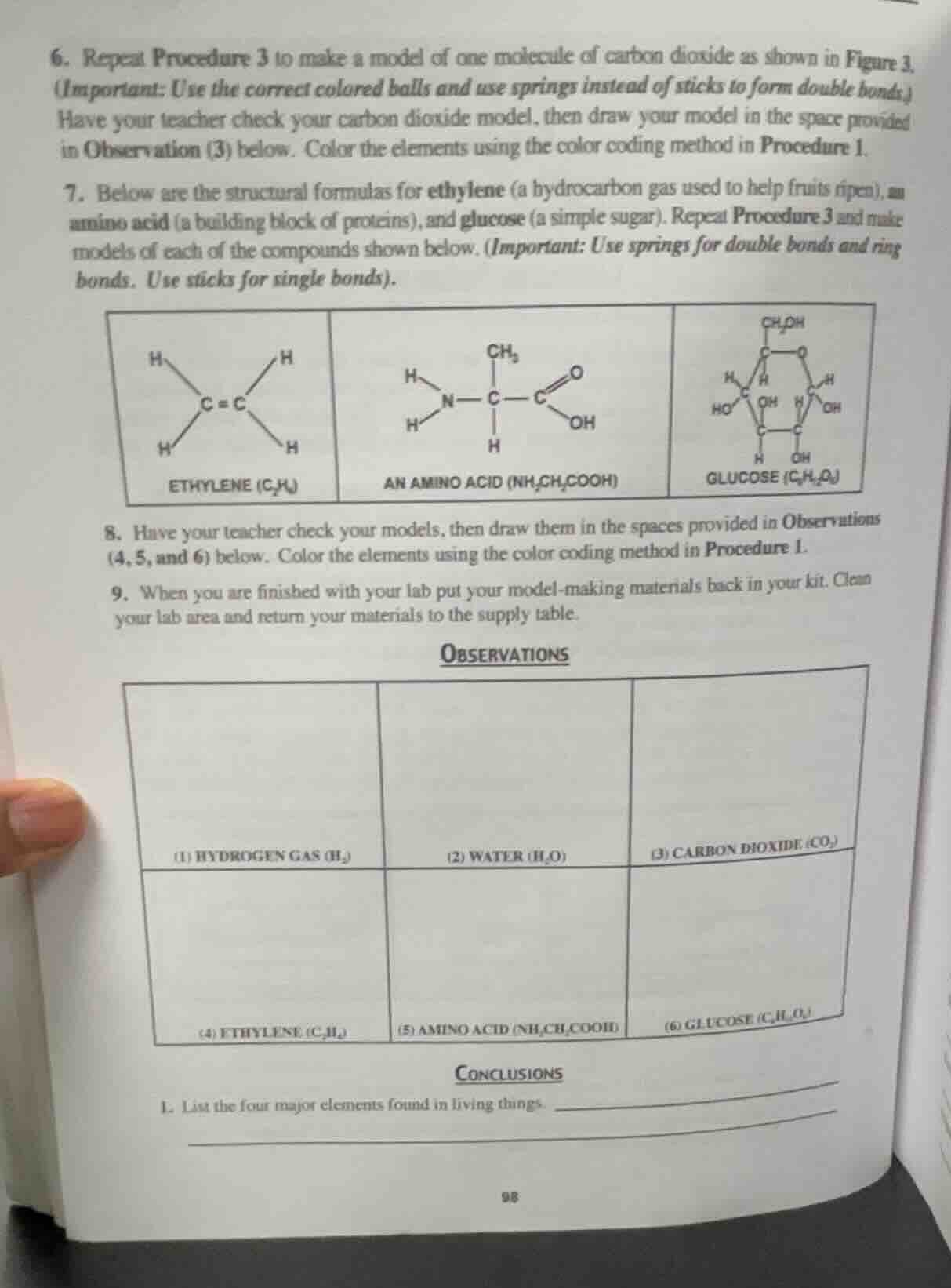
- repeat procedure 3 to make a model of one molecule of carbon dioxide as shown in figure 3. (important: use the correct colored balls and use springs instead of sticks to form double bonds.) have your teacher check your carbon dioxide model, then draw your model in the space provided in observation (3) below. color the elements using the color coding method in procedure 1.7. below are the structural formulas for ethylene (a hydrocarbon gas used to help fruits ripen), an amino acid (a building block of proteins), and glucose (a simple sugar). repeat procedure 3 and make models of each of the compounds shown below. (important: use springs for double bonds and ring bonds. use sticks for single bonds.)ethylene ($c_2h_4$)an amino acid ($nh_2ch_2cooh$)glucose ($c_6h_{12}o_6$)8. have your teacher check your models, then draw them in the spaces provided in observations (4, 5, and 6) below. color the elements using the color coding method in procedure 1.9. when you are finished with your lab put your model-making materials back in your kit. clean your lab area and return your materials to the supply table.observations(1) hydrogen gas ($h_2$)(2) water ($h_2o$)(3) carbon dioxide ($co_2$)(4) ethylene ($c_2h_4$)(5) amino acid ($nh_2ch_2cooh$)(6) glucose ($c_6h_{12}o_6$)conclusions1. list the four major elements found in living things.
Brief Explanations
The question asks for the four major elements found in living things, which are the most abundant and essential for biological molecules like proteins, carbohydrates, and lipids seen in the lab activity (ethylene, amino acid, glucose).

Snap & solve any problem in the app
Get step-by-step solutions on Sovi AI
Photo-based solutions with guided steps
Explore more problems and detailed explanations
Carbon (C), Hydrogen (H), Oxygen (O), Nitrogen (N)