QUESTION IMAGE
Question
reproductive strategies unit test
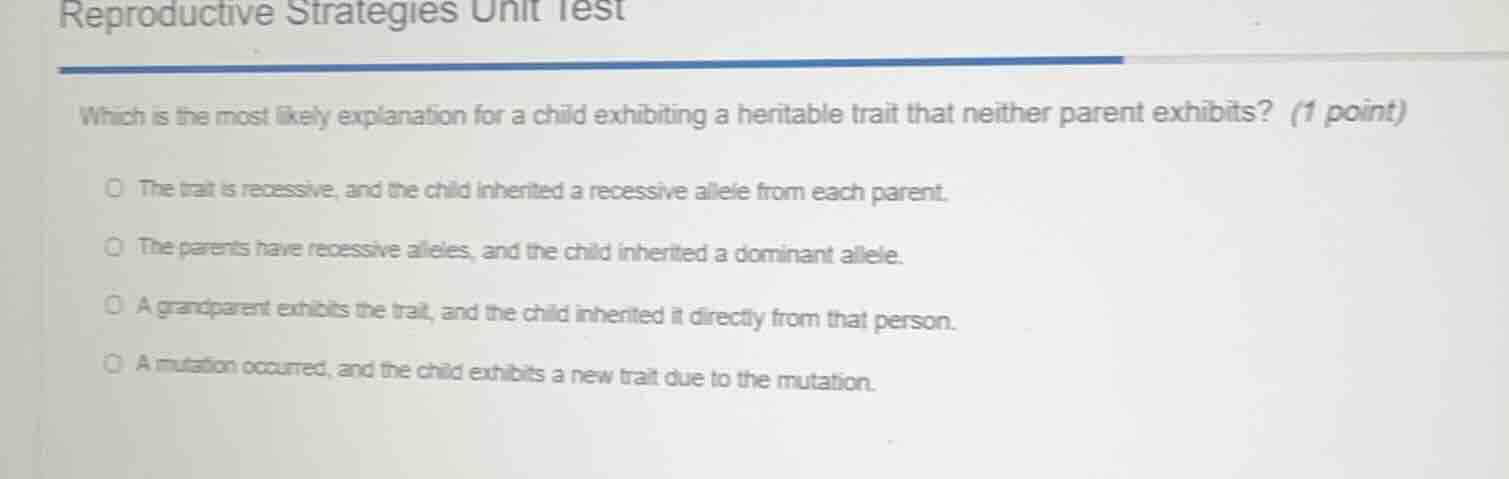
which is the most likely explanation for a child exhibiting a heritable trait that neither parent exhibits? (1 point)
the trait is recessive, and the child inherited a recessive allele from each parent.
the parents have recessive alleles, and the child inherited a dominant allele.
a grandparent exhibits the trait, and the child inherited it directly from that person.
a mutation occurred, and the child exhibits a new trait due to the mutation.
Brief Explanations
- Analyze Option 1: For a recessive trait, parents can be carriers (heterozygous, having one dominant and one recessive allele, so they don't show the trait). If the child inherits a recessive allele from each parent (homozygous recessive), they will exhibit the recessive trait that neither parent shows (since parents are heterozygous, dominant allele masks the recessive).
- Analyze Option 2: If parents have recessive alleles and the child inherits a dominant allele, the child would show the dominant trait, not a new trait neither parent has (dominant allele would be from a parent or mutation, but this option's logic is flawed as inheriting a dominant allele from parents who have recessive alleles would mean the dominant allele is present in a parent, so the parent would show the dominant trait, contradicting "neither parent exhibits").
- Analyze Option 3: Traits are inherited through parents' gametes, not directly from grandparents. Grandparents pass alleles to parents, who then pass to child. So a child can't inherit directly from a grandparent.
- Analyze Option 4: While mutations can cause new traits, the question specifies a "heritable" trait. Mutations are heritable only if in germ cells, but the most common and likely explanation for a heritable trait (from parental alleles) that neither parent shows is recessive inheritance, not mutation (mutation is less likely than recessive inheritance in typical cases).

Snap & solve any problem in the app
Get step-by-step solutions on Sovi AI
Photo-based solutions with guided steps
Explore more problems and detailed explanations
A. The trait is recessive, and the child inherited a recessive allele from each parent.