QUESTION IMAGE
Question
required information
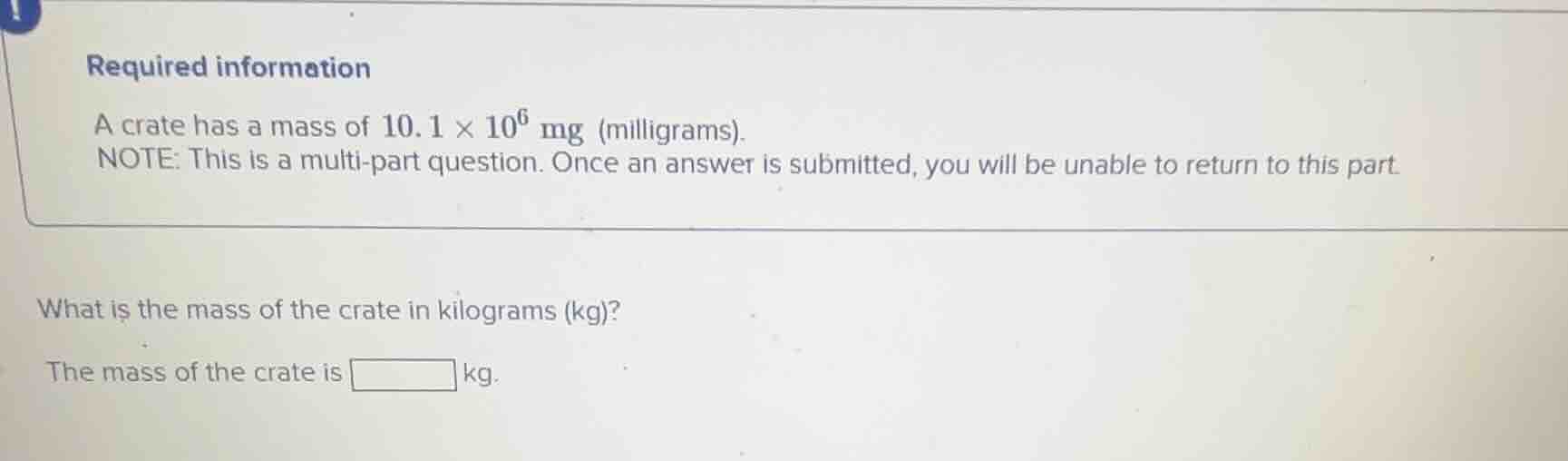
a crate has a mass of $10.1 \times 10^6$ mg (milligrams).
note: this is a multi - part question. once an answer is submitted, you will be unable to return to this part.
what is the mass of the crate in kilograms (kg)?
the mass of the crate is \boxed{} kg.
Step1: Recall unit conversion factors
We know that \(1\space kg = 10^{6}\space g\) and \(1\space g= 10^{3}\space mg\), so \(1\space kg=10^{6}\times10^{3}\space mg = 10^{9}\space mg\), or we can convert milligrams to grams first then to kilograms. First, convert milligrams to grams: since \(1\space g = 10^{3}\space mg\), then to convert \(mg\) to \(g\) we divide by \(10^{3}\), and to convert \(g\) to \(kg\) we divide by \(10^{3}\) again (since \(1\space kg = 10^{3}\space g\)). So overall, to convert \(mg\) to \(kg\), we divide by \(10^{3}\times10^{3}=10^{6}\)? Wait, no, let's do it step by step.
First, convert milligrams to grams: Given mass \(m = 10.1\times 10^{6}\space mg\). Since \(1\space g=10^{3}\space mg\), so \(m\) in grams is \(m_{g}=\frac{10.1\times 10^{6}\space mg}{10^{3}\space mg/g}=10.1\times 10^{3}\space g\).
Step2: Convert grams to kilograms
Now, convert grams to kilograms. Since \(1\space kg = 10^{3}\space g\), so \(m_{kg}=\frac{10.1\times 10^{3}\space g}{10^{3}\space g/kg}\).
Simplify the expression: \(\frac{10.1\times 10^{3}}{10^{3}}= 10.1\space kg\). Wait, alternatively, using the direct conversion from \(mg\) to \(kg\): since \(1\space kg = 10^{9}\space mg\)? No, wait, no: \(1\space mg=10^{-3}\space g\), \(1\space g = 10^{-3}\space kg\), so \(1\space mg=10^{-3}\times10^{-3}\space kg=10^{-6}\space kg\). So then \(10.1\times 10^{6}\space mg\times10^{-6}\space kg/mg=10.1\space kg\).
Step1 (Alternative): Direct conversion from mg to kg
We know that \(1\space kg = 10^{9}\space mg\)? Wait, no, let's check the prefixes:
- Milli (m) is \(10^{-3}\)
- Kilo (k) is \(10^{3}\)
So to convert from milligrams (mg) to kilograms (kg), we can use the conversion factor:
\(1\space kg=10^{3}\space g = 10^{3}\times10^{3}\space mg=10^{6}\space mg\)? Wait, no, \(1\space g = 1000\space mg\), so \(1\space kg = 1000\space g=1000\times1000\space mg = 10^{6}\space mg\)? Wait, no, \(1000\times1000 = 10^{6}\)? No, \(1000\times1000=10^{3}\times10^{3}=10^{6}\)? Wait, \(10^{3}\times10^{3}=10^{6}\), yes. Wait, but \(1\space kg = 10^{3}\space g\) and \(1\space g = 10^{3}\space mg\), so \(1\space kg=10^{3}\times10^{3}\space mg = 10^{6}\space mg\)? Wait, that can't be right, because \(1\space kg = 1000\space g\), \(1\space g=1000\space mg\), so \(1\space kg = 1000\times1000\space mg=1,000,000\space mg = 10^{6}\space mg\). Wait, but then if we have \(10.1\times 10^{6}\space mg\), dividing by \(10^{6}\space mg/kg\) gives \(10.1\space kg\). Yes, that's correct. So the conversion factor from \(mg\) to \(kg\) is \(1\space kg = 10^{6}\space mg\). So:
\(m_{kg}=\frac{10.1\times 10^{6}\space mg}{10^{6}\space mg/kg}\)
Step2: Simplify the expression
Simplify \(\frac{10.1\times 10^{6}}{10^{6}} = 10.1\space kg\)

Snap & solve any problem in the app
Get step-by-step solutions on Sovi AI
Photo-based solutions with guided steps
Explore more problems and detailed explanations
\(10.1\)