QUESTION IMAGE
Question
requirements:
- 5 - 7 complete sentences
- include the line or describe it clearly
- explain its significance
text entry
copy and paste or type your submission right here.
edit view insert format tools table
12pt paragraph | b i u a t² |
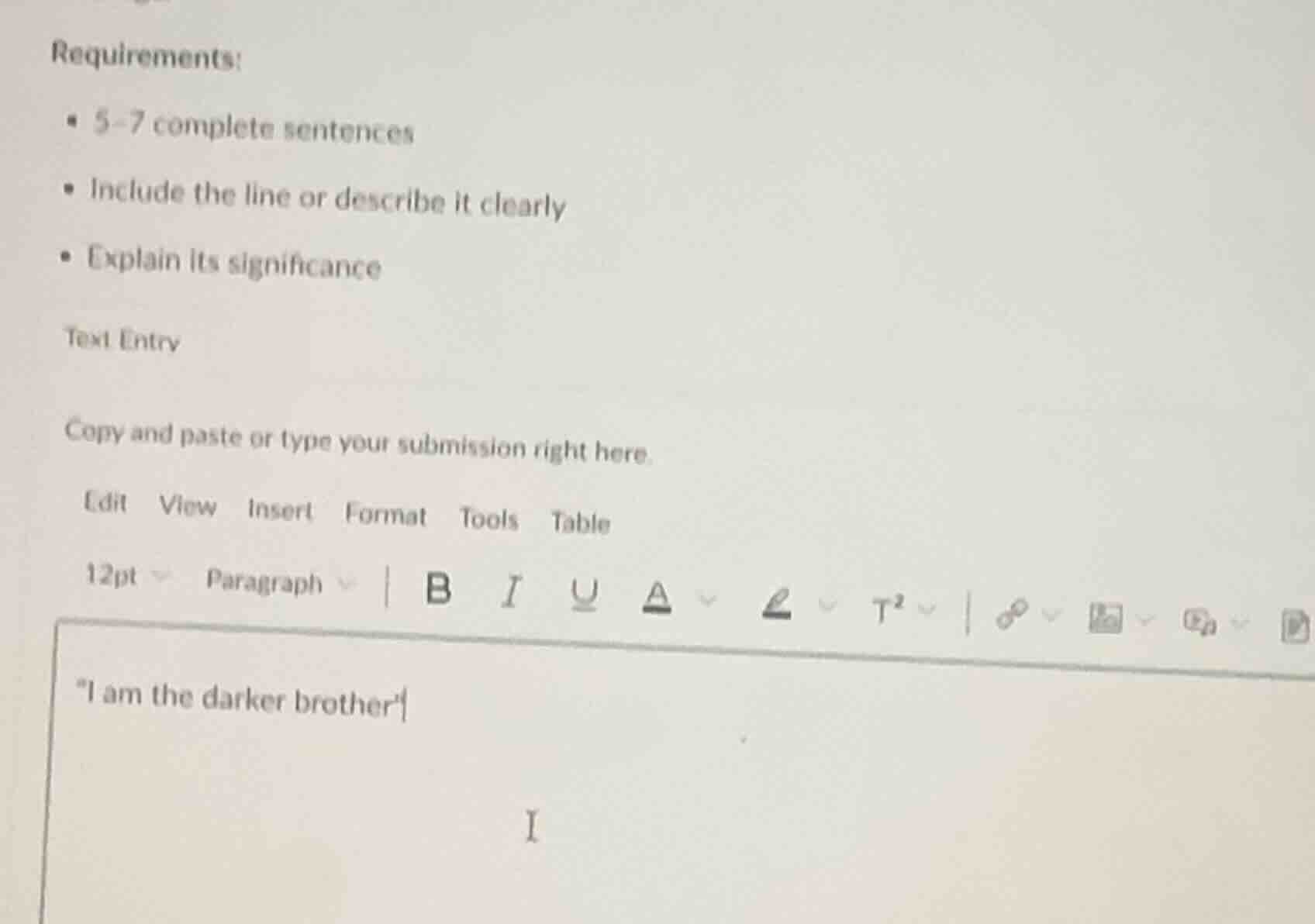
\i am the darker brother\
The line "I am the darker brother" opens Langston Hughes' poem I, Too. It immediately establishes the speaker as a Black American, framing him as a marginalized member of the "American family" referenced later in the work. This line sets up the poem's core theme of racial exclusion and the speaker's quiet resilience: he is part of the nation but pushed to the margins, sent to eat in the kitchen when company comes. Its significance lies in its understated assertion of identity and belonging, laying the groundwork for the speaker's declaration that he too will one day be seen and celebrated as an equal part of America. The line's simplicity carries profound weight, capturing the lived experience of racial othering while planting the seed of hope for a more inclusive future.

Snap & solve any problem in the app
Get step-by-step solutions on Sovi AI
Photo-based solutions with guided steps
Explore more problems and detailed explanations
"I am the darker brother" is the opening line of Langston Hughes' poem I, Too. This line immediately positions the speaker as a Black American, framing him as a marginalized member of the broader "American family" that the poem centers on. It establishes the core tension of the work: the speaker is part of the nation but is excluded and hidden away (sent to eat in the kitchen) when company arrives, a metaphor for the systemic racial segregation and erasure faced by Black people in the U.S. Its significance lies in its quiet, unflinching assertion of identity and belonging; it lays the groundwork for the speaker's later declaration that he too will one day sit at the table and be recognized as an equal, powerful statement of resilience and the demand for racial justice. The line's brevity and directness make it a potent encapsulation of the Black American experience of being both part of and excluded from the American dream.