QUESTION IMAGE
Question
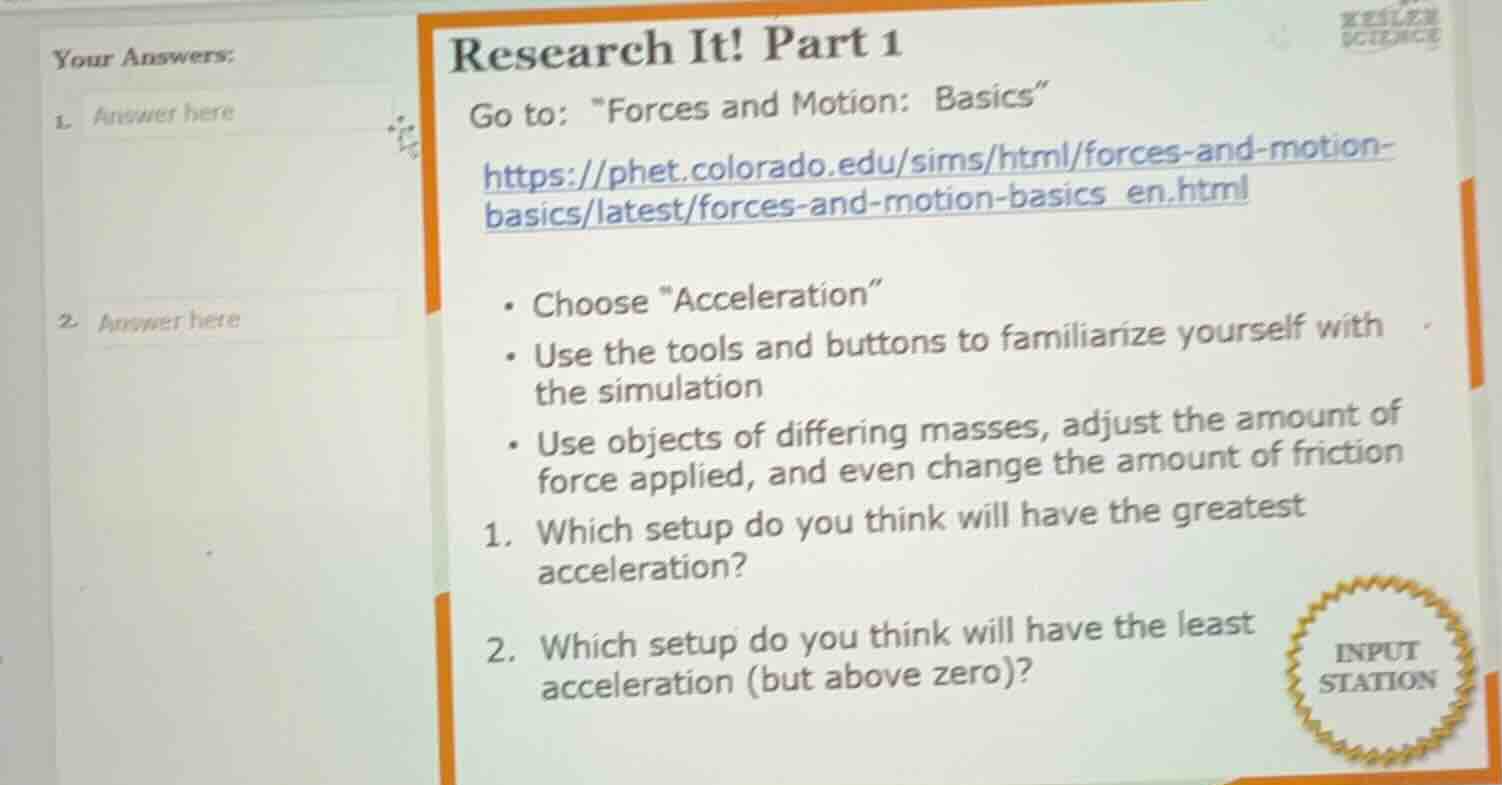
research it! part 1
go to: \forces and motion: basics\
https://phet.colorado.edu/sims/html/forces-and-motion-basics/latest/forces-and-motion-basics_en.html
- choose \acceleration\
- use the tools and buttons to familiarize yourself with the simulation
- use objects of differing masses, adjust the amount of force applied, and even change the amount of friction
- which setup do you think will have the greatest acceleration?
- which setup do you think will have the least acceleration (but above zero)?
To answer these questions, we refer to Newton's second law of motion, \( F = ma \) (or \( a=\frac{F}{m} \)), where \( a \) is acceleration, \( F \) is net force, and \( m \) is mass. Acceleration is directly proportional to the net force applied and inversely proportional to the mass of the object, and also affected by friction (a resistive force that reduces the net force).
Question 1: Greatest Acceleration
Step 1: Analyze the relationship
From \( a=\frac{F}{m} \), to maximize acceleration, we need a large net force and a small mass (since acceleration is directly related to force and inversely related to mass). Additionally, friction opposes motion, so minimizing friction (or having no friction) increases the net force (because net force = applied force - friction force).
Step 2: Apply to the simulation setup
In the “Forces and Motion: Basics” simulation (Acceleration tab), the setup with:
- The largest applied force (e.g., maximum push/pull from the person or other force source),
- The smallest mass (e.g., the lightest object like the small box or skateboard),
- And no friction (or the lowest friction setting, like “none” or “low” friction)
will have the greatest acceleration. For example, if you can choose a small mass (e.g., 1 kg), apply the maximum force (e.g., 100 N), and set friction to “none,” the acceleration \( a=\frac{100\,\text{N}}{1\,\text{kg}} = 100\,\text{m/s}^2 \) (which is larger than setups with more mass, less force, or more friction).
Question 2: Least Acceleration (Above Zero)
Step 1: Analyze the relationship
To minimize acceleration (while keeping it above zero), we need a small net force and a large mass (since acceleration is inversely related to mass and directly related to net force). Friction also reduces the net force, so increasing friction (or using a higher friction setting) will further reduce the net force (and thus acceleration).
Step 2: Apply to the simulation setup
In the simulation, the setup with:
- The smallest applied force (e.g., minimum push/pull),
- The largest mass (e.g., the heaviest object like the large box or truck),
- And high friction (to reduce the net force as much as possible, while still having a net force above zero)
will have the least acceleration (above zero). For example, if you choose a large mass (e.g., 100 kg), apply a small force (e.g., 10 N), and set friction to “high,” the acceleration \( a=\frac{10\,\text{N} - f_{\text{friction}}}{100\,\text{kg}} \) (where \( f_{\text{friction}} \) is non - zero but small enough that net force \( (10 - f_{\text{friction}}) \) is still positive). This will result in a small acceleration (e.g., if \( f_{\text{friction}} = 5\,\text{N} \), net force = \( 5\,\text{N} \), so \( a=\frac{5\,\text{N}}{100\,\text{kg}} = 0.05\,\text{m/s}^2 \)), which is the least acceleration (above zero) among setups.
Final Answers
- The setup with the largest applied force, smallest mass, and no (or lowest) friction will have the greatest acceleration. (Example: Small mass, maximum force, no friction.)
- The setup with the smallest applied force, largest mass, and highest friction (while still having a net force above zero) will have the least acceleration. (Example: Large mass, minimum force, high friction.)

Snap & solve any problem in the app
Get step-by-step solutions on Sovi AI
Photo-based solutions with guided steps
Explore more problems and detailed explanations
To answer these questions, we refer to Newton's second law of motion, \( F = ma \) (or \( a=\frac{F}{m} \)), where \( a \) is acceleration, \( F \) is net force, and \( m \) is mass. Acceleration is directly proportional to the net force applied and inversely proportional to the mass of the object, and also affected by friction (a resistive force that reduces the net force).
Question 1: Greatest Acceleration
Step 1: Analyze the relationship
From \( a=\frac{F}{m} \), to maximize acceleration, we need a large net force and a small mass (since acceleration is directly related to force and inversely related to mass). Additionally, friction opposes motion, so minimizing friction (or having no friction) increases the net force (because net force = applied force - friction force).
Step 2: Apply to the simulation setup
In the “Forces and Motion: Basics” simulation (Acceleration tab), the setup with:
- The largest applied force (e.g., maximum push/pull from the person or other force source),
- The smallest mass (e.g., the lightest object like the small box or skateboard),
- And no friction (or the lowest friction setting, like “none” or “low” friction)
will have the greatest acceleration. For example, if you can choose a small mass (e.g., 1 kg), apply the maximum force (e.g., 100 N), and set friction to “none,” the acceleration \( a=\frac{100\,\text{N}}{1\,\text{kg}} = 100\,\text{m/s}^2 \) (which is larger than setups with more mass, less force, or more friction).
Question 2: Least Acceleration (Above Zero)
Step 1: Analyze the relationship
To minimize acceleration (while keeping it above zero), we need a small net force and a large mass (since acceleration is inversely related to mass and directly related to net force). Friction also reduces the net force, so increasing friction (or using a higher friction setting) will further reduce the net force (and thus acceleration).
Step 2: Apply to the simulation setup
In the simulation, the setup with:
- The smallest applied force (e.g., minimum push/pull),
- The largest mass (e.g., the heaviest object like the large box or truck),
- And high friction (to reduce the net force as much as possible, while still having a net force above zero)
will have the least acceleration (above zero). For example, if you choose a large mass (e.g., 100 kg), apply a small force (e.g., 10 N), and set friction to “high,” the acceleration \( a=\frac{10\,\text{N} - f_{\text{friction}}}{100\,\text{kg}} \) (where \( f_{\text{friction}} \) is non - zero but small enough that net force \( (10 - f_{\text{friction}}) \) is still positive). This will result in a small acceleration (e.g., if \( f_{\text{friction}} = 5\,\text{N} \), net force = \( 5\,\text{N} \), so \( a=\frac{5\,\text{N}}{100\,\text{kg}} = 0.05\,\text{m/s}^2 \)), which is the least acceleration (above zero) among setups.
Final Answers
- The setup with the largest applied force, smallest mass, and no (or lowest) friction will have the greatest acceleration. (Example: Small mass, maximum force, no friction.)
- The setup with the smallest applied force, largest mass, and highest friction (while still having a net force above zero) will have the least acceleration. (Example: Large mass, minimum force, high friction.)