QUESTION IMAGE
Question
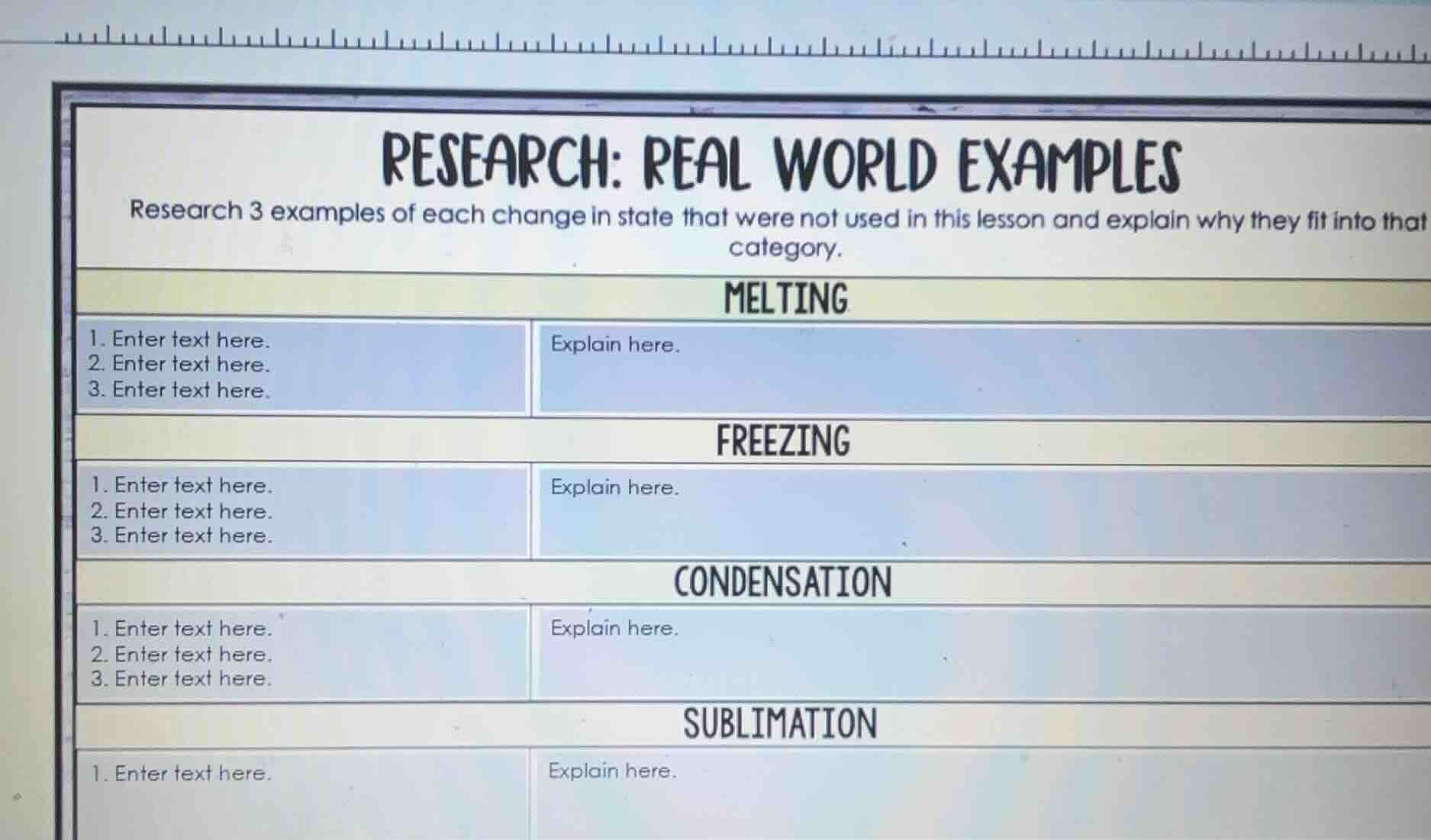
research: real world examples
research 3 examples of each change in state that were not used in this lesson and explain why they fit into that category.
melting
- enter text here.
- enter text here.
- enter text here.
explain here.
freezing
- enter text here.
- enter text here.
- enter text here.
explain here.
condensation
- enter text here.
- enter text here.
- enter text here.
explain here.
sublimation
- enter text here.
explain here.
To complete this task, we will provide 3 examples for each state change (melting, freezing, condensation, sublimation) and their explanations:
MELTING
- Example 1: Candle Wax Melting
- Explanation: Candle wax is a solid at room temperature. When the candle is lit, the heat from the flame increases the temperature of the wax, causing it to change from a solid to a liquid (melt). This fits the melting category because it involves a solid turning into a liquid due to heat absorption.
- Example 2: Butter Melting on a Hot Pan
- Explanation: Butter is a solid fat. When placed on a hot pan, the heat from the pan is transferred to the butter, raising its temperature above its melting point. As a result, the solid butter becomes a liquid. This is melting because it is the phase transition of a solid to a liquid.
- Example 3: Gallium Melting in Hand
- Explanation: Gallium is a metal with a very low melting point (around 29.76°C). When held in the hand, the heat from the body (which is around 37°C) is enough to raise the temperature of gallium above its melting point, causing the solid metal to turn into a liquid. This is a classic example of melting as the solid transitions to a liquid due to heat.
FREEZING
- Example 1: Making Ice Cubes
- Explanation: Water is a liquid at room temperature. When placed in a freezer (where the temperature is below 0°C, the freezing point of water), the liquid water loses heat and its temperature drops to 0°C. At this point, the liquid water changes into solid ice. This is freezing because it is the phase transition of a liquid to a solid.
- Example 2: Lava Freezing (Solidifying) into Rock
- Explanation: Lava is molten (liquid) rock expelled from a volcano. When it flows onto the Earth’s surface, it is exposed to cooler temperatures. As the lava loses heat, it cools down and transitions from a liquid to a solid (rock). This is freezing (solidification) of a liquid into a solid.
- Example 3: Freezing of Molten Chocolate into a Solid Bar
- Explanation: Molten chocolate is a liquid mixture of cocoa, fat, and sugar. When poured into a mold and cooled (either at room temperature or in a refrigerator), the liquid chocolate loses heat and solidifies into a chocolate bar. This is freezing because the liquid chocolate transitions to a solid state.
CONDENSATION
- Example 1: Water Droplets on a Cold Soda Can
- Explanation: The air around us contains water vapor (gaseous water). When this warm, moist air comes into contact with a cold soda can, the water vapor in the air loses heat (because the can is colder than the air). As a result, the water vapor condenses into liquid water droplets on the surface of the can. This is condensation (gas to liquid).
- Example 2: Morning Dew on Grass
- Explanation: At night, the temperature of the air and surfaces (like grass) drops. Water vapor in the air (which is warmer) comes into contact with the cold grass. The water vapor loses heat and condenses into liquid water droplets (dew) on the grass. This is condensation as it involves gas (water vapor) turning into liquid (dew).
- Example 3: Steam Condensing on a Bathroom Mirror
- Explanation: When you take a hot shower, the water in the shower turns into steam (water vapor, gas) due to heating. This warm, moist air (with water vapor) comes into contact with the cool bathroom mirror. The water vapor loses heat to the mirror and condenses into liquid water droplets on the mirror’s surface. This is condensation (gas…

Snap & solve any problem in the app
Get step-by-step solutions on Sovi AI
Photo-based solutions with guided steps
Explore more problems and detailed explanations
To complete this task, we will provide 3 examples for each state change (melting, freezing, condensation, sublimation) and their explanations:
MELTING
- Example 1: Candle Wax Melting
- Explanation: Candle wax is a solid at room temperature. When the candle is lit, the heat from the flame increases the temperature of the wax, causing it to change from a solid to a liquid (melt). This fits the melting category because it involves a solid turning into a liquid due to heat absorption.
- Example 2: Butter Melting on a Hot Pan
- Explanation: Butter is a solid fat. When placed on a hot pan, the heat from the pan is transferred to the butter, raising its temperature above its melting point. As a result, the solid butter becomes a liquid. This is melting because it is the phase transition of a solid to a liquid.
- Example 3: Gallium Melting in Hand
- Explanation: Gallium is a metal with a very low melting point (around 29.76°C). When held in the hand, the heat from the body (which is around 37°C) is enough to raise the temperature of gallium above its melting point, causing the solid metal to turn into a liquid. This is a classic example of melting as the solid transitions to a liquid due to heat.
FREEZING
- Example 1: Making Ice Cubes
- Explanation: Water is a liquid at room temperature. When placed in a freezer (where the temperature is below 0°C, the freezing point of water), the liquid water loses heat and its temperature drops to 0°C. At this point, the liquid water changes into solid ice. This is freezing because it is the phase transition of a liquid to a solid.
- Example 2: Lava Freezing (Solidifying) into Rock
- Explanation: Lava is molten (liquid) rock expelled from a volcano. When it flows onto the Earth’s surface, it is exposed to cooler temperatures. As the lava loses heat, it cools down and transitions from a liquid to a solid (rock). This is freezing (solidification) of a liquid into a solid.
- Example 3: Freezing of Molten Chocolate into a Solid Bar
- Explanation: Molten chocolate is a liquid mixture of cocoa, fat, and sugar. When poured into a mold and cooled (either at room temperature or in a refrigerator), the liquid chocolate loses heat and solidifies into a chocolate bar. This is freezing because the liquid chocolate transitions to a solid state.
CONDENSATION
- Example 1: Water Droplets on a Cold Soda Can
- Explanation: The air around us contains water vapor (gaseous water). When this warm, moist air comes into contact with a cold soda can, the water vapor in the air loses heat (because the can is colder than the air). As a result, the water vapor condenses into liquid water droplets on the surface of the can. This is condensation (gas to liquid).
- Example 2: Morning Dew on Grass
- Explanation: At night, the temperature of the air and surfaces (like grass) drops. Water vapor in the air (which is warmer) comes into contact with the cold grass. The water vapor loses heat and condenses into liquid water droplets (dew) on the grass. This is condensation as it involves gas (water vapor) turning into liquid (dew).
- Example 3: Steam Condensing on a Bathroom Mirror
- Explanation: When you take a hot shower, the water in the shower turns into steam (water vapor, gas) due to heating. This warm, moist air (with water vapor) comes into contact with the cool bathroom mirror. The water vapor loses heat to the mirror and condenses into liquid water droplets on the mirror’s surface. This is condensation (gas to liquid).
SUBLIMATION
- Example 1: Dry Ice (Solid CO₂) Sublimating
- Explanation: Dry ice is solid carbon dioxide. At standard atmospheric pressure, it does not melt into a liquid. Instead, it directly transitions from a solid to a gas (carbon dioxide gas) when exposed to room temperature. This is sublimation because it is the phase transition of a solid directly to a gas, skipping the liquid phase.
- Example 2: Mothballs (Naphthalene) Sublimating
- Explanation: Mothballs are made of naphthalene, which is a solid at room temperature. Over time, especially in a warm environment, the solid naphthalene sublimes, meaning it turns directly into naphthalene gas. This is why mothballs shrink and disappear over time—they are undergoing sublimation (solid to gas).
- Example 3: Snow Sublimating on a Cold, Sunny Day
- Explanation: Snow is solid water (ice crystals). On a cold but sunny day, the snow can absorb heat from the sun. Instead of melting into liquid water (if the temperature is still below 0°C), the solid snow sublimes directly into water vapor (gas) and disappears. This is sublimation because the solid snow transitions directly to gas without becoming liquid.
You can now enter these examples and explanations into the provided table.