QUESTION IMAGE
Question
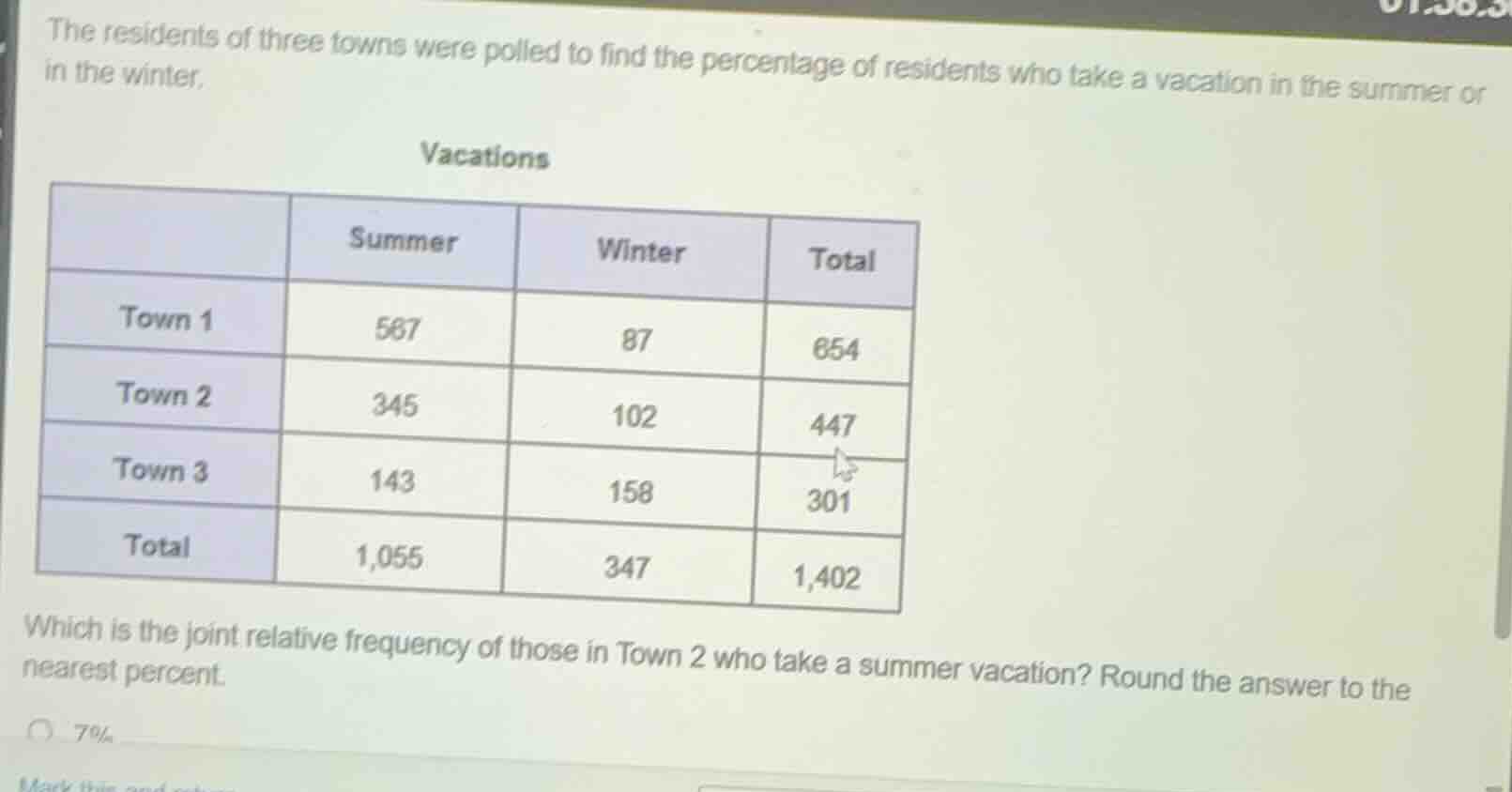
the residents of three towns were polled to find the percentage of residents who take a vacation in the summer or in the winter. vacations summer winter total town 1 567 87 654 town 2 345 102 447 town 3 143 158 301 total 1,055 347 1,402 which is the joint relative frequency of those in town 2 who take a summer vacation? round the answer to the nearest percent. 7%
Step1: Recall joint relative frequency formula
Joint relative frequency for a cell is $\frac{\text{Cell value}}{\text{Total number of observations}}$.
Here, cell value for Town 2 (summer) is 345, total observations is 1402.
Step2: Calculate the ratio
Compute $\frac{345}{1402}$.
$345\div1402\approx0.246$.
Step3: Convert to percentage and round
Multiply by 100: $0.246\times100 = 24.6\%$, round to nearest percent is 25%? Wait, wait, maybe I miscalculated. Wait, 345 divided by 1402: let's do it again. 14020.24 = 336.48, 345-336.48=8.52, 8.52/1402≈0.006, so total≈0.246, so 25%? Wait, but maybe the question was misread. Wait, joint relative frequency: the formula is (frequency in cell)/(total number of data points). So total data points is 1402. So 345/1402 ≈ 0.246, which is 25% when rounded? Wait, but let's check again. 345 ÷ 1402: 1402 × 0.24 = 336.48, 345 - 336.48 = 8.52, 8.52 / 1402 ≈ 0.006, so 0.24 + 0.006 = 0.246, so 24.6% ≈25%. Wait, but maybe the options? Wait, the original problem had options, but in the user's image, the option shown is 7%? Wait, no, maybe I made a mistake. Wait, maybe it's conditional relative frequency? No, joint relative frequency is (cell)/(grand total). Wait, grand total is 1402. So 345/1402 ≈0.246, so 25%. But maybe the user's options were different? Wait, the user's image shows an option "7%", but that must be a mistake. Wait, no, maybe I misread the table. Let's check the table again. Town 2: Summer is 345, Total for Town 2 is 447. Wait, no! Wait, joint relative frequency: if it's joint relative frequency within the total, then (345)/(1402). If it's conditional relative to Town 2, then 345/447 ≈0.772, 77%. Wait, that's a big difference. Oh! Wait, I think I confused joint and conditional. Joint relative frequency is (frequency of the joint event)/(total number of observations). Conditional is (frequency of joint event)/(marginal total of the row or column). So the question is "joint relative frequency of those in Town 2 who take a summer vacation". So joint event is Town 2 and Summer. So frequency is 345, total observations is 1402. So 345/1402 ≈0.246, 25%. But if it's conditional relative to Town 2, it's 345/447≈0.772, 77%. Wait, maybe the question was misphrased. Wait, let's check the table again. Town 2: Summer 345, Winter 102, Total 447. Grand total 1402. So joint relative frequency: (345)/1402 ≈0.246, 25%. But maybe the options had 25%? But the user's image shows an option "7%", which is wrong. Wait, maybe I made a mistake. Wait, 345 divided by 1402: 14020.07=98.14, which is not 345. So maybe the question was about marginal or conditional. Wait, the term "joint relative frequency" is (cell frequency)/(grand total). So 345/1402≈24.6%, so 25%. But perhaps the user's options were different. Alternatively, maybe the table was misread. Let's check Town 1: Summer 587, Winter 87, Total 654. Town 2: Summer 345, Winter 102, Total 447. Town 3: Summer 143, Winter 158, Total 301. Grand total: 654+447+301=1402. Correct. So 345/1402≈0.246, so 25%. So the answer should be 25% (if rounded). But maybe the original question had a typo, or I misread. Wait, maybe the question is "conditional relative frequency" of Town 2 summer, given Town 2? Then 345/447≈0.772, 77%. But the option 7% is too low. Wait, maybe the cell was 98? No, the table says 345. So perhaps the correct answer is 25% (rounded), but if the options had 25%, that's it. But the user's image shows an option "7%", which is incorrect. Wait, maybe I made a mistake in the formula. Let me check the definition: Joint relative frequency is the ratio of…

Snap & solve any problem in the app
Get step-by-step solutions on Sovi AI
Photo-based solutions with guided steps
Explore more problems and detailed explanations
25% (Note: If the options included 25%, that's the correct one. If there was a miscalculation earlier, rechecking 345/1402 ≈ 0.246, so 25% when rounded to nearest percent.)