QUESTION IMAGE
Question
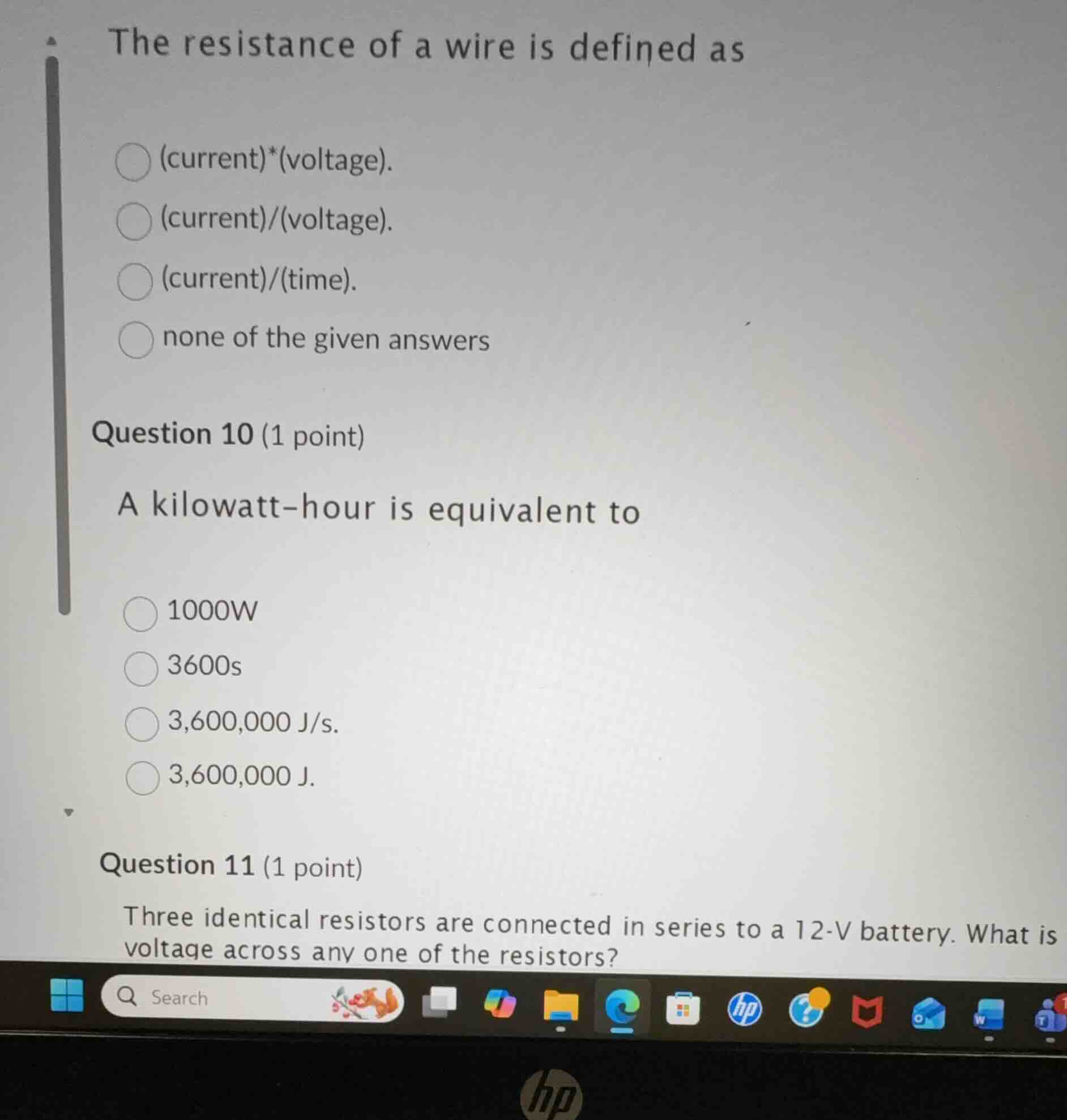
the resistance of a wire is defined as
(current)*(voltage).
(current)/(voltage).
(current)/(time).
none of the given answers
question 10 (1 point)
a kilowatt-hour is equivalent to
1000w
3600s
3,600,000 j/s.
3,600,000 j.
question 11 (1 point)
three identical resistors are connected in series to a 12-v battery. what is voltage across any one of the resistors?
Question about wire resistance:
Resistance \( R \) is defined by Ohm's Law, \( V = IR \), so \( R=\frac{V}{I} \) (voltage/current), not current*voltage, current/voltage (incorrect ratio), or current/time (which is charge rate, not resistance). So the correct choice is "none of the given answers".
Step1: Recall the definitions of power and energy. Power \( P \) is in watts (W), where \( 1\space W = 1\space J/s \), and energy \( E=P\times t \). A kilowatt - hour (\( kWh \)) is \( 1000\space W\times3600\space s \) (since 1 hour = 3600 seconds).
Step2: Calculate the energy. \( E = 1000\space J/s\times3600\space s=3600000\space J \). So a kilowatt - hour is equivalent to \( 3,600,000\space J \).
Step1: Recall series circuit voltage rule. In a series circuit with identical resistors, the total voltage \( V_{total} \) is divided equally among the resistors. Let the resistance of each resistor be \( R \), and the total resistance \( R_{total}=R + R+R = 3R \).
Step2: Find the current. From Ohm's Law \( I=\frac{V_{total}}{R_{total}}=\frac{12\space V}{3R}=\frac{4\space V}{R} \).
Step3: Find the voltage across one resistor. Using \( V = IR \), for one resistor, \( V = I\times R=\frac{4\space V}{R}\times R = 4\space V \).

Snap & solve any problem in the app
Get step-by-step solutions on Sovi AI
Photo-based solutions with guided steps
Explore more problems and detailed explanations
none of the given answers