QUESTION IMAGE
Question
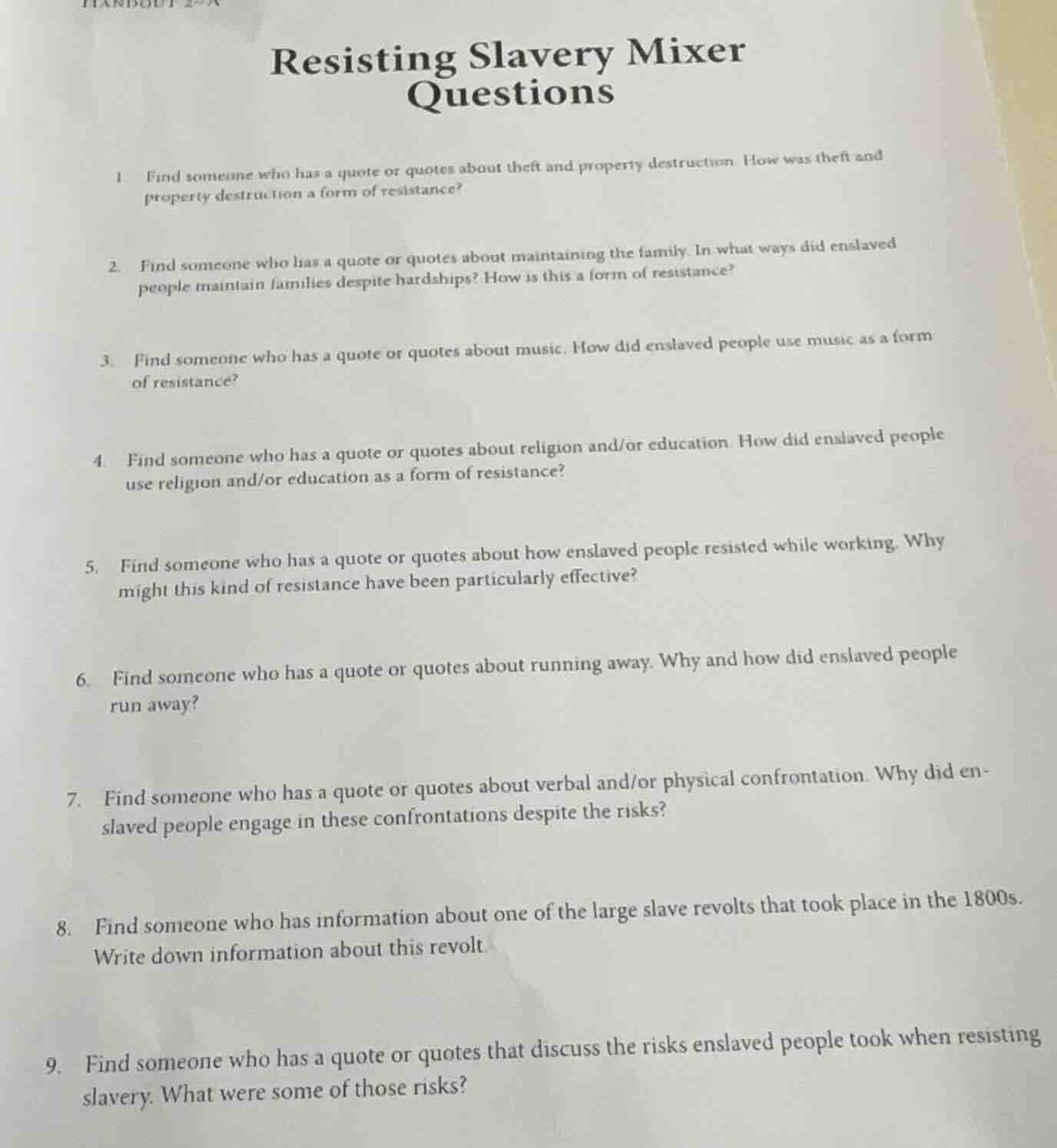
resisting slavery mixer questions
1 find someone who has a quote or quotes about theft and property destruction. how was theft and property destruction a form of resistance?
2 find someone who has a quote or quotes about maintaining the family. in what ways did enslaved people maintain families despite hardships? how is this a form of resistance?
3 find someone who has a quote or quotes about music. how did enslaved people use music as a form of resistance?
4 find someone who has a quote or quotes about religion and/or education. how did enslaved people use religion and/or education as a form of resistance?
5 find someone who has a quote or quotes about how enslaved people resisted while working. why might this kind of resistance have been particularly effective?
6 find someone who has a quote or quotes about running away. why and how did enslaved people run away?
7 find someone who has a quote or quotes about verbal and/or physical confrontation. why did enslaved people engage in these confrontations despite the risks?
8 find someone who has information about one of the large slave revolts that took place in the 1800s. write down information about this revolt.
9 find someone who has a quote or quotes that discuss the risks enslaved people took when resisting slavery. what were some of those risks?
- Theft/property destruction disrupted the enslavers' economic system (the core of slavery), cutting into their profits and forcing them to divert resources to security, directly undermining their control. Example quote: "Every time we took what they claimed was theirs, we took a little of their power too." (enslaved person interviewed by WPA)
- Enslaved people maintained families by secret meetings, passing down names/histories, and creating chosen family bonds. This preserved their cultural identity and humanity, rejecting enslavers' attempts to dehumanize them by treating people as disposable property. Example quote: "We kept our families close, even when they sold our children. That was our way of not letting them win." (enslaved person interviewed by WPA)
- Enslaved people used music to encode escape routes (e.g., spirituals like "Follow the Drinking Gourd"), communicate secret messages, and preserve African cultural traditions, fostering solidarity and hope. Example quote: "We sang songs that told us how to get free, without the masters ever knowing." (enslaved person interviewed by WPA)
- Religion (e.g., Black Christianity) was used to frame freedom as a divine right, while secret education allowed enslaved people to read abolitionist literature, understand laws, and organize resistance. Example quote: "We read the Bible and knew that God meant for us to be free, not in chains." (enslaved person interviewed by WPA)
- On-the-job resistance included slowdowns, feigning illness, or breaking tools. It was effective because it was low-risk, hard to prove, and consistently reduced the enslavers' productivity over time without triggering violent reprisals for overt rebellion. Example quote: "We worked just slow enough that they couldn't beat us for it, but not fast enough to make them rich." (enslaved person interviewed by WPA)
- Enslaved people ran away to escape violence, reunite with family, or gain freedom. They used the Underground Railroad, hidden paths, and help from abolitionists; some fled to free states or Indigenous communities. Example quote: "I ran because I couldn't watch them beat my wife anymore. The Underground Railroad helped me get to Canada." (Henry "Box" Brown, enslaved person who escaped by mail)
- Enslaved people engaged in verbal/physical confrontation to defend themselves or family, protest brutal treatment, or assert their humanity. The risks (torture, death) were outweighed by the need to resist dehumanization and sometimes secure better conditions. Example quote: "I fought back when he tried to sell my son. I knew I might die, but I had to try." (enslaved person interviewed by WPA)
- Nat Turner's Rebellion (1831, Virginia): Nat Turner, an enslaved preacher, led a group of ~75 enslaved people in an uprising, killing ~60 white enslavers and their families. The rebellion was suppressed within 48 hours; Turner was captured, tried, and hanged. In retaliation, white mobs killed over 200 enslaved people. The revolt led to stricter slave codes across the South, banning Black education and assembly.
- Risks included torture, sale away from family, public execution, and collective punishment of other enslaved people. These risks were used to deter resistance, but many enslaved people chose to resist anyway to retain their dignity. Example quote: "If we resisted, they might sell us, or kill us. But if we didn't, we were already dead inside." (enslaved person interviewed by WPA)

Snap & solve any problem in the app
Get step-by-step solutions on Sovi AI
Photo-based solutions with guided steps
Explore more problems and detailed explanations
- Theft and property destruction undermined enslavers' economic power and control.
- Enslaved people maintained families via secret bonds and cultural preservation, resisting dehumanization.
- Music encoded escape messages, preserved culture, and built solidarity.
- Religion framed freedom as divine; education enabled organizing and understanding rights.
- On-the-job resistance was low-risk and consistently reduced enslaver productivity.
- Enslaved people ran away for freedom/family, using the Underground Railroad and hidden routes.
- Confrontations defended loved ones and asserted humanity, outweighing violent risks.
- Nat Turner's Rebellion (1831): Led by Nat Turner, killed 60 whites; suppressed, with 200+ enslaved people killed in retaliation, leading to harsher slave codes.
- Risks included torture, family separation, execution, and collective punishment.