QUESTION IMAGE
Question
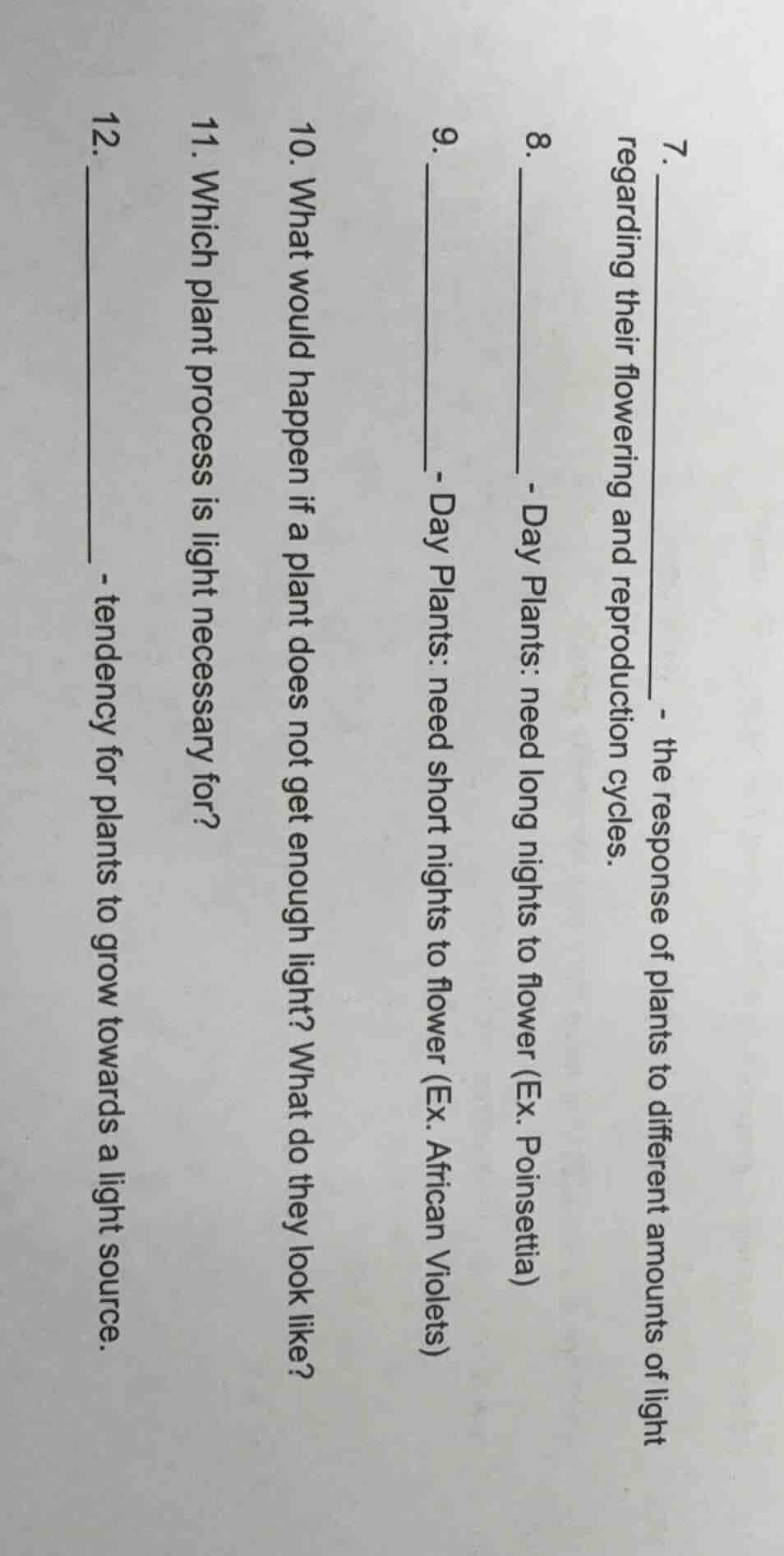
- _________________________ - the response of plants to different amounts of light regarding their flowering and reproduction cycles.
- _________________________ - day plants: need long nights to flower (ex. poinsettia)
- _________________________ - day plants: need short nights to flower (ex. african violets)
- what would happen if a plant does not get enough light? what do they look like?
- which plant process is light necessary for?
- _________________________ - tendency for plants to grow towards a light source.
Brief Explanations
- This term describes plant responses to light duration for flowering/reproduction.
- This category of plants requires long uninterrupted dark periods (nights) to initiate flowering, matching the example.
- This category of plants requires short uninterrupted dark periods (nights) to initiate flowering, matching the example.
- Light is critical for photosynthesis; insufficient light limits food production, causing these visible changes.
- This process relies on light energy to produce glucose for the plant's growth and survival.
- This is the specific directional growth response of plants toward a light source.

Snap & solve any problem in the app
Get step-by-step solutions on Sovi AI
Photo-based solutions with guided steps
Explore more problems and detailed explanations
- Photoperiodism
- Short
- Long
- The plant will be unable to perform sufficient photosynthesis, so it will become weak, have yellowed (chlorotic) leaves, grow leggy (tall and spindly) as it stretches for light, and may fail to flower or produce fruit.
- Photosynthesis
- Phototropism