QUESTION IMAGE
Question
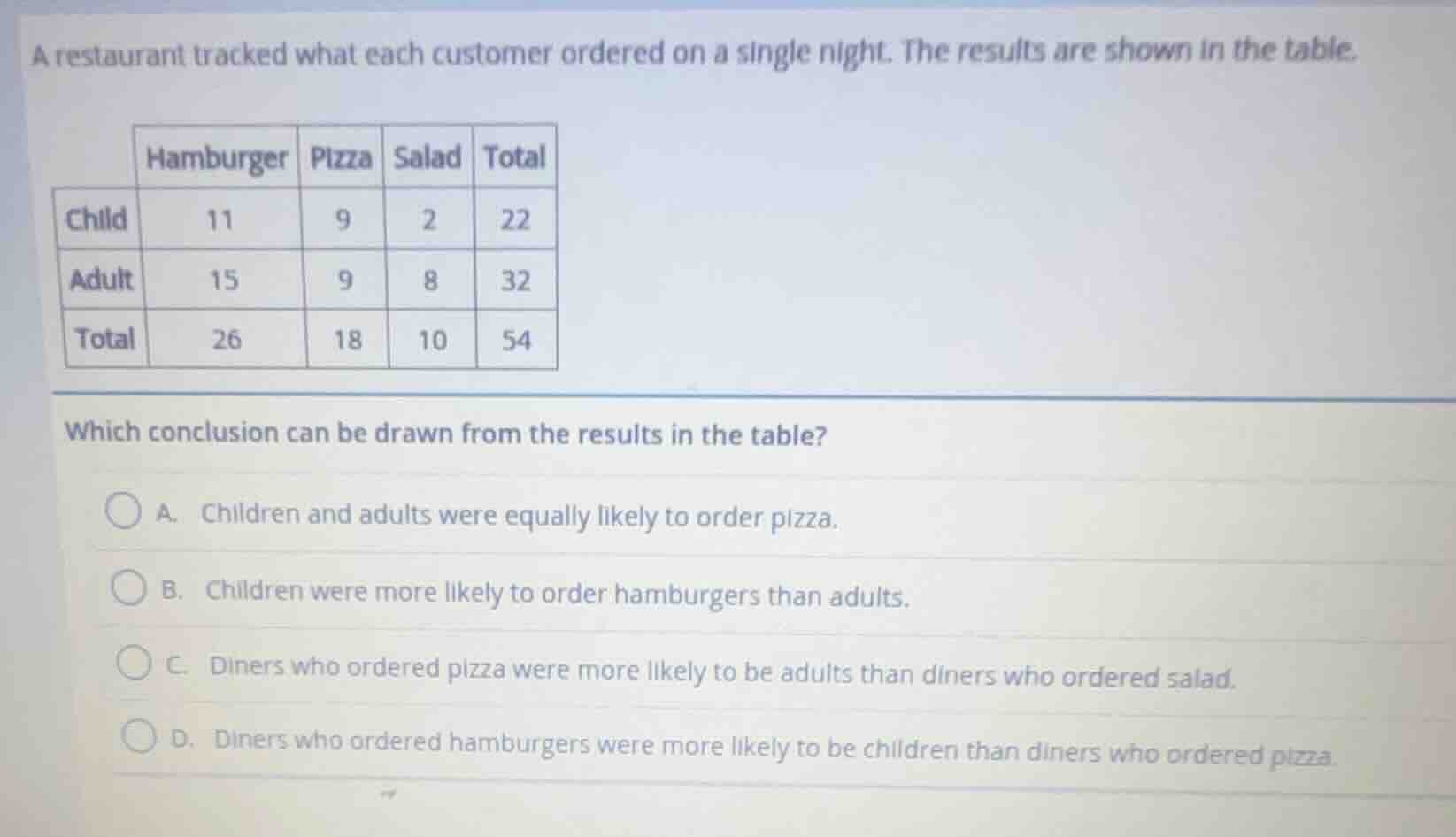
a restaurant tracked what each customer ordered on a single night. the results are shown in the table. table content: rows (child, adult, total) and columns (hamburger, pizza, salad, total) with values: child - hamburger 11, pizza 9, salad 2, total 22; adult - hamburger 15, pizza 9, salad 8, total 32; total - hamburger 26, pizza 18, salad 10, total 54 which conclusion can be drawn from the results in the table? a. children and adults were equally likely to order pizza. b. children were more likely to order hamburgers than adults. c. diners who ordered pizza were more likely to be adults than diners who ordered salad. d. diners who ordered hamburgers were more likely to be children than diners who ordered pizza.
Step1: Analyze Option A
Calculate the probability of a child ordering pizza: $\frac{9}{22} \approx 0.409$.
Calculate the probability of an adult ordering pizza: $\frac{9}{32} \approx 0.281$.
Since $0.409
eq 0.281$, children and adults are not equally likely to order pizza. So A is incorrect.
Step2: Analyze Option B
Probability of a child ordering a hamburger: $\frac{11}{22} = 0.5$.
Probability of an adult ordering a hamburger: $\frac{15}{32} \approx 0.469$.
Since $0.5 > 0.469$, children are more likely to order hamburgers than adults? Wait, no, wait. Wait, the probability for child is 11/22 = 0.5, adult is 15/32 ≈ 0.469. But wait, let's check again. Wait, the question is "children were more likely to order hamburgers than adults". But let's check the other options too. Wait, maybe I made a mistake here. Wait, let's check Option C.
Step3: Analyze Option C
Probability of a diner who ordered pizza being an adult: $\frac{9}{18} = 0.5$.
Probability of a diner who ordered salad being an adult: $\frac{8}{10} = 0.8$.
Since $0.5 < 0.8$, diners who ordered pizza are less likely to be adults than those who ordered salad. So C is incorrect.
Step4: Analyze Option D
Probability of a diner who ordered hamburgers being a child: $\frac{11}{26} \approx 0.423$.
Probability of a diner who ordered pizza being a child: $\frac{9}{18} = 0.5$.
Since $0.423 < 0.5$, diners who ordered hamburgers are less likely to be children than those who ordered pizza. So D is incorrect.
Wait, but earlier in Step 2, for Option B, the probability of child ordering hamburger is 11/22 = 0.5, adult is 15/32 ≈ 0.469. So 0.5 > 0.469, so children are more likely to order hamburgers than adults? But let's check the table again. Child total is 22, 11 hamburgers. Adult total is 32, 15 hamburgers. So 11/22 = 0.5, 15/32 ≈ 0.46875. So yes, 0.5 is greater than 0.46875. So B seems correct? But wait, the initial analysis for Option B: "Children were more likely to order hamburgers than adults." So according to the probabilities, that's true. But wait, let's check the other options again. Wait, maybe I made a mistake in Option C. Wait, pizza total is 18, adults who ordered pizza is 9, so 9/18 = 0.5. Salad total is 10, adults who ordered salad is 8, so 8/10 = 0.8. So 0.5 < 0.8, so diners who ordered pizza are less likely to be adults than those who ordered salad. So C is wrong. Option D: hamburger total is 26, children who ordered hamburger is 11, so 11/26 ≈ 0.423. Pizza total is 18, children who ordered pizza is 9, so 9/18 = 0.5. So 0.423 < 0.5, so diners who ordered hamburgers are less likely to be children than those who ordered pizza. So D is wrong. Option A: children pizza probability 9/22 ≈ 0.409, adult pizza probability 9/32 ≈ 0.281. So not equal. So A is wrong. So the correct answer should be B? Wait, but let's confirm again.
Wait, the question is "Which conclusion can be drawn from the results in the table?" Let's re-express the probabilities:
- Option A: P(pizza | child) = 9/22 ≈ 0.409, P(pizza | adult) = 9/32 ≈ 0.281. Not equal. So A is false.
- Option B: P(hamburger | child) = 11/22 = 0.5, P(hamburger | adult) = 15/32 ≈ 0.469. 0.5 > 0.469, so children are more likely to order hamburgers than adults. So B is true.
- Option C: P(adult | pizza) = 9/18 = 0.5, P(adult | salad) = 8/10 = 0.8. 0.5 < 0.8, so C is false.
- Option D: P(child | hamburger) = 11/26 ≈ 0.423, P(child | pizza) = 9/18 = 0.5. 0.423 < 0.5, so D is false.
So the correct answer is B.

Snap & solve any problem in the app
Get step-by-step solutions on Sovi AI
Photo-based solutions with guided steps
Explore more problems and detailed explanations
B. Children were more likely to order hamburgers than adults.