QUESTION IMAGE
Question
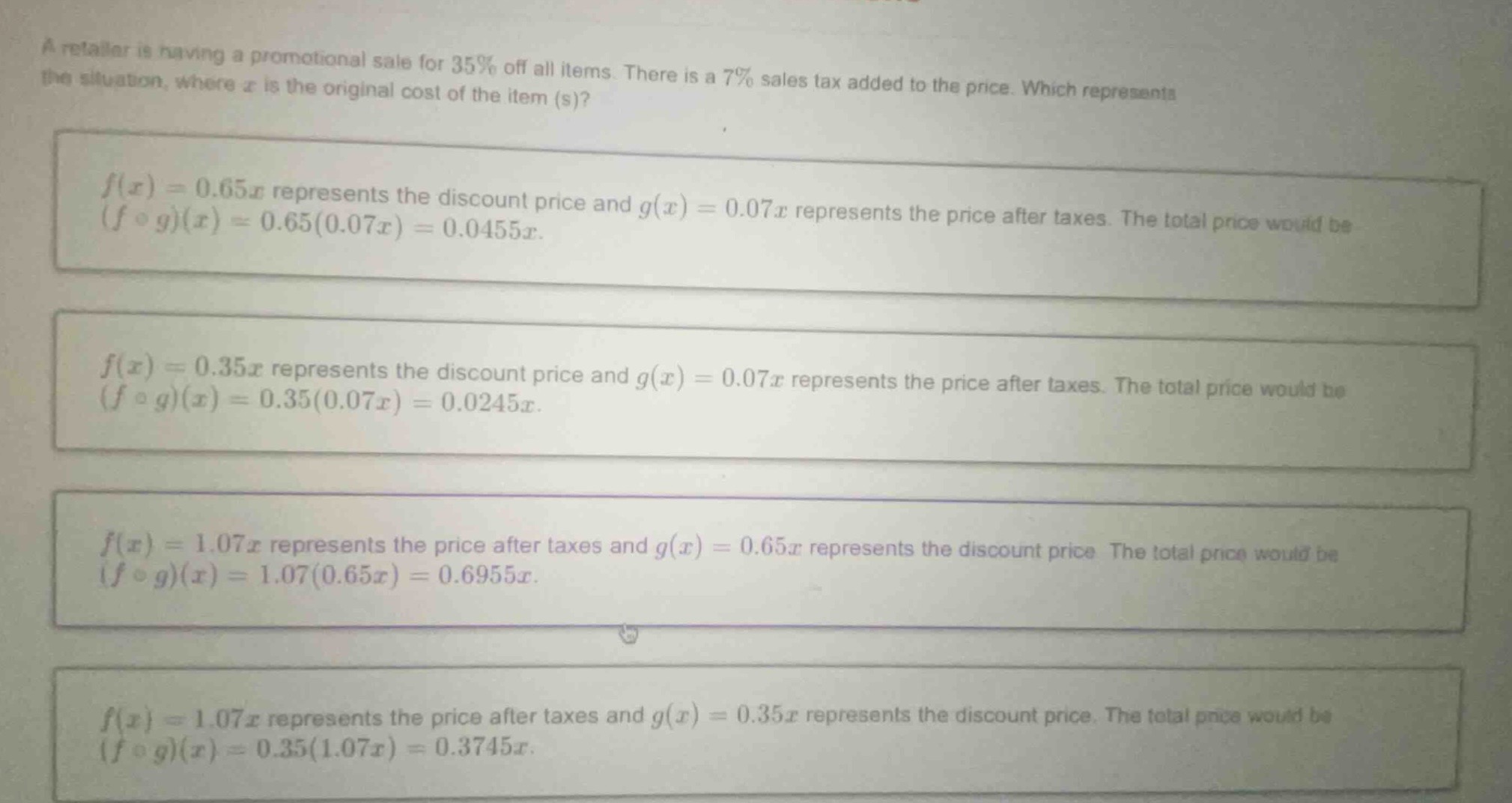
a retailer is having a promotional sale for 35% off all items. there is a 7% sales tax added to the price. which represents the situation, where x is the original cost of the item ($)?
$f(x) = 0.65x$ represents the discount price and $g(x) = 0.07x$ represents the price after taxes. the total price would be $(f \circ g)(x) = 0.65(0.07x) = 0.0455x$.
$f(x) = 0.35x$ represents the discount price and $g(x) = 0.07x$ represents the price after taxes. the total price would be $(f \circ g)(x) = 0.35(0.07x) = 0.0245x$.
$f(x) = 1.07x$ represents the price after taxes and $g(x) = 0.65x$ represents the discount price. the total price would be $(f \circ g)(x) = 1.07(0.65x) = 0.6955x$.
$f(x) = 1.07x$ represents the price after taxes and $g(x) = 0.35x$ represents the discount price. the total price would be $(f \circ g)(x) = 0.35(1.07x) = 0.3745x$.
Step1: Calculate discount price
If there is a 35% discount, the customer pays 65% of the original price, so the discount price function is $g(x)=0.65x$.
Step2: Calculate tax-inclusive price
A 7% sales tax means the final price is 107% of the discounted price, so the tax function is $f(x)=1.07x$.
Step3: Compute composite function
We apply the tax to the discounted price, so $(f\circ g)(x)=f(g(x))=1.07(0.65x)$.
Calculate the product: $1.07\times0.65=0.6955$, so $(f\circ g)(x)=0.6955x$.

Snap & solve any problem in the app
Get step-by-step solutions on Sovi AI
Photo-based solutions with guided steps
Explore more problems and detailed explanations
$f(x) = 1.07x$ represents the price after taxes and $g(x) = 0.65x$ represents the discount price. The total price would be $(f \circ g)(x) = 1.07(0.65x) = 0.6955x$.