QUESTION IMAGE
Question
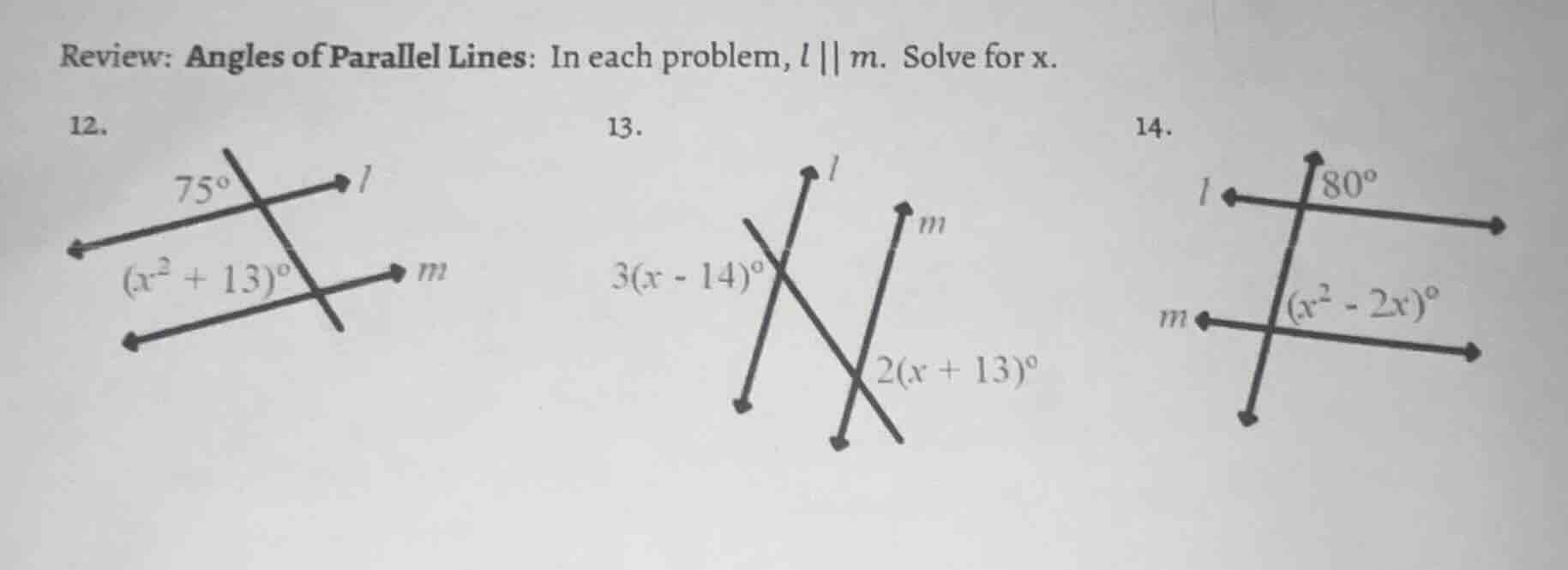
review: angles of parallel lines: in each problem, ( l parallel m ). solve for ( x ).
12.
13.
14.
Problem 12
Step 1: Identify the relationship
Since \( l \parallel m \), the angles \( 75^\circ \) and \( (x^2 + 13)^\circ \) are equal (corresponding angles or alternate interior angles, depending on the transversal). So we set up the equation:
\( x^2 + 13 = 75 \)
Step 2: Solve the quadratic equation
Subtract 13 from both sides:
\( x^2 = 75 - 13 \)
\( x^2 = 62 \)
Take the square root of both sides:
\( x = \pm\sqrt{62} \)
But since we are dealing with angle measures in a typical geometry problem (and usually we consider positive values for the context here, but let's check if the problem implies a positive solution. However, maybe I made a mistake. Wait, maybe the angles are alternate interior or corresponding, so they should be equal. Wait, maybe I misread. Wait, the diagram: the two angles are on the same side? Wait, no, maybe they are equal. Wait, but \( x^2 +13 =75 \), so \( x^2=62 \), so \( x=\sqrt{62}\approx7.87 \) or \( x=-\sqrt{62} \). But in geometry, we usually take positive values, so \( x = \sqrt{62} \) or \( x = -\sqrt{62} \), but maybe the problem expects a positive solution, so \( x = \sqrt{62} \approx 7.87 \), but let's check again. Wait, maybe the angles are supplementary? Wait, no, if the lines are parallel, and the transversal cuts them, then if they are same - side interior angles, they are supplementary, but if alternate interior or corresponding, they are equal. Let's look at the diagram: the two angles are on the same side? Wait, the first angle is \( 75^\circ \) and the second is \( (x^2 +13)^\circ \) on the other line. So maybe they are equal (corresponding). So the equation is \( x^2 +13 =75 \), so \( x^2 = 62 \), so \( x=\pm\sqrt{62} \). But maybe the problem has a typo, or maybe I misinterpret. Wait, maybe the angle is \( 75^\circ \) and the other is \( (x^2 +13)^\circ \), so \( x^2=62 \), so \( x = \sqrt{62} \) or \( x = -\sqrt{62} \). But since we are dealing with a geometry problem, we can write \( x=\sqrt{62} \) or \( x = -\sqrt{62} \), but usually, we take the positive root, so \( x=\sqrt{62}\approx7.87 \). But maybe I made a mistake. Wait, maybe the angles are supplementary? Let's check: if they are same - side interior angles, then \( 75+(x^2 +13)=180 \), so \( x^2 +88 = 180 \), \( x^2=92 \), \( x=\sqrt{92}\approx9.59 \). But the diagram is not very clear, but the problem says "solve for x". Let's assume they are equal (corresponding angles), so \( x^2 +13 =75 \), so \( x^2 = 62 \), \( x=\pm\sqrt{62} \).
Problem 13
Step 1: Identify the relationship
Since \( l \parallel m \), the angles \( 3(x - 14)^\circ \) and \( 2(x + 13)^\circ \) are equal (corresponding angles or alternate interior angles, depending on the transversal and the intersection of the lines). So we set up the equation:
\( 3(x - 14)=2(x + 13) \)
Step 2: Solve the linear equation
Expand both sides:
\( 3x-42 = 2x + 26 \)
Subtract \( 2x \) from both sides:
\( 3x-2x-42=2x - 2x+26 \)
\( x - 42=26 \)
Add 42 to both sides:
\( x=26 + 42 \)
\( x = 68 \)
Problem 14
Step 1: Identify the relationship
Since \( l \parallel m \), the angle \( 80^\circ \) and \( (x^2 - 2x)^\circ \) are equal (corresponding angles or alternate interior angles, or maybe supplementary? Wait, let's look at the diagram. The \( 80^\circ \) angle and \( (x^2 - 2x)^\circ \) angle: if they are corresponding angles, they are equal, or if they are same - side interior angles, they are supplementary. Wait, the diagram: the \( 80^\circ \) angle is above the line \( l \), and \( (x^2 - 2x)^\circ \) is below the line \( m \). Wait, maybe they are equal (corresponding) or supplementary. Let's check: if they are equal, then \( x^2 - 2x=80 \), if supplementary, \( x^2 - 2x + 80 = 180 \). Let's try equal first.
Step 2: Solve the quadratic equation (case 1: equal angles)
Set \( x^2 - 2x=80 \)
Rearrange to standard quadratic form:
\( x^2 - 2x - 80 = 0 \)
Factor the quadratic:
We need two numbers that multiply to - 80 and add to - 2. The numbers are - 10 and 8.
\( (x - 10)(x + 8)=0 \)
Set each factor equal to zero:
\( x - 10 = 0 \) or \( x + 8 = 0 \)
\( x = 10 \) or \( x=-8 \)
Now check the supplementary case: \( x^2 - 2x+80 = 180 \)
\( x^2 - 2x - 100 = 0 \)
Using the quadratic formula \( x=\frac{2\pm\sqrt{4 + 400}}{2}=\frac{2\pm\sqrt{404}}{2}=\frac{2\pm2\sqrt{101}}{2}=1\pm\sqrt{101}\approx1\pm10.05 \), so \( x\approx11.05 \) or \( x\approx - 9.05 \). But in the context of angle measures, \( x = 10 \) gives \( x^2-2x=100 - 20 = 80 \), which matches the other angle, so that makes sense. \( x=-8 \) would give \( x^2 - 2x=64 + 16 = 80 \) as well, but in geometry, we usually take positive values for \( x \) (since it's a variable representing a length - related quantity in the angle formula), so \( x = 10 \) is the more reasonable solution.
Final Answers
- Problem 12: \( x=\pm\sqrt{62}\approx\pm7.87 \) (if we consider the equal angle relationship)
- Problem 13: \( x = 68 \)
- Problem 14: \( x = 10 \) (or \( x=-8 \), but \( x = 10 \) is more reasonable)
(Note: The answers depend on the correct identification of the angle relationships from the diagrams, which we inferred based on typical parallel line angle properties.)
For Problem 12, if we assume the angles are equal (corresponding/alternate interior), \( x=\pm\sqrt{62}\approx\pm7.87 \)
For Problem 13, \( x = 68 \)
For Problem 14, \( x = 10 \) (choosing the positive solution that makes sense in the geometric context)

Snap & solve any problem in the app
Get step-by-step solutions on Sovi AI
Photo-based solutions with guided steps
Explore more problems and detailed explanations
Step 1: Identify the relationship
Since \( l \parallel m \), the angle \( 80^\circ \) and \( (x^2 - 2x)^\circ \) are equal (corresponding angles or alternate interior angles, or maybe supplementary? Wait, let's look at the diagram. The \( 80^\circ \) angle and \( (x^2 - 2x)^\circ \) angle: if they are corresponding angles, they are equal, or if they are same - side interior angles, they are supplementary. Wait, the diagram: the \( 80^\circ \) angle is above the line \( l \), and \( (x^2 - 2x)^\circ \) is below the line \( m \). Wait, maybe they are equal (corresponding) or supplementary. Let's check: if they are equal, then \( x^2 - 2x=80 \), if supplementary, \( x^2 - 2x + 80 = 180 \). Let's try equal first.
Step 2: Solve the quadratic equation (case 1: equal angles)
Set \( x^2 - 2x=80 \)
Rearrange to standard quadratic form:
\( x^2 - 2x - 80 = 0 \)
Factor the quadratic:
We need two numbers that multiply to - 80 and add to - 2. The numbers are - 10 and 8.
\( (x - 10)(x + 8)=0 \)
Set each factor equal to zero:
\( x - 10 = 0 \) or \( x + 8 = 0 \)
\( x = 10 \) or \( x=-8 \)
Now check the supplementary case: \( x^2 - 2x+80 = 180 \)
\( x^2 - 2x - 100 = 0 \)
Using the quadratic formula \( x=\frac{2\pm\sqrt{4 + 400}}{2}=\frac{2\pm\sqrt{404}}{2}=\frac{2\pm2\sqrt{101}}{2}=1\pm\sqrt{101}\approx1\pm10.05 \), so \( x\approx11.05 \) or \( x\approx - 9.05 \). But in the context of angle measures, \( x = 10 \) gives \( x^2-2x=100 - 20 = 80 \), which matches the other angle, so that makes sense. \( x=-8 \) would give \( x^2 - 2x=64 + 16 = 80 \) as well, but in geometry, we usually take positive values for \( x \) (since it's a variable representing a length - related quantity in the angle formula), so \( x = 10 \) is the more reasonable solution.
Final Answers
- Problem 12: \( x=\pm\sqrt{62}\approx\pm7.87 \) (if we consider the equal angle relationship)
- Problem 13: \( x = 68 \)
- Problem 14: \( x = 10 \) (or \( x=-8 \), but \( x = 10 \) is more reasonable)
(Note: The answers depend on the correct identification of the angle relationships from the diagrams, which we inferred based on typical parallel line angle properties.)
For Problem 12, if we assume the angles are equal (corresponding/alternate interior), \( x=\pm\sqrt{62}\approx\pm7.87 \)
For Problem 13, \( x = 68 \)
For Problem 14, \( x = 10 \) (choosing the positive solution that makes sense in the geometric context)