QUESTION IMAGE
Question
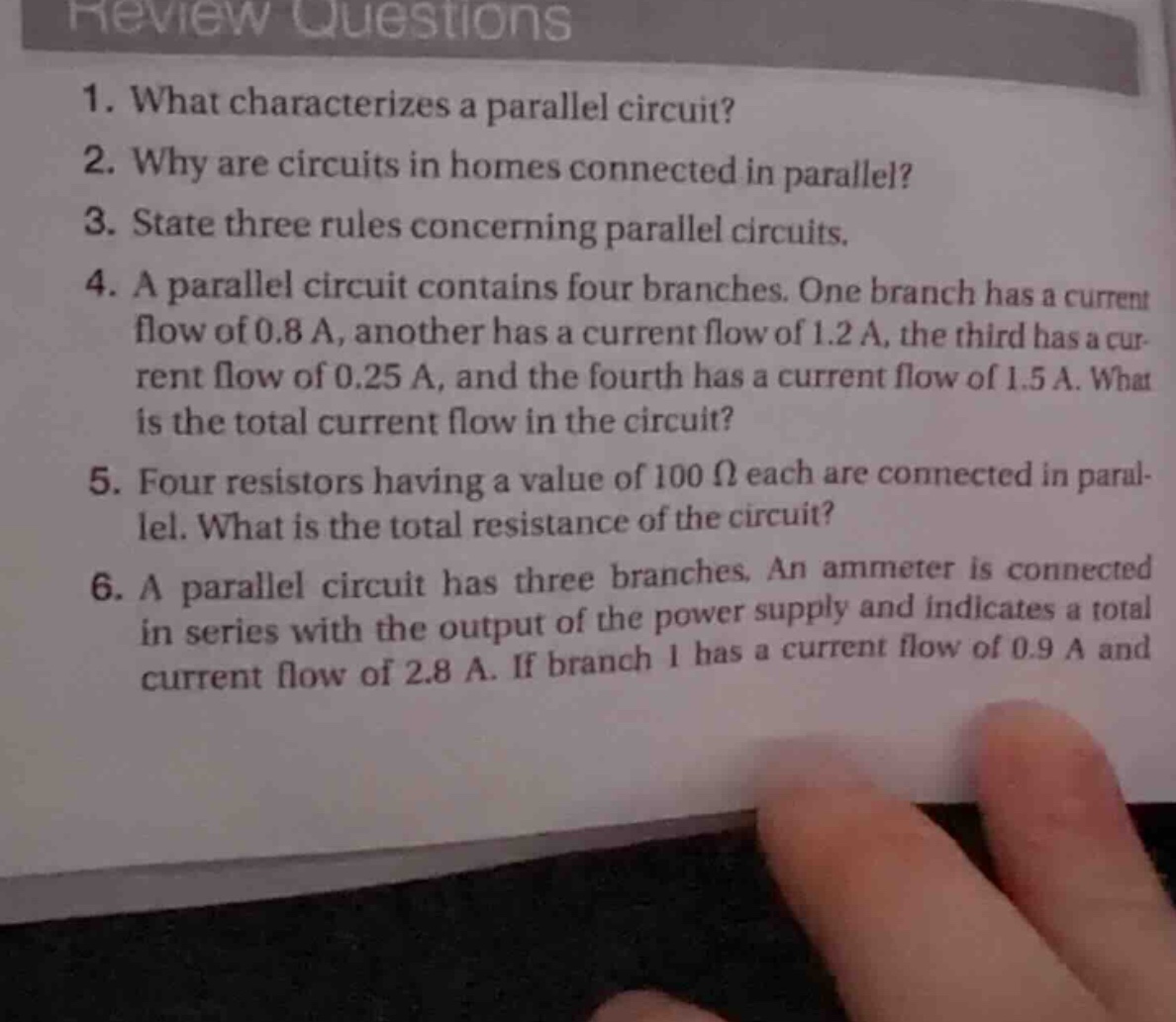
review questions
- what characterizes a parallel circuit?
- why are circuits in homes connected in parallel?
- state three rules concerning parallel circuits.
- a parallel circuit contains four branches. one branch has a current flow of 0.8 a, another has a current flow of 1.2 a, the third has a current flow of 0.25 a, and the fourth has a current flow of 1.5 a. what is the total current flow in the circuit?
- four resistors having a value of 100 ω each are connected in parallel. what is the total resistance of the circuit?
- a parallel circuit has three branches. an ammeter is connected in series with the output of the power supply and indicates a total current flow of 2.8 a. if branch 1 has a current flow of 0.9 a and
Brief Explanations
- A parallel circuit is defined by components connected across the same two common nodes, creating multiple separate current paths from the power source.
- Home circuits use parallel connections to ensure each device receives the full source voltage, devices operate independently (one failing doesn't affect others), and total current capacity increases with more devices.
- Key parallel circuit rules:
- Voltage across all branches is equal to the source voltage ($V_{total}=V_1=V_2=V_3=...$)
- Total current equals the sum of branch currents ($I_{total}=I_1+I_2+I_3+...$)
- Total resistance is calculated by $\frac{1}{R_{total}}=\frac{1}{R_1}+\frac{1}{R_2}+\frac{1}{R_3}+...$ (and is always less than the smallest branch resistance)
Step1: Sum all branch currents
$I_{total}=0.8\ \text{A} + 1.2\ \text{A} + 0.25\ \text{A} + 1.5\ \text{A}$
Step2: Calculate total current
$I_{total}=3.75\ \text{A}$
Step1: Apply parallel resistance formula
$\frac{1}{R_{total}}=\frac{1}{100\ \Omega}+\frac{1}{100\ \Omega}+\frac{1}{100\ \Omega}+\frac{1}{100\ \Omega}$
Step2: Simplify the right-hand side
$\frac{1}{R_{total}}=\frac{4}{100\ \Omega}$
Step3: Solve for total resistance
$R_{total}=\frac{100\ \Omega}{4}=25\ \Omega$
Step1: Subtract known branch current from total current
$I_3=I_{total}-I_1=2.8\ \text{A} - 0.9\ \text{A}$
Step2: Calculate remaining branch current
$I_3=1.9\ \text{A}$

Snap & solve any problem in the app
Get step-by-step solutions on Sovi AI
Photo-based solutions with guided steps
Explore more problems and detailed explanations
- A parallel circuit is characterized by multiple components connected across the same two common points, creating separate parallel current paths from the power supply.
- Home circuits are parallel so each device receives the full household voltage, devices operate independently (if one fails, others keep working), and additional devices can be added without reducing voltage to existing ones.
- 1. The voltage across every branch equals the source voltage.
- The total current is the sum of the currents in each individual branch.
- The reciprocal of total resistance equals the sum of reciprocals of each branch's resistance.
- $3.75\ \text{A}$
- $25\ \Omega$
- $1.9\ \text{A}$