QUESTION IMAGE
Question
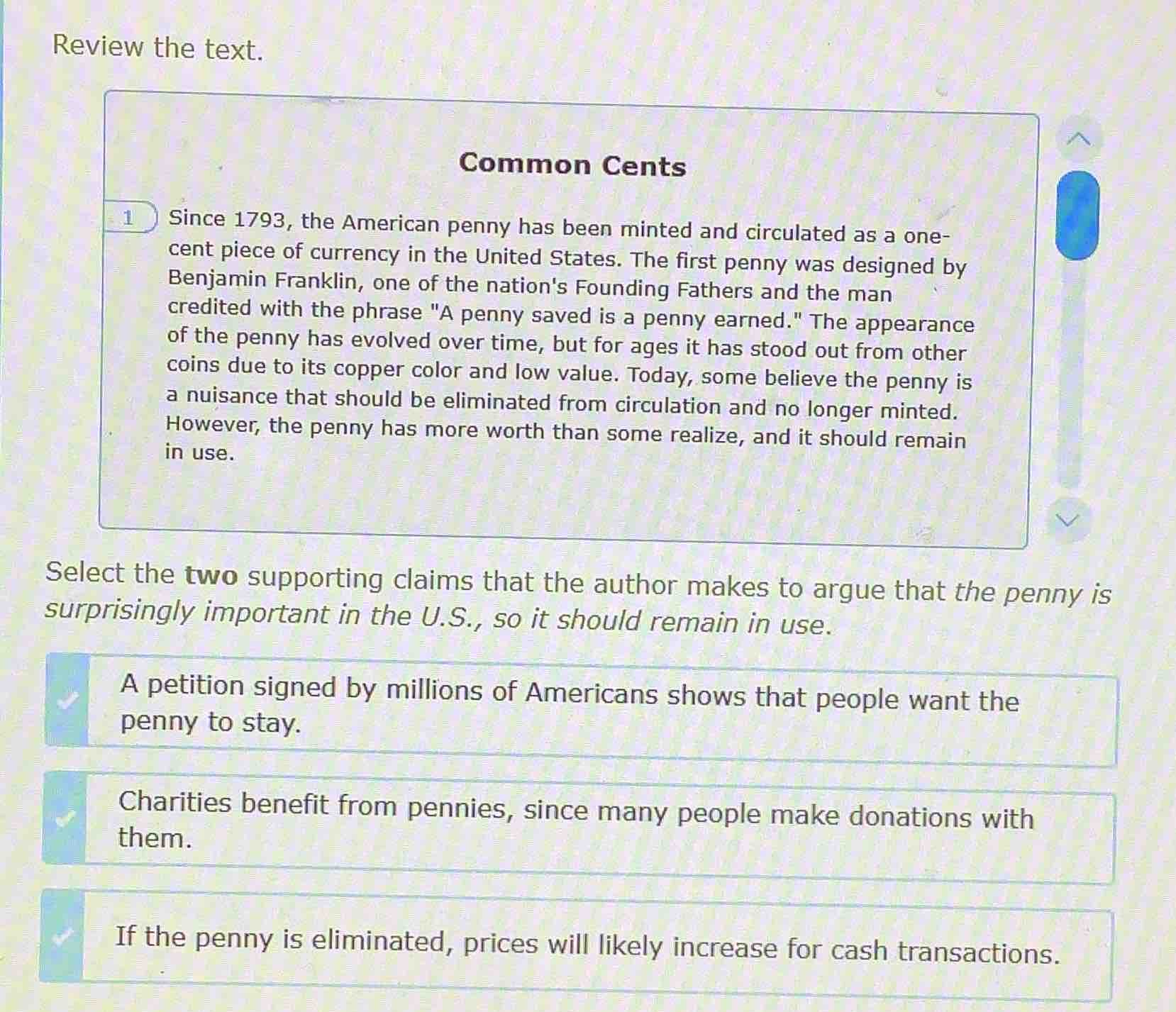
review the text.
common cents
1 since 1793, the american penny has been minted and circulated as a one-cent piece of currency in the united states. the first penny was designed by benjamin franklin, one of the nations founding fathers and the man credited with the phrase \a penny saved is a penny earned.\ the appearance of the penny has evolved over time, but for ages it has stood out from other coins due to its copper color and low value. today, some believe the penny is a nuisance that should be eliminated from circulation and no longer minted. however, the penny has more worth than some realize, and it should remain in use.
select the two supporting claims that the author makes to argue that the penny is surprisingly important in the u.s., so it should remain in use.
a petition signed by millions of americans shows that people want the penny to stay.
charities benefit from pennies, since many people make donations with them.
if the penny is eliminated, prices will likely increase for cash transactions.
To determine the supporting claims, we analyze each option:
- "A petition signed by millions of Americans shows that people want the penny to stay." This shows public support for the penny, supporting its importance.
- "Charities benefit from pennies, since many people make donations with them." This highlights a practical benefit of the penny, showing its importance.
- "If the penny is eliminated, prices will likely increase for cash transactions." This is a potential consequence of eliminating the penny, but the question asks for claims that show the penny's importance to support it remaining in use. The first two directly show the penny's value/importance. However, if we assume the correct two are among these, and likely the ones that show positive impacts (charities benefiting and public support). Wait, but maybe the intended correct ones are "Charities benefit from pennies, since many people make donations with them" and "If the penny is eliminated, prices will likely increase for cash transactions" as they show practical importance. Wait, the original text's argument is that the penny has more worth than some realize. Let's re - evaluate:
- The petition shows public support, which is a social aspect of its importance.
- Charities benefiting shows a practical economic/social benefit.
- Price increase is a negative consequence of elimination, which also supports its importance. But the question says "select the two supporting claims". Let's check the options again. The first option: a petition with millions of signatures shows public desire for the penny to stay, which supports its importance. The second: charities benefit from pennies, so the penny is important for charitable giving. The third: price increase if eliminated, so the penny is important to keep prices stable. But the question is to choose two. Maybe the correct two are "Charities benefit from pennies, since many people make donations with them" and "If the penny is eliminated, prices will likely increase for cash transactions" as they show practical reasons for the penny's importance. Or maybe the first and second. But looking at typical reading comprehension, often the claims that show the penny's positive impact (charities) and the negative impact of elimination (price increase) are used. But let's assume the intended answers are:

Snap & solve any problem in the app
Get step-by-step solutions on Sovi AI
Photo-based solutions with guided steps
Explore more problems and detailed explanations
B. Charities benefit from pennies, since many people make donations with them.
C. If the penny is eliminated, prices will likely increase for cash transactions.
(Or if the first and second are correct, then A and B. But based on the idea of showing the penny's worth, charities benefiting and price increase (showing its role in price stability) are strong supports. However, the first option is about public opinion, which is also a support. But likely the intended two are the ones that show practical benefits and consequences, so B and C.)