QUESTION IMAGE
Question
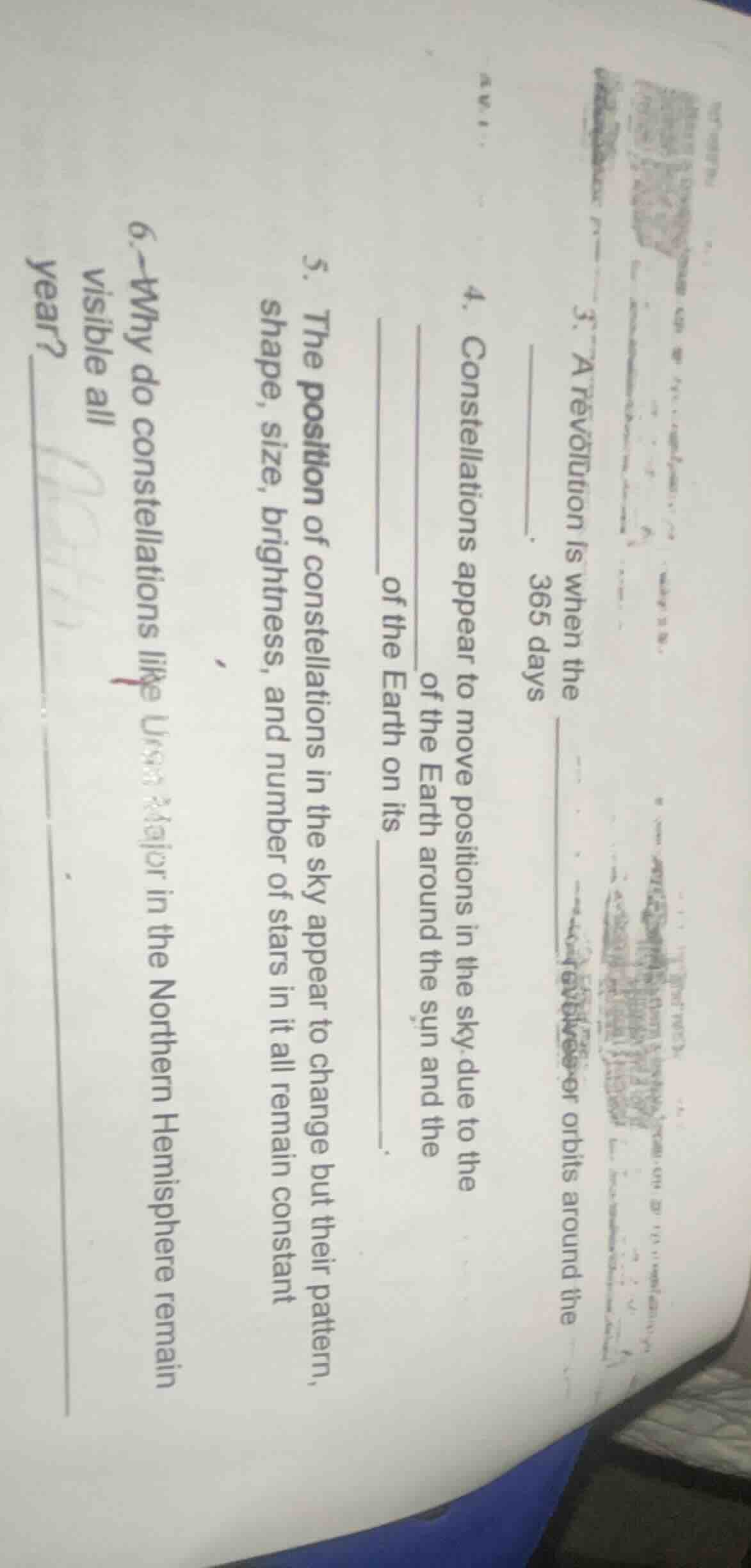
- a revolution is when the
365 days
- constellations appear to move positions in the sky due to the
of the earth around the sun and the
of the earth on its
- the position of constellations in the sky appear to change but their pattern, shape, size, brightness, and number of stars in it all remain constant
- why do constellations like ursa major in the northern hemisphere remain visible all year?
Question 3
A revolution in the context of celestial bodies is when a planet (like Earth) orbits around the Sun. The time taken for Earth to complete one revolution around the Sun is approximately 365 days. So the blanks should be filled with "Earth", "Sun", and "takes about" (or similar to complete the sentence: "A revolution is when the Earth revolves/orbits around the Sun. It takes about 365 days").
Constellations appear to move positions in the sky due to two main motions of the Earth: the revolution of the Earth around the Sun and the rotation of the Earth on its axis. The revolution causes the seasonal change in constellation visibility, and the rotation causes the daily apparent motion of stars and constellations across the sky.
The position of constellations in the sky appears to change, but their pattern, shape, size, brightness, and number of stars in them remain constant because the stars in a constellation are at a very large (and relatively fixed with respect to each other) distance from Earth. The apparent change in position is due to Earth's motion (revolution and rotation), but the actual arrangement of stars in a constellation (their pattern) is stable over human timescales as the stars are part of the same stellar system or are at similar distances (or the relative motion between them is very slow).

Snap & solve any problem in the app
Get step-by-step solutions on Sovi AI
Photo-based solutions with guided steps
Explore more problems and detailed explanations
First blank: Earth
Second blank: Sun
Third blank: takes about