QUESTION IMAGE
Question
rewriting literal equations
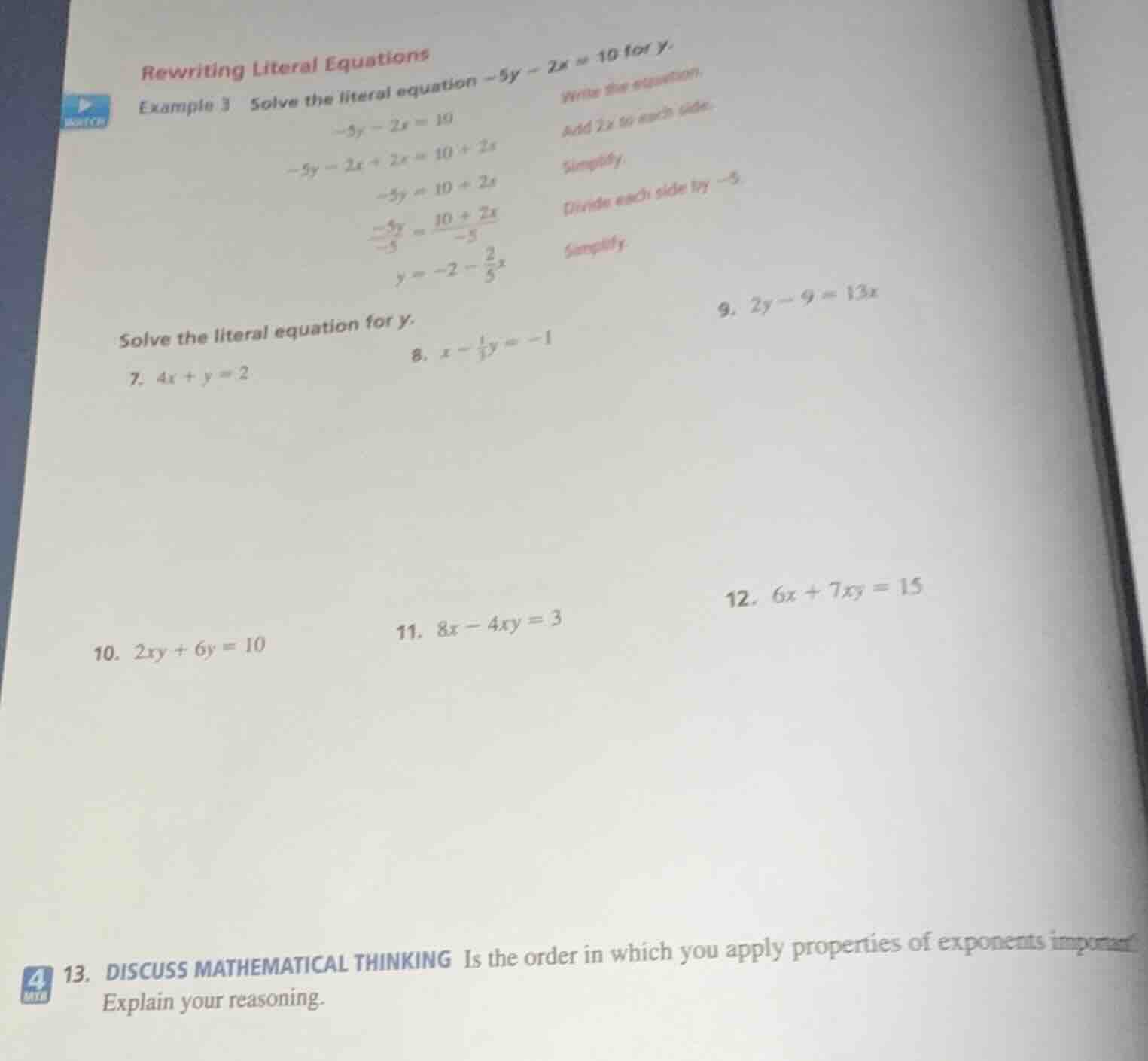
example 3 solve the literal equation -5y - 2x = 10 for y.
-5y - 2x = 10
-5y - 2x + 2x = 10 + 2x
-5y = 10 + 2x
\frac{-5y}{-5} = \frac{10 + 2x}{-5}
y = -2 - \frac{2}{5}x
solve the literal equation for y.
- 4x + y = 2
- x - \frac{1}{3}y = -1
- 2y - 9 = 13x
- 2xy + 6y = 10
- 8x - 4xy = 3
- 6x + 7xy = 15
- discuss mathematical thinking is the order in which you apply properties of exponents important?
explain your reasoning.
7. Step1: Isolate $y$
$4x + y = 2$
$y = 2 - 4x$
8. Step1: Isolate $y$-term
$x - \frac{1}{4}y = -1$
$-\frac{1}{4}y = -1 - x$
8. Step2: Multiply by -4
$y = (-1 - x) \times (-4)$
$y = 4 + 4x$
9. Step1: Isolate $2y$
$2y - 9 = 13x$
$2y = 13x + 9$
9. Step2: Divide by 2
$y = \frac{13x + 9}{2}$
$y = \frac{13}{2}x + \frac{9}{2}$
10. Step1: Factor out $y$
$2xy + 6y = 10$
$y(2x + 6) = 10$
10. Step2: Divide by $2x+6$
$y = \frac{10}{2x + 6}$
$y = \frac{5}{x + 3}$
11. Step1: Factor out $x$
$8x - 4xy = 3$
$x(8 - 4y) = 3$
11. Step2: Isolate $y$-term
$8 - 4y = \frac{3}{x}$
$-4y = \frac{3}{x} - 8$
11. Step3: Divide by -4
$y = \frac{8 - \frac{3}{x}}{4}$
$y = 2 - \frac{3}{4x}$
12. Step1: Isolate $y$-term
$6x + 7xy = 15$
$7xy = 15 - 6x$
12. Step2: Divide by $7x$
$y = \frac{15 - 6x}{7x}$
$y = \frac{15}{7x} - \frac{6}{7}$
13. Step1: Explain exponent order importance
Exponent properties (e.g., $(a^m)^n=a^{mn}$, $a^m \cdot a^n=a^{m+n}$) have strict rules. Swapping order can lead to different results. For example, $(2^3)^2=2^6=64$, but $2^{(3^2)}=2^9=512$.

Snap & solve any problem in the app
Get step-by-step solutions on Sovi AI
Photo-based solutions with guided steps
Explore more problems and detailed explanations
- $y = 2 - 4x$
- $y = 4 + 4x$
- $y = \frac{13}{2}x + \frac{9}{2}$
- $y = \frac{5}{x + 3}$
- $y = 2 - \frac{3}{4x}$
- $y = \frac{15}{7x} - \frac{6}{7}$
- Yes, the order of applying exponent properties is important. Different orders can produce different results, as exponent properties follow specific hierarchical rules (e.g., power of a power vs. exponentiation of a base to a power of a power yield distinct values).