QUESTION IMAGE
Question
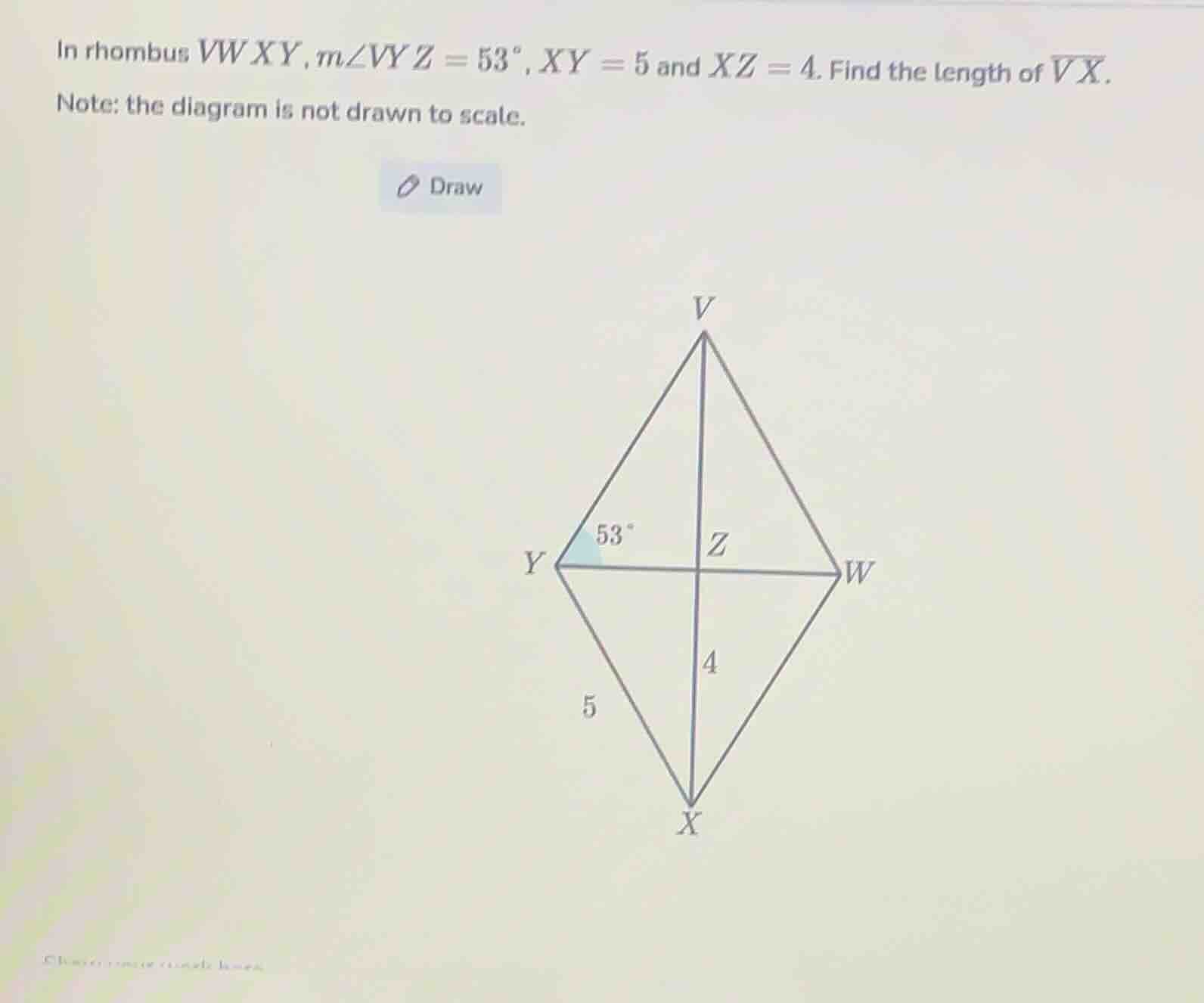
in rhombus vwxy, m∠vyz = 53°, xy = 5 and xz = 4. find the length of (overline{vx}). note: the diagram is not drawn to scale.
Step1: Recall properties of a rhombus
In a rhombus, the diagonals bisect each other at right angles? Wait, no, actually, the diagonals of a rhombus bisect the angles and bisect each other. Also, all sides of a rhombus are equal. So \( XY = VY = 5 \) (since all sides of a rhombus are equal). Also, \( XZ = 4 \), and we need to find \( VX \). Wait, looking at the diagram, \( Z \) is the intersection of the diagonals? Wait, no, in the diagram, \( VX \) is a diagonal? Wait, no, \( VX \) is a side? Wait, no, the problem says "Find the length of \( \overline{VX} \)". Wait, in the rhombus \( VWXY \), so the vertices are \( V, W, X, Y \). So \( XY \) is a side, length 5. \( XZ = 4 \), and \( \angle VYZ = 53^\circ \). Wait, maybe triangle \( VYZ \) is a triangle where we can use trigonometry? Wait, no, maybe \( VX \) is composed of \( VZ \) and \( XZ \), since \( Z \) is on \( VX \). So \( VX = VZ + XZ \). We know \( XZ = 4 \), so we need to find \( VZ \).
In triangle \( VYZ \), we have \( \angle VYZ = 53^\circ \), \( VY = 5 \) (side of rhombus), and \( \angle YZV = 90^\circ \)? Wait, are the diagonals of a rhombus perpendicular? Yes! The diagonals of a rhombus are perpendicular bisectors of each other. So triangle \( VYZ \) is a right triangle with right angle at \( Z \). So \( \sin(53^\circ) = \frac{VZ}{VY} \).
Step2: Calculate \( VZ \)
Since \( \sin(\theta) = \frac{\text{opposite}}{\text{hypotenuse}} \), here \( \theta = 53^\circ \), opposite side is \( VZ \), hypotenuse is \( VY = 5 \). So \( \sin(53^\circ) = \frac{VZ}{5} \). We know that \( \sin(53^\circ) \approx 0.8 \) (since \( \sin(53^\circ) \approx \frac{4}{5} \) from 3-4-5 triangle, as \( \sin(53^\circ) \approx 0.8 \), \( \cos(53^\circ) \approx 0.6 \)). So \( VZ = 5 \times \sin(53^\circ) \approx 5 \times 0.8 = 4 \)? Wait, no, that can't be. Wait, maybe \( \cos(53^\circ) \)? Wait, no, let's check. If \( \angle VYZ = 53^\circ \), then in right triangle \( VYZ \), \( \cos(53^\circ) = \frac{YZ}{VY} \), and \( \sin(53^\circ) = \frac{VZ}{VY} \). Wait, \( VY = 5 \), so \( VZ = VY \times \sin(53^\circ) \approx 5 \times 0.8 = 4 \). Then \( VX = VZ + XZ = 4 + 4 = 8 \)? Wait, but that seems too simple. Wait, maybe I made a mistake. Wait, \( XZ = 4 \), and if \( VZ = 4 \), then \( VX = 8 \). But let's verify.
Wait, alternatively, maybe using the Pythagorean theorem. In triangle \( VYZ \), right-angled at \( Z \), \( VY = 5 \), \( YZ \) can be found by \( \cos(53^\circ) = \frac{YZ}{5} \), so \( YZ = 5 \times \cos(53^\circ) \approx 5 \times 0.6 = 3 \). Then, by Pythagoras, \( VZ = \sqrt{VY^2 - YZ^2} = \sqrt{25 - 9} = \sqrt{16} = 4 \). Ah, there we go. So \( VZ = 4 \). Then, since \( XZ = 4 \), and \( VZ + XZ = VX \) (because \( Z \) is on \( VX \)), so \( VX = 4 + 4 = 8 \).
Wait, but let's confirm the properties. Diagonals of a rhombus are perpendicular bisectors, so they bisect each other. So \( VZ = XZ \)? No, wait, no. Wait, the diagonals bisect each other, so \( VZ = XZ \) only if the diagonals are equal, but in a rhombus, diagonals are not equal unless it's a square. Wait, no, I think I messed up the diagram. Wait, in the diagram, \( XZ = 4 \), and \( VX \) is a diagonal, with \( Z \) being the midpoint? No, maybe \( Z \) is not the midpoint. Wait, the problem says "Note: the diagram is not drawn to scale." So maybe \( VX \) is a side? No, \( XY \) is a side, length 5. Wait, maybe \( VX \) is a side, but \( XY \) is also a side, so \( VX = XY = 5 \)? But that contradicts the diagram. Wait, no, the diagram shows \( XZ = 4 \), and \( VX \) is a diagonal? Wait, I think I made a mistake…

Snap & solve any problem in the app
Get step-by-step solutions on Sovi AI
Photo-based solutions with guided steps
Explore more problems and detailed explanations
\( \boxed{8} \)