QUESTION IMAGE
Question
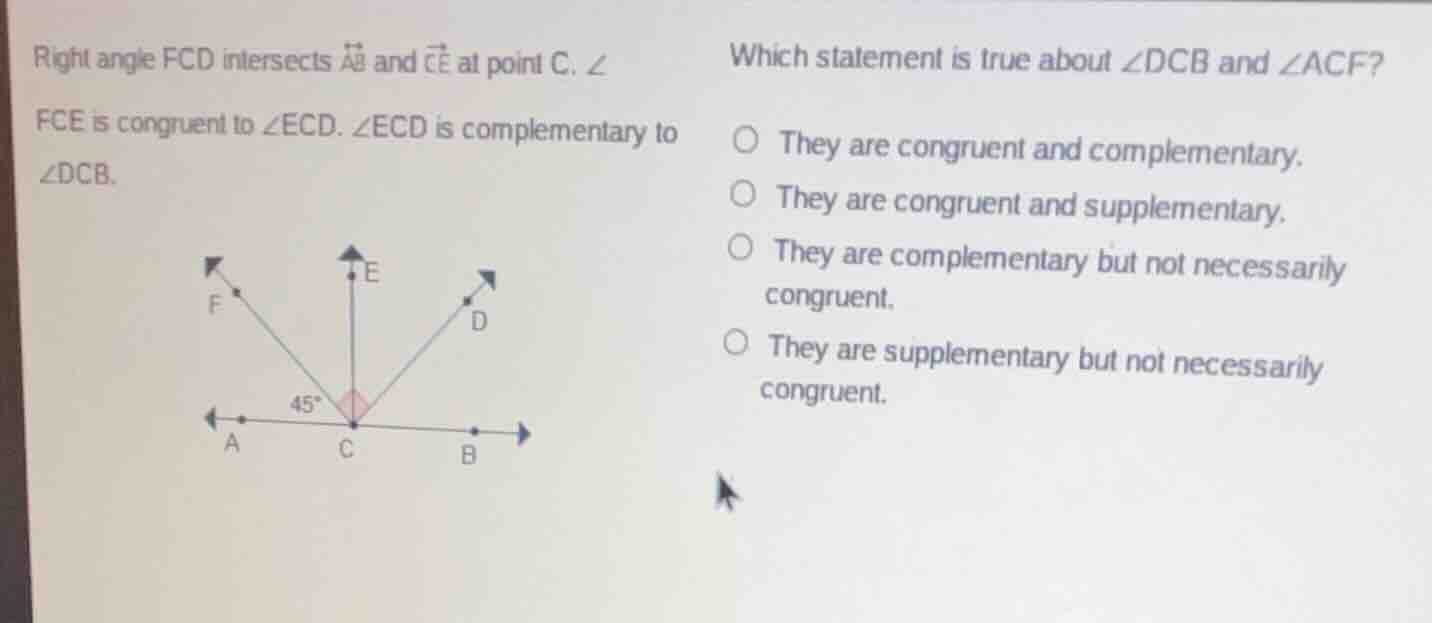
right angle fcd intersects \\(\overleftrightarrow{ab}\\) and \\(\overleftrightarrow{ce}\\) at point c. \\(\angle fce\\) is congruent to \\(\angle ecd\\). \\(\angle ecd\\) is complementary to \\(\angle dcb\\). which statement is true about \\(\angle dcb\\) and \\(\angle acf\\)? \\(\bigcirc\\) they are congruent and complementary. \\(\bigcirc\\) they are congruent and supplementary. \\(\bigcirc\\) they are complementary but not necessarily congruent. \\(\bigcirc\\) they are supplementary but not necessarily congruent.
Step1: Analyze ∠FCE and ∠ECD
Given ∠FCE ≅ ∠ECD and ∠FCD is a right angle (90°), so ∠FCE + ∠ECD = 90°. Since they are congruent, each is 45° (∠FCE = ∠ECD = 45°).
Step2: Analyze ∠ECD and ∠DCB
∠ECD is complementary to ∠DCB, so ∠ECD + ∠DCB = 90°. Since ∠ECD = 45°, ∠DCB = 90° - 45° = 45°.
Step3: Analyze ∠ACF
From the diagram, ∠ACF is 45° (given as 45° at point C on line AB).
Step4: Compare ∠DCB and ∠ACF
∠DCB = 45°, ∠ACF = 45°, so they are congruent. Also, their sum is 45° + 45° = 90°, so they are complementary.

Snap & solve any problem in the app
Get step-by-step solutions on Sovi AI
Photo-based solutions with guided steps
Explore more problems and detailed explanations
They are congruent and complementary.