QUESTION IMAGE
Question
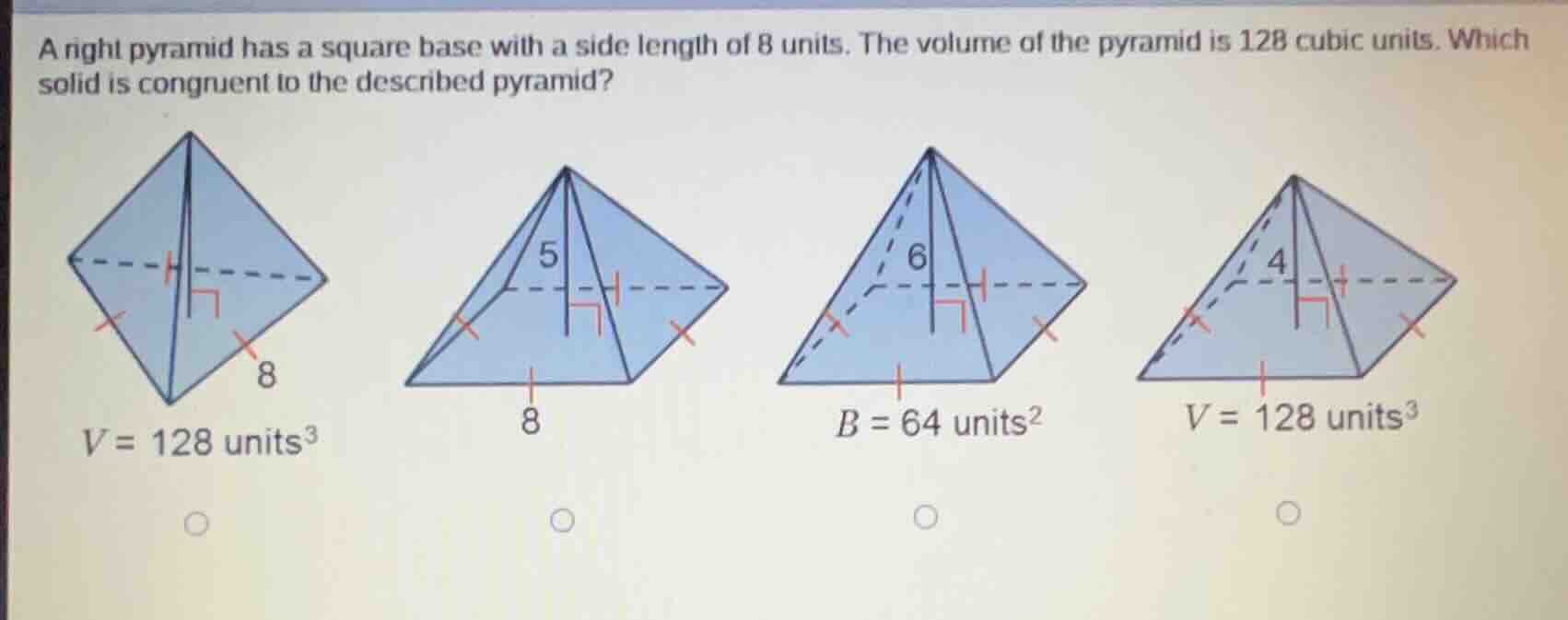
a right pyramid has a square base with a side length of 8 units. the volume of the pyramid is 128 cubic units. which solid is congruent to the described pyramid? (four pyramid figures with some labels: first has v = 128 units³ and base side 8; second has height 5, base side 8; third has b = 64 units², height 6; fourth has height 4, v = 128 units³)
Step1: Recall Pyramid Volume Formula
The volume \( V \) of a pyramid is given by \( V = \frac{1}{3}Bh \), where \( B \) is the area of the base and \( h \) is the height. For a square base with side length \( s \), \( B = s^2 \). Here, \( s = 8 \), so \( B = 8^2 = 64 \) square units.
Step2: Find Height of Given Pyramid
Using the volume formula \( V = \frac{1}{3}Bh \), substitute \( V = 128 \) and \( B = 64 \):
\( 128 = \frac{1}{3}(64)h \)
Multiply both sides by 3: \( 384 = 64h \)
Divide by 64: \( h = 6 \)? Wait, no—wait, let's recalculate. Wait, \( 128 = \frac{1}{3} \times 64 \times h \) → \( h = \frac{128 \times 3}{64} = 6 \)? Wait, no, wait the first figure: let's check each option.
Wait, the first option has volume 128, base side 8 (so \( B = 64 \)), and we can check height. But let's check congruence: congruent solids have same shape and size (same dimensions: base side, height, volume).
First figure: \( V = 128 \), base side 8 (so \( B = 64 \)), let's find height: \( 128 = \frac{1}{3} \times 64 \times h \) → \( h = \frac{128 \times 3}{64} = 6 \)? Wait, no, wait the third figure has \( B = 64 \) (base side 8, since \( 8^2 = 64 \)) and height 6? Wait, no, the third figure's height is labeled 6, base area 64 (so base side 8). Wait, but the given pyramid has base side 8, volume 128. Let's check the first option: it has base side 8 (marked 8), volume 128, so same base and volume. Let's confirm height: \( h = \frac{3V}{B} = \frac{3 \times 128}{64} = 6 \)? Wait, no, wait the first figure: the height—wait, maybe the first figure is a square pyramid with base side 8, volume 128, so same as the described pyramid. Wait, the options:
- First option: \( V = 128 \), base side 8 (so \( B = 64 \)), so height \( h = \frac{3 \times 128}{64} = 6 \)? Wait, no, maybe I miscalculated. Wait, \( 128 = \frac{1}{3} \times 64 \times h \) → \( h = 6 \). Wait, the third figure has \( B = 64 \) (base side 8) and height 6, so same as the calculated height. Wait, but the first figure: let's check the labels. The first figure has base side 8, volume 128, so same as the described pyramid. Wait, the problem says "which solid is congruent"—congruent means same dimensions (base side, height, volume). The first figure has base side 8, volume 128, so same as the given pyramid (base side 8, volume 128). Wait, but let's check the third figure: \( B = 64 \) (so base side 8), height 6, volume \( \frac{1}{3} \times 64 \times 6 = 128 \), which matches. Wait, but the first figure also has volume 128, base side 8. Wait, maybe the first figure is the congruent one. Wait, the first option: labeled \( V = 128 \) units³, base side 8, so same as the described pyramid (base side 8, volume 128). So the first solid (leftmost) is congruent.

Snap & solve any problem in the app
Get step-by-step solutions on Sovi AI
Photo-based solutions with guided steps
Explore more problems and detailed explanations
The first solid (with \( V = 128 \) units³ and base side 8) is congruent. (Assuming the first option is the leftmost with \( V = 128 \), base side 8.)