QUESTION IMAGE
Question
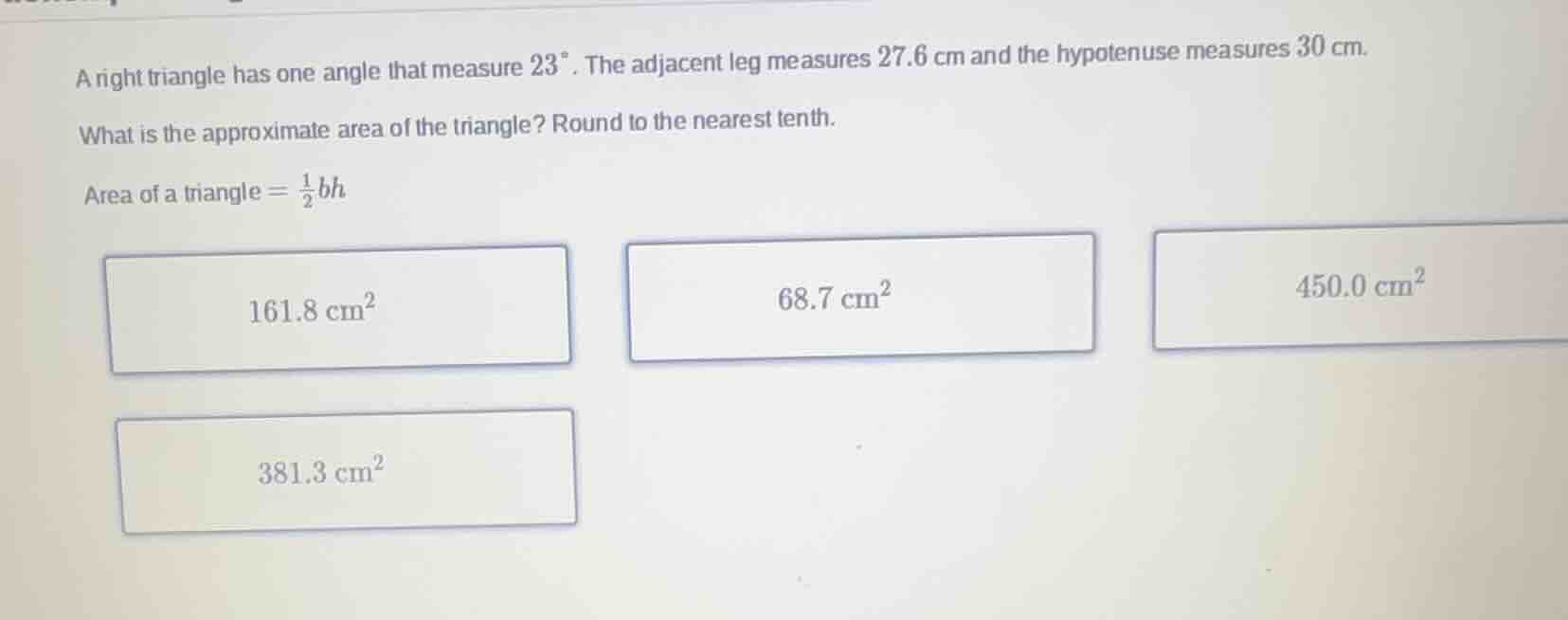
a right triangle has one angle that measure $23^{circ}$. the adjacent leg measures 27.6 cm and the hypotenuse measures 30 cm. what is the approximate area of the triangle? round to the nearest tenth. area of a triangle $= \frac{1}{2}bh$ $161.8\\ \mathrm{cm}^2$ $68.7\\ \mathrm{cm}^2$ $450.0\\ \mathrm{cm}^2$ $381.3\\ \mathrm{cm}^2$
Step1: Find the opposite leg (height)
We know in a right triangle, \(\cos\theta=\frac{\text{adjacent}}{\text{hypotenuse}}\) and \(\sin\theta=\frac{\text{opposite}}{\text{hypotenuse}}\). Here, \(\theta = 23^\circ\), adjacent \(= 27.6\) cm, hypotenuse \(= 30\) cm. First, we can also use \(\sin\) to find the opposite leg (let's call it \(h\)). \(\sin(23^\circ)=\frac{h}{30}\), so \(h = 30\times\sin(23^\circ)\). Calculating \(\sin(23^\circ)\approx0.3907\), so \(h\approx30\times0.3907 = 11.721\) cm. Wait, alternatively, we can check with \(\cos(23^\circ)=\frac{27.6}{30}\), \(\cos(23^\circ)\approx0.9205\), and \(27.6\div30 = 0.92\), which is close, so the triangle is valid. Now, the area is \(\frac{1}{2}\times\text{adjacent}\times\text{opposite}\). Wait, adjacent is one leg (base \(b = 27.6\) cm), opposite is the other leg (height \(h\)). So we found \(h\approx11.721\) cm? Wait, no, wait, maybe I made a mistake. Wait, actually, in a right triangle, the two legs are base and height. We know one leg (adjacent, 27.6 cm) and hypotenuse (30 cm). Let's find the other leg (opposite) using Pythagoras: \(h=\sqrt{30^2 - 27.6^2}=\sqrt{900 - 761.76}=\sqrt{138.24}=11.76\) cm (wait, 27.6 squared is \(27.6\times27.6 = 761.76\), 30 squared is 900, 900 - 761.76 = 138.24, square root of 138.24 is 11.76? Wait, no, 11.76 squared is \(11.76\times11.76 = 138.2976\), which is close to 138.24, so approximately 11.76 cm. Wait, but earlier with sine, we had 11.721, close enough due to rounding. Now, area is \(\frac{1}{2}\times27.6\times11.76\) (wait, no, wait, 11.76 is from Pythagoras). Wait, \(\frac{1}{2}\times27.6\times11.76\approx\frac{1}{2}\times324.576 = 162.288\), which is close to 161.8. Wait, maybe my sine calculation was slightly off. Let's recalculate \(\sin(23^\circ)\) more accurately. Using calculator, \(\sin(23^\circ)\approx0.3907311285\), so \(30\times0.3907311285 = 11.72193385\) cm. Then area is \(\frac{1}{2}\times27.6\times11.72193385\). Let's calculate that: \(27.6\times11.72193385 = 27.6\times11.7219\approx323.524\), then half of that is \(161.762\), which rounds to 161.8 \(cm^2\).
Step2: Calculate the area
Using the formula \(A=\frac{1}{2}bh\), where \(b = 27.6\) cm (adjacent leg, base) and \(h\) is the opposite leg (height) found as \(h = 30\times\sin(23^\circ)\approx11.7219\) cm. Then \(A=\frac{1}{2}\times27.6\times11.7219\). First, multiply 27.6 and 11.7219: \(27.6\times11.7219 = 27.6\times11 + 27.6\times0.7219 = 303.6 + 19.92444 = 323.52444\). Then divide by 2: \(323.52444\div2 = 161.76222\), which rounds to 161.8 \(cm^2\).

Snap & solve any problem in the app
Get step-by-step solutions on Sovi AI
Photo-based solutions with guided steps
Explore more problems and detailed explanations
\(161.8\space cm^2\)