QUESTION IMAGE
Question
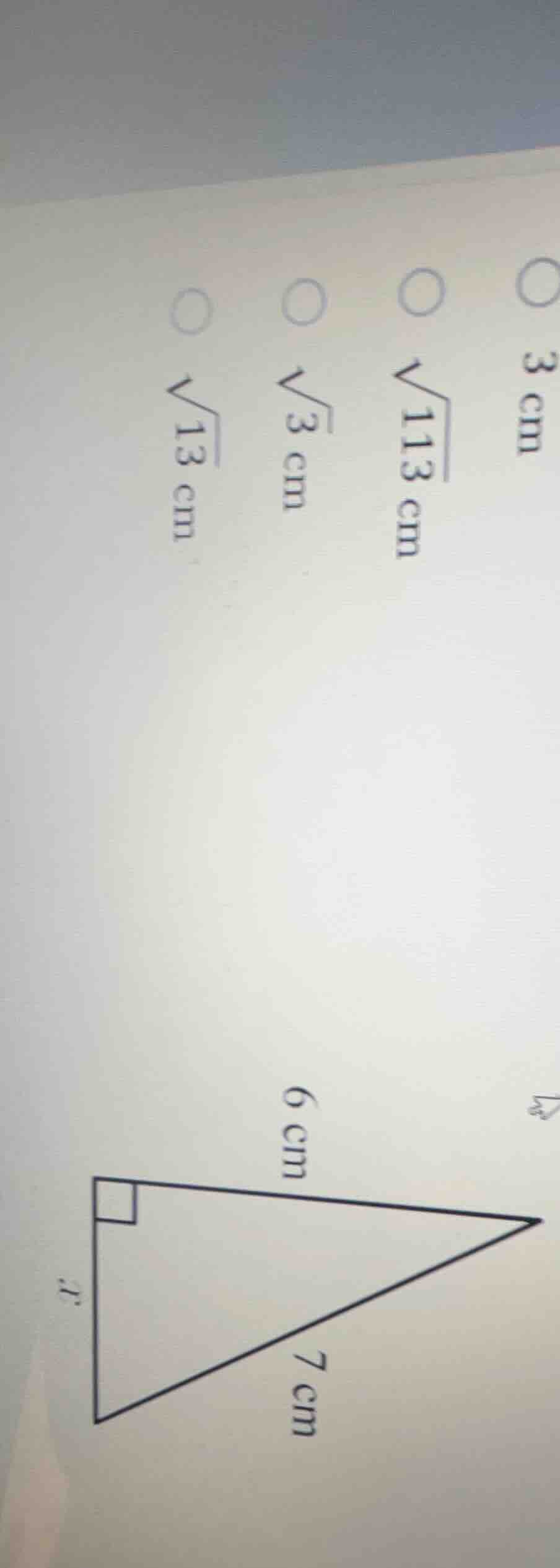
a right triangle with one leg labeled ( x ), the other leg labeled ( 6 , \text{cm} ), and the hypotenuse labeled ( 7 , \text{cm} ). the multiple - choice options for the value of ( x ) are ( 3 , \text{cm} ), ( sqrt{113} , \text{cm} ), ( sqrt{3} , \text{cm} ), ( sqrt{13} , \text{cm} ).
Step1: Identify the triangle type
This is a right - triangle, so we can use the Pythagorean theorem. The Pythagorean theorem states that in a right - triangle, if the lengths of the two legs are \(a\) and \(b\) and the length of the hypotenuse is \(c\), then \(a^{2}+b^{2}=c^{2}\). Here, one leg is \(x\), the other leg is \(6\space cm\), and the hypotenuse is \(7\space cm\).
Step2: Apply the Pythagorean theorem
We know that \(x^{2}+6^{2}=7^{2}\). First, calculate \(6^{2}=36\) and \(7^{2} = 49\). Then, we can rewrite the equation as \(x^{2}=7^{2}-6^{2}\). Substitute the values: \(x^{2}=49 - 36\).
Step3: Calculate the value of \(x^{2}\)
\(49-36 = 13\), so \(x^{2}=13\).
Step4: Solve for \(x\)
Taking the square root of both sides, since \(x\) represents the length of a side (a non - negative quantity), we get \(x=\sqrt{13}\space cm\).

Snap & solve any problem in the app
Get step-by-step solutions on Sovi AI
Photo-based solutions with guided steps
Explore more problems and detailed explanations
\(\sqrt{13}\space cm\) (corresponding to the option with \(\sqrt{13}\space cm\))