QUESTION IMAGE
Question
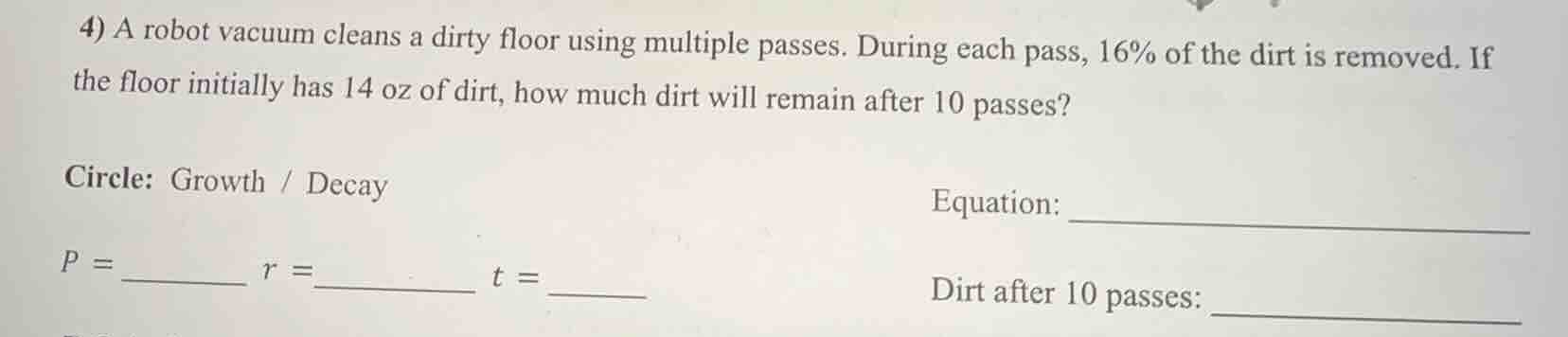
- a robot vacuum cleans a dirty floor using multiple passes. during each pass, 16% of the dirt is removed. if the floor initially has 14 oz of dirt, how much dirt will remain after 10 passes? circle: growth / decay equation: _ p = _ r = _ t = _ dirt after 10 passes: _
Step1: Identify the type of model
This is an exponential decay problem because the amount of dirt is decreasing over each pass. The general formula for exponential decay is \( P(t) = P_0(1 - r)^t \), where \( P_0 \) is the initial amount, \( r \) is the rate of decay (as a decimal), and \( t \) is the time (number of passes).
Step2: Determine the values of \( P_0 \), \( r \), and \( t \)
- \( P_0 \) (initial amount of dirt) is 14 oz, so \( P_0 = 14 \).
- The rate of dirt removal is 16% per pass. To convert this to a decimal, we divide by 100: \( r = 0.16 \). However, since we are looking at the remaining dirt, the factor by which the dirt remains is \( 1 - r = 1 - 0.16 = 0.84 \).
- The number of passes \( t = 10 \).
Step3: Plug the values into the decay formula
Using the formula \( P(t) = P_0(1 - r)^t \), we substitute \( P_0 = 14 \), \( 1 - r = 0.84 \), and \( t = 10 \):
\[
P(10) = 14 \times (0.84)^{10}
\]
Step4: Calculate \( (0.84)^{10} \)
First, we calculate \( 0.84^{10} \). Using a calculator, \( 0.84^{10} \approx 0.1749 \) (you can verify this by multiplying 0.84 by itself 10 times or using a calculator for exponentiation).
Step5: Calculate the remaining dirt
Now, multiply this result by the initial amount of dirt:
\[
P(10) = 14 \times 0.1749 \approx 2.4486
\]

Snap & solve any problem in the app
Get step-by-step solutions on Sovi AI
Photo-based solutions with guided steps
Explore more problems and detailed explanations
- Circle: Decay
- Equation: \( P(t) = 14(0.84)^t \)
- \( P_0 = 14 \), \( r = 0.16 \) (or the decay factor is \( 0.84 \)), \( t = 10 \)
- Dirt after 10 passes: Approximately \( 2.45 \) oz (rounded to two decimal places) or more precisely \( \approx 2.45 \) oz. If we use more precise calculation for \( 0.84^{10} \):
Using a calculator for \( 0.84^{10} \):
\( 0.84^1 = 0.84 \)
\( 0.84^2 = 0.84 \times 0.84 = 0.7056 \)
\( 0.84^3 = 0.7056 \times 0.84 \approx 0.5927 \)
\( 0.84^4 = 0.5927 \times 0.84 \approx 0.4979 \)
\( 0.84^5 = 0.4979 \times 0.84 \approx 0.4182 \)
\( 0.84^6 = 0.4182 \times 0.84 \approx 0.3513 \)
\( 0.84^7 = 0.3513 \times 0.84 \approx 0.2951 \)
\( 0.84^8 = 0.2951 \times 0.84 \approx 0.2479 \)
\( 0.84^9 = 0.2479 \times 0.84 \approx 0.2082 \)
\( 0.84^{10} = 0.2082 \times 0.84 \approx 0.1749 \)
Then \( 14 \times 0.1749 \approx 2.4486 \), so approximately \( 2.45 \) oz.