QUESTION IMAGE
Question
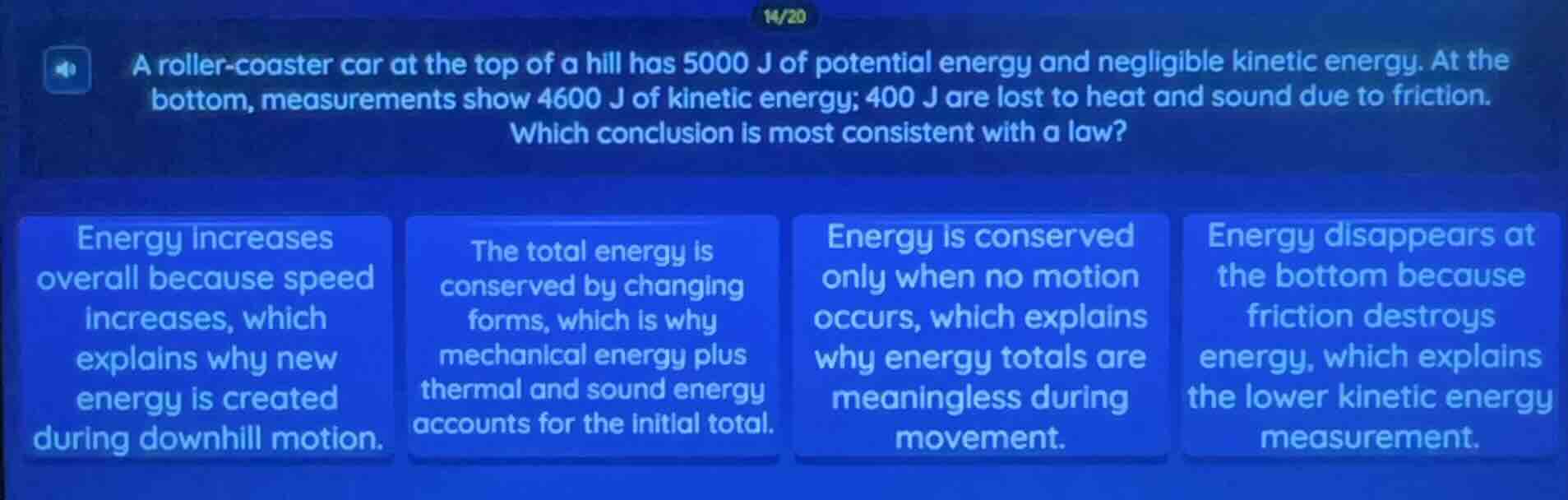
a roller - coaster car at the top of a hill has 5000 j of potential energy and negligible kinetic energy. at the bottom, measurements show 4600 j of kinetic energy; 400 j are lost to heat and sound due to friction. which conclusion is most consistent with a law? energy increases overall because speed increases, which explains why new energy is created during downhill motion. the total energy is conserved by changing forms, which is why mechanical energy plus thermal and sound energy accounts for the initial total. energy is conserved only when no motion occurs, which explains why energy totals are meaningless during movement. energy disappears at the bottom because friction destroys energy, which explains the lower kinetic energy measurement.
The law of conservation of energy states that energy cannot be created or destroyed, only transformed from one form to another. Here, initial potential energy (5000 J) becomes kinetic energy (4600 J) plus energy lost to heat/sound (400 J), which sums to the initial total energy, demonstrating energy conservation via form changes. Other options violate the conservation law by claiming energy is created, disappears, or only conserved at rest.

Snap & solve any problem in the app
Get step-by-step solutions on Sovi AI
Photo-based solutions with guided steps
Explore more problems and detailed explanations
The total energy is conserved by changing forms, which is why mechanical energy plus thermal and sound energy accounts for the initial total.