QUESTION IMAGE
Question
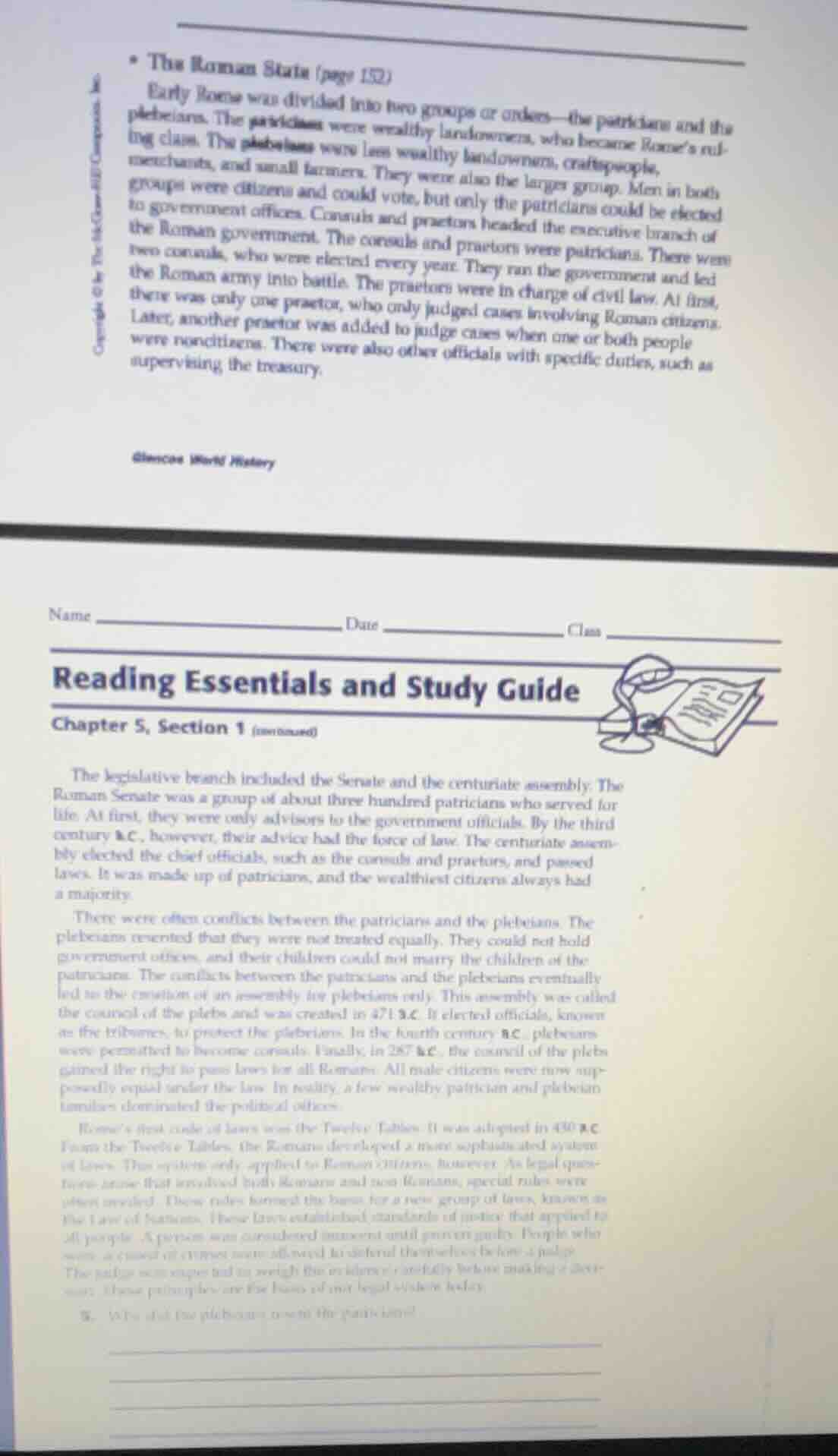
the roman state (page 152)
early rome was divided into two groups or orders—the patricians and the plebeians. the patricians were wealthy landowners, who became rome’s rul - ing class. the plebeians were less wealthy landowners, craftspeople, merchants, and small farmers. they were also the larger group. men in both groups were citizens and could vote, but only the patricians could be elected to government offices. consuls and praetors headed the executive branch of the roman government. the consuls and praetors were patricians. there were two consuls, who were elected every year. they ran the government and led the roman army into battle. the praetors were in charge of civil law. at first, there was only one praetor, who only judged cases involving roman citizens. later, another praetor was added to judge cases when one or both people were noncitizens. there were also other officials with specific duties, such as supervising the treasury.
glencoe world history
name ______________________ date _________________ class __________________
reading essentials and study guide
chapter 5, section 1 (continued)
the legislative branch included the senate and the centuriate assembly. the roman senate was a group of about three hundred patricians who served for life. at first, they were only advisors to the government officials. by the third century b.c., however, their advice had the force of law. the centuriate assem - bly elected the chief officials, such as the consuls and praetors, and passed laws. it was made up of patricians, and the wealthiest citizens always had a majority.
there were often conflicts between the patricians and the plebeians. the plebeians resented that they were not treated equally. they could not hold government offices, and their children could not marry the children of the patricians. the conflicts between the patricians and the plebeians eventually led to the creation of an assembly for plebeians only. this assembly was called the council of the plebs and was created in 471 b.c. it elected officials, known as the tribunes, to protect the plebeians. in the fourth century b.c., plebeians were permitted to become consuls. finally, in 287 b.c., the council of the plebs gained the right to pass laws for all romans. all male citizens were now sup - posedly equal under the laws. in reality, a few wealthy patrician and plebeian families dominated the political offices.
rome’s first code of laws was the twelve tables. it was adopted in 450 b.c. from the twelve tables, the romans developed a more sophisticated system of laws. this system only applied to roman citizens, however. as legal ques - tions arose that involved both romans and non - romans, special rules were often needed. these rules formed the basis for a new group of laws, known as the law of nations. these laws established standards of justice that applied to all people. a person was considered innocent until proven guilty. people who were accused of crimes were allowed to defend themselves before a judge. the judge was expected to weigh the evidence carefully before making a deci - sion. these principles are the basis of our legal system today.
- why did the plebeians resent the patricians?
The plebeians resented the patricians because they faced systemic inequality. They could vote but were barred from holding government offices, their children could not marry patrician children, and they did not have equal political power or legal standing compared to the wealthy patrician ruling class.

Snap & solve any problem in the app
Get step-by-step solutions on Sovi AI
Photo-based solutions with guided steps
Explore more problems and detailed explanations
The plebeians resented the patricians because they were treated unequally: they could not hold government offices, their children could not marry patrician children, and they lacked the same political power and legal standing as the patrician ruling class despite being citizens with voting rights.