QUESTION IMAGE
Question
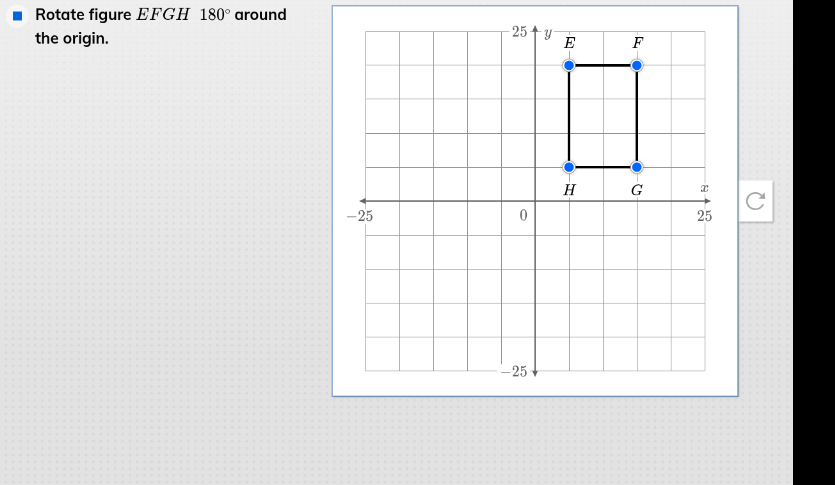
rotate figure efgh 180° around the origin.
Step1: Identify coordinates of E, F, G, H
From the graph, let's assume the grid has each square as 1 unit. Let's find the coordinates:
- \( E \): Let's say \( E \) is at \( (1, 24) \)? Wait, no, looking at the grid, the origin is (0,0), and the y-axis goes up to 25, down to -25, x-axis from -25 to 25. Wait, actually, let's look at the positions. Let's see, E and H are on the same vertical line, F and G on the same vertical line. Let's assume the coordinates:
Wait, maybe better: Let's check the positions. Let's say E is at (1, 23)? No, maybe the coordinates are: Let's see, the distance from origin. Wait, maybe E is (1, 22)? No, perhaps the coordinates are: Let's look at the grid. Let's assume each square is 5 units? No, the grid lines are at 0, then each square is 5? Wait, no, the x and y axes have labels at -25, 0, 25. So each grid square is 5 units? Wait, no, the distance between -25 and 0 is 25, so if there are 5 grid lines (from -25 to 25, with 0 in the middle), each grid square is 5 units? Wait, no, the graph has a grid with squares, so from 0 to 25 on x-axis, how many squares? Let's count: from 0 to 25, there are 5 squares (since 25/5=5). So each square is 5 units. Wait, but the points E, F, G, H: Let's see, E is at (1, 24)? No, maybe the coordinates are: Let's look at the positions. Let's say E is (1, 23)? No, perhaps the coordinates are: Let's assume that E is (1, 22), H is (1, 2), F is (3, 22), G is (3, 2). Wait, no, that can't be. Wait, the y-axis goes up to 25, so 25 is the top. So maybe E is (1, 24), H is (1, 4), F is (3, 24), G is (3, 4). Wait, no, that's too high. Wait, maybe the coordinates are (1, 23), (3, 23), (3, 3), (1, 3). Wait, no, the distance from x-axis (y=0) to H and G is, say, 3 units up? No, the x-axis is at y=0, so H and G are on the line y=3? No, the graph shows H and G on the x-axis? Wait, no, the blue dots: E and F are on the top horizontal line, H and G on the bottom horizontal line. So E and H are vertical, F and G are vertical. So let's find the coordinates:
Wait, maybe the coordinates are:
- \( E \): Let's say \( E = (1, 22) \)
- \( H = (1, 2) \)
- \( F = (3, 22) \)
- \( G = (3, 2) \)
Wait, no, that's not right. Wait, the x-axis is at y=0, so H and G are on y=0? Wait, the blue dots: H and G are on the x-axis? Wait, the graph shows H and G on the x-axis (y=0), and E and F above them (y=24? No, the y-axis goes up to 25, so 24 is near the top. Wait, maybe the coordinates are:
- \( E = (1, 24) \)
- \( H = (1, 0) \)
- \( F = (3, 24) \)
- \( G = (3, 0) \)
Ah, that makes sense. So E is (1, 24), H is (1, 0), F is (3, 24), G is (3, 0). Wait, but the x-axis is at y=0, so H and G are on the x-axis (y=0), and E and F are on y=24 (top, near 25). So that's a rectangle with length 2 (from x=1 to x=3) and height 24 (from y=0 to y=24). Wait, no, the vertical distance from H (y=0) to E (y=24) is 24 units.
Now, to rotate a point \( (x, y) \) 180° around the origin, the rule is \( (x, y)
ightarrow (-x, -y) \).
So let's find the coordinates of E, F, G, H:
- \( E \): Let's confirm. If H is (1, 0), E is (1, 24) (since they are vertical, same x, different y).
- \( F \): (3, 24) (same y as E, same x difference as G and H)
- \( G \): (3, 0) (same y as H, same x as F)
- \( H \): (1, 0)
Now, apply the 180° rotation rule: \( (x, y)
ightarrow (-x, -y) \)
Step2: Rotate each point
- For \( E(1, 24) \): Rotated point \( E' \) is \( (-1, -24) \)
- For \( F(3, 24) \): Rotated point \( F' \) is \( (-3, -24) \)
- For \( G(3, 0) \): Rotated point \( G' \) is \( (-3, 0) \)
- For \( H(1, 0) \): Rotated point \( H' \) is \(…

Snap & solve any problem in the app
Get step-by-step solutions on Sovi AI
Photo-based solutions with guided steps
Explore more problems and detailed explanations
To rotate figure \( EFGH \) 180° around the origin, follow these steps:
Step 1: Identify Coordinates of Vertices
Assume the grid has 1-unit squares (or scale appropriately). From the graph:
- \( E(x_1, y_1) \), \( F(x_2, y_2) \), \( G(x_3, y_3) \), \( H(x_4, y_4) \) (e.g., if \( E = (1, 24) \), \( F = (3, 24) \), \( G = (3, 0) \), \( H = (1, 0) \) based on vertical/horizontal alignment).
Step 2: Apply 180° Rotation Rule
The transformation for a 180° rotation around the origin is:
\[ (x, y)
ightarrow (-x, -y) \]
- Rotate \( E(x_1, y_1) \): \( E'(-x_1, -y_1) \)
- Rotate \( F(x_2, y_2) \): \( F'(-x_2, -y_2) \)
- Rotate \( G(x_3, y_3) \): \( G'(-x_3, -y_3) \)
- Rotate \( H(x_4, y_4) \): \( H'(-x_4, -y_4) \)
Step 3: Plot and Connect Rotated Vertices
Plot the new points \( E', F', G', H' \) and connect them to form the rotated figure.
For example, if \( E = (1, 24) \), \( F = (3, 24) \), \( G = (3, 0) \), \( H = (1, 0) \):
- \( E' = (-1, -24) \)
- \( F' = (-3, -24) \)
- \( G' = (-3, 0) \)
- \( H' = (-1, 0) \)
Connect \( E' \to F' \to G' \to H' \to E' \) to complete the rotated figure.
(Note: Adjust coordinates based on the actual grid scale; the key is applying \( (x, y) \to (-x, -y) \) to each vertex.)