QUESTION IMAGE
Question
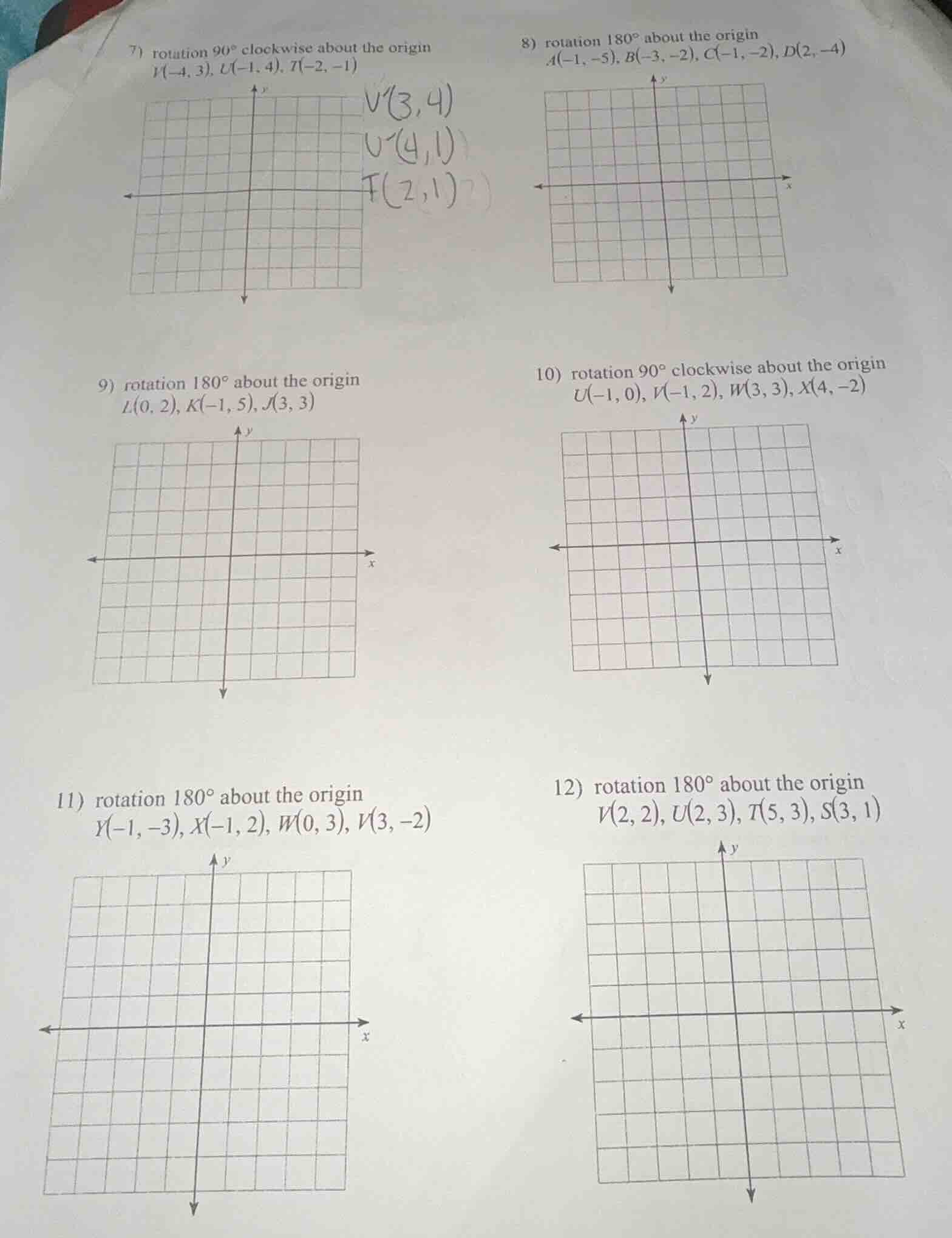
- rotation $90^{\circ}$ clockwise about the origin
$v(-4, 3), u(-1, 4), t(-2, -1)$
- rotation $180^{\circ}$ about the origin
$a(-1, -5), b(-3, -2), c(-1, -2), d(2, -4)$
- rotation $180^{\circ}$ about the origin
$l(0, 2), k(-1, 5), j(3, 3)$
- rotation $90^{\circ}$ clockwise about the origin
$u(-1, 0), v(-1, 2), w(3, 3), x(4, -2)$
- rotation $180^{\circ}$ about the origin
$y(-1, -3), x(-1, 2), w(0, 3), v(3, -2)$
- rotation $180^{\circ}$ about the origin
$v(2, 2), u(2, 3), t(5, 3), s(3, 1)$
7) 90° clockwise about origin
Step1: Recall rotation rule
For a point $(x,y)$, 90° clockwise rotation about the origin transforms to $(y, -x)$.
Step2: Apply to $V(-4,3)$
$V'=(3, -(-4))=(3,4)$
Step3: Apply to $U(-1,4)$
$U'=(4, -(-1))=(4,1)$
Step4: Apply to $T(-2,-1)$
$T'=(-1, -(-2))=(-1,2)$
---
8) 180° about origin
Step1: Recall rotation rule
For a point $(x,y)$, 180° rotation about the origin transforms to $(-x,-y)$.
Step2: Apply to $A(-1,-5)$
$A'=(-(-1), -(-5))=(1,5)$
Step3: Apply to $B(-3,-2)$
$B'=(-(-3), -(-2))=(3,2)$
Step4: Apply to $C(-1,-2)$
$C'=(-(-1), -(-2))=(1,2)$
Step5: Apply to $D(2,-4)$
$D'=(-2, -(-4))=(-2,4)$
---
9) 180° about origin
Step1: Recall rotation rule
For a point $(x,y)$, 180° rotation about the origin transforms to $(-x,-y)$.
Step2: Apply to $L(0,2)$
$L'=(-0, -2)=(0,-2)$
Step3: Apply to $K(-1,5)$
$K'=(-(-1), -5)=(1,-5)$
Step4: Apply to $J(3,3)$
$J'=(-3, -3)=(-3,-3)$
---
10) 90° clockwise about origin
Step1: Recall rotation rule
For a point $(x,y)$, 90° clockwise rotation about the origin transforms to $(y, -x)$.
Step2: Apply to $U(-1,0)$
$U'=(0, -(-1))=(0,1)$
Step3: Apply to $V(-1,2)$
$V'=(2, -(-1))=(2,1)$
Step4: Apply to $W(3,3)$
$W'=(3, -3)$
Step5: Apply to $X(4,-2)$
$X'=(-2, -4)$
---
11) 180° about origin
Step1: Recall rotation rule
For a point $(x,y)$, 180° rotation about the origin transforms to $(-x,-y)$.
Step2: Apply to $Y(-1,-3)$
$Y'=(-(-1), -(-3))=(1,3)$
Step3: Apply to $X(-1,2)$
$X'=(-(-1), -2)=(1,-2)$
Step4: Apply to $W(0,3)$
$W'=(-0, -3)=(0,-3)$
Step5: Apply to $V(3,-2)$
$V'=(-3, -(-2))=(-3,2)$
---
12) 180° about origin
Step1: Recall rotation rule
For a point $(x,y)$, 180° rotation about the origin transforms to $(-x,-y)$.
Step2: Apply to $V(2,2)$
$V'=(-2, -2)=(-2,-2)$
Step3: Apply to $U(2,3)$
$U'=(-2, -3)=(-2,-3)$
Step4: Apply to $T(5,3)$
$T'=(-5, -3)=(-5,-3)$
Step5: Apply to $S(3,1)$
$S'=(-3, -1)=(-3,-1)$

Snap & solve any problem in the app
Get step-by-step solutions on Sovi AI
Photo-based solutions with guided steps
Explore more problems and detailed explanations
- $V'(3,4)$, $U'(4,1)$, $T'(-1,2)$
- $A'(1,5)$, $B'(3,2)$, $C'(1,2)$, $D'(-2,4)$
- $L'(0,-2)$, $K'(1,-5)$, $J'(-3,-3)$
- $U'(0,1)$, $V'(2,1)$, $W'(3,-3)$, $X'(-2,-4)$
- $Y'(1,3)$, $X'(1,-2)$, $W'(0,-3)$, $V'(-3,2)$
- $V'(-2,-2)$, $U'(-2,-3)$, $T'(-5,-3)$, $S'(-3,-1)$