QUESTION IMAGE
Question
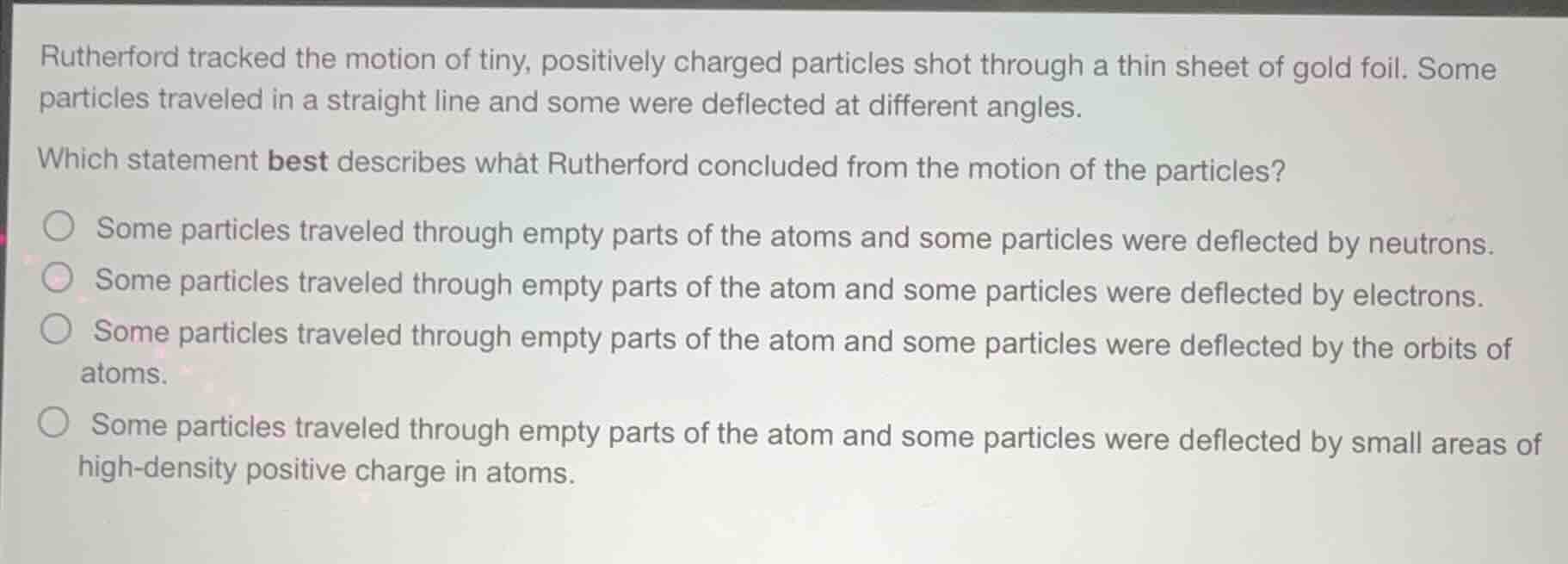
rutherford tracked the motion of tiny, positively charged particles shot through a thin sheet of gold foil. some particles traveled in a straight line and some were deflected at different angles. which statement best describes what rutherford concluded from the motion of the particles? some particles traveled through empty parts of the atoms and some particles were deflected by neutrons. some particles traveled through empty parts of the atom and some particles were deflected by electrons. some particles traveled through empty parts of the atom and some particles were deflected by the orbits of atoms. some particles traveled through empty parts of the atom and some particles were deflected by small areas of high - density positive charge in atoms.
Rutherford's gold foil experiment showed that most alpha particles passed through the foil (proving atoms have large empty spaces), while a small number were deflected at large angles. This deflection occurred because the positively charged alpha particles repelled off the small, dense, positively charged atomic nucleus (the small area of high-density positive charge in atoms). Neutrons are neutral and cannot deflect positive particles; electrons are too low-mass to cause large deflections; and orbits are not a physical structure that would deflect particles.

Snap & solve any problem in the app
Get step-by-step solutions on Sovi AI
Photo-based solutions with guided steps
Explore more problems and detailed explanations
Some particles traveled through empty parts of the atom and some particles were deflected by small areas of high-density positive charge in atoms.