QUESTION IMAGE
Question
sa: cbc review questions
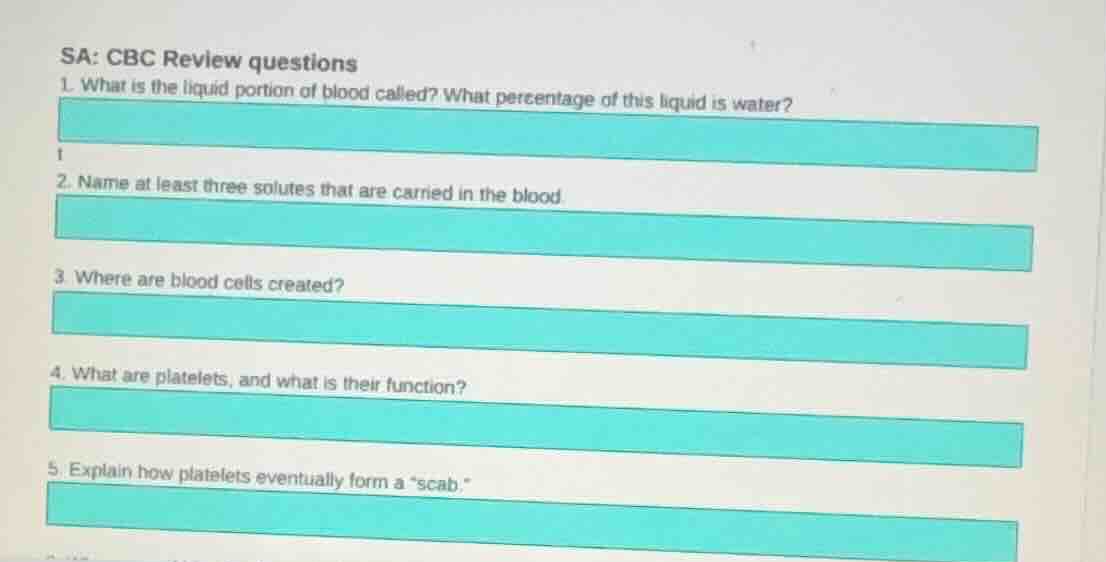
- what is the liquid portion of blood called? what percentage of this liquid is water?
- name at least three solutes that are carried in the blood
- where are blood cells created?
- what are platelets, and what is their function?
- explain how platelets eventually form a \scab\.
Sub - question 1
The liquid portion of blood is plasma. Plasma is approximately 90 - 92% water. This is a basic fact in the study of blood composition in biology (specifically in the sub - field of human physiology or hematology within biology).
In blood, common solutes include glucose (which provides energy to cells), salts (such as sodium, potassium, and chloride ions that help in maintaining osmotic balance and nerve - muscle function), and proteins (like albumin which helps in maintaining blood volume, and globulins which are involved in immune responses and transporting substances). These solutes are carried in the plasma of the blood, and this knowledge is part of the study of blood biochemistry within biology.
Blood cells are created in the bone marrow. Specifically, red blood cells, white blood cells, and platelets all originate from hematopoietic stem cells in the bone marrow. This is a key concept in hematology, a sub - field of biology that deals with blood and blood - forming tissues.

Snap & solve any problem in the app
Get step-by-step solutions on Sovi AI
Photo-based solutions with guided steps
Explore more problems and detailed explanations
The liquid portion of blood is called plasma. Approximately 90 - 92% of plasma is water.