QUESTION IMAGE
Question
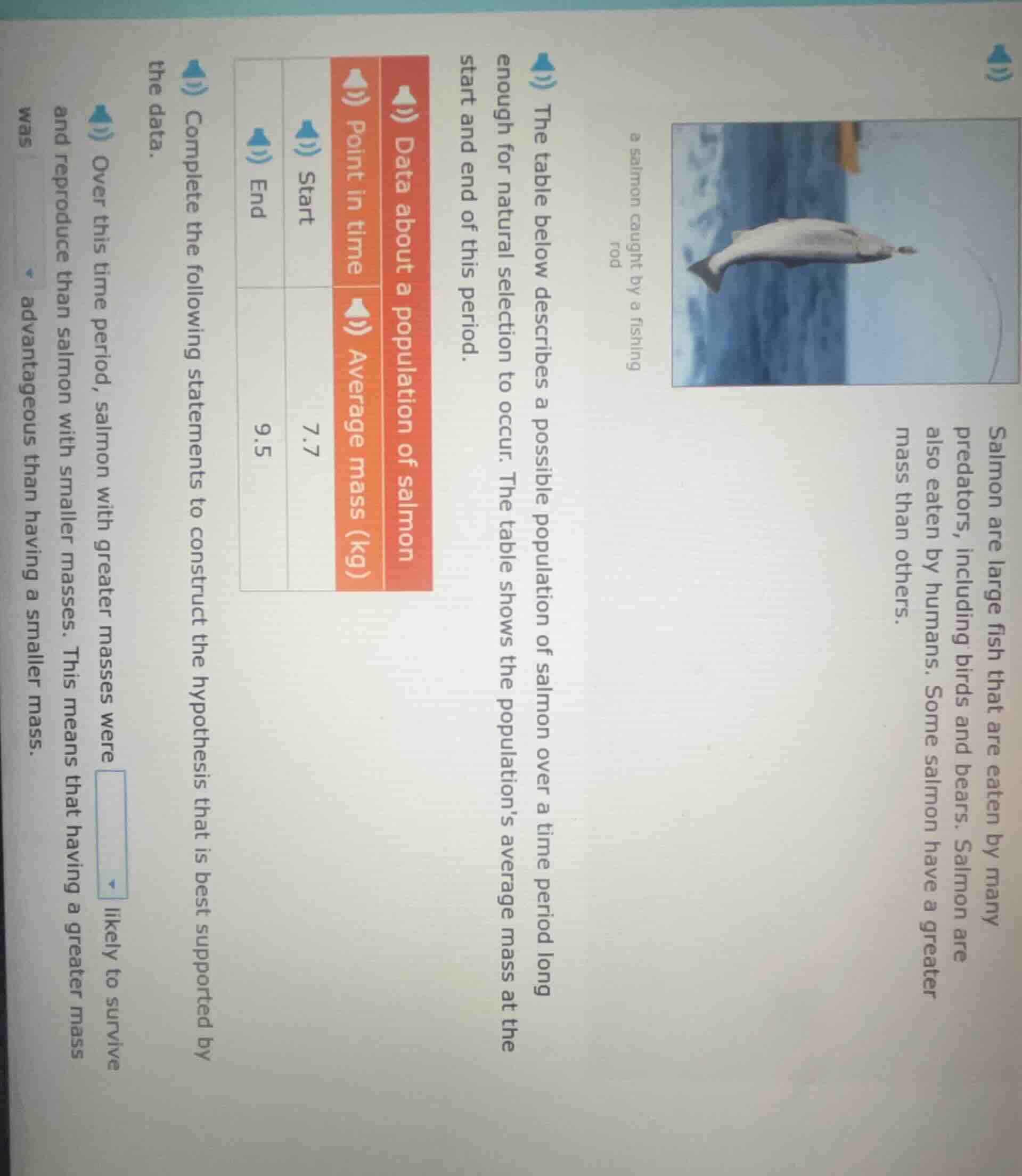
salmon are large fish that are eaten by many predators, including birds and bears. salmon are also eaten by humans. some salmon have a greater mass than others.
the table below describes a possible population of salmon over a time period long enough for natural selection to occur. the table shows the population’s average mass at the start and end of this period.
data about a population of salmon
point in time average mass (kg)
start 7.7
end 9.5
complete the following statements to construct the hypothesis that is best supported by the data.
over this time period, salmon with greater masses were ▼ likely to survive and reproduce than salmon with smaller masses. this means that having a greater mass was ▼ advantageous than having a smaller mass.
- The average mass of salmon increased from 7.7 kg to 9.5 kg over the period. This shows that larger salmon were more successful at surviving and reproducing, so having a greater mass was advantageous.
- The completed hypothesis aligns with the trend in the data: as average mass increased, greater mass must have been the more favorable trait for survival and reproduction.

Snap & solve any problem in the app
Get step-by-step solutions on Sovi AI
Photo-based solutions with guided steps
Explore more problems and detailed explanations
- Complete the statement: less
- Full statement: Over this time period, salmon with greater masses were less likely to survive and reproduce than salmon with smaller masses. This means that having a greater mass was not advantageous than having a smaller mass.
- Completed hypothesis (aligned with data): As the average mass of the salmon population increased from 7.7 kg to 9.5 kg over the period, salmon with greater masses were more likely to survive and reproduce than salmon with smaller masses. This means that having a greater mass was advantageous than having a smaller mass.