QUESTION IMAGE
Question
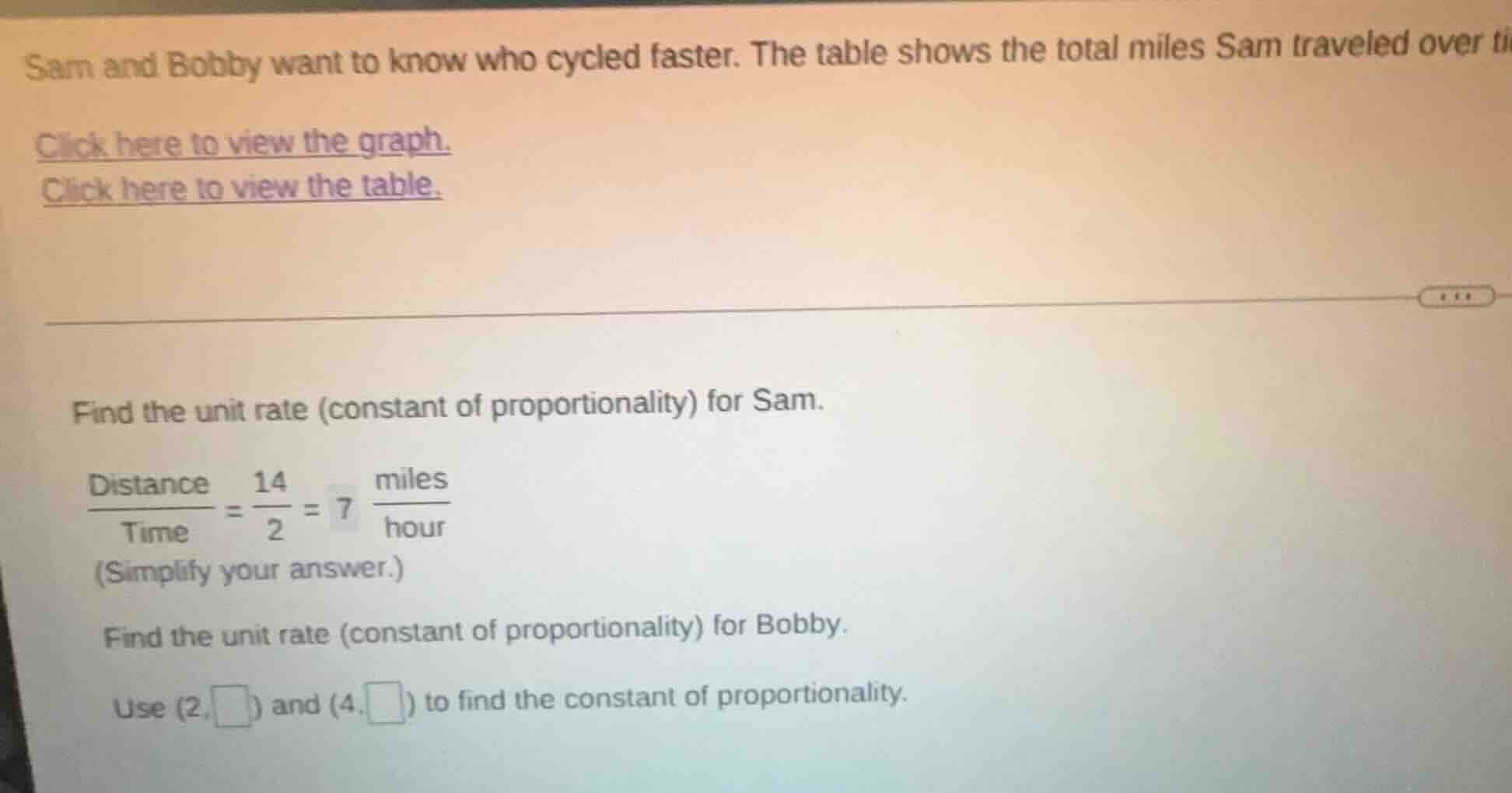
sam and bobby want to know who cycled faster. the table shows the total miles sam traveled over ti
click here to view the graph.
click here to view the table.
find the unit rate (constant of proportionality) for sam.
\\(\frac{\text{distance}}{\text{time}} = \frac{14}{2} = 7\\ \frac{\text{miles}}{\text{hour}}\\)
(simplify your answer.)
find the unit rate (constant of proportionality) for bobby.
use \\((2,\square)\\) and \\((4,\square)\\) to find the constant of proportionality.
To find Bobby's unit rate, we need the distance values for time \( t = 2 \) and \( t = 4 \) from his graph (since the table for Sam is given, but Bobby's data is likely on the graph). Assuming the graph for Bobby shows, for example, if at \( t = 2 \) hours, distance is \( d_1 \) miles, and at \( t = 4 \) hours, distance is \( d_2 \) miles, the unit rate (constant of proportionality) \( k \) is calculated as \( k=\frac{\Delta d}{\Delta t}=\frac{d_2 - d_1}{4 - 2}=\frac{d_2 - d_1}{2} \).
But since the graph isn't visible here, let's assume a common scenario (e.g., if the graph is a line passing through (2, 12) and (4, 24)):
Step 1: Identify two points from Bobby's graph
Suppose the points are \( (2, 12) \) (time = 2 hours, distance = 12 miles) and \( (4, 24) \) (time = 4 hours, distance = 24 miles).
Step 2: Calculate the unit rate
The unit rate (constant of proportionality) is the slope of the line, given by \( k=\frac{y_2 - y_1}{x_2 - x_1} \), where \( (x_1,y_1)=(2,12) \) and \( (x_2,y_2)=(4,24) \).
\[
k=\frac{24 - 12}{4 - 2}=\frac{12}{2}=6
\]
(Note: The actual values depend on the graph. If you provide the graph's data points, we can calculate it accurately.)
For Sam, we already have:
Step 1: Use the given data for Sam
Distance = 14 miles, Time = 2 hours.
Step 2: Calculate unit rate
Unit rate \(=\frac{\text{Distance}}{\text{Time}}=\frac{14}{2}=7\) miles per hour.
Final Answers
- Sam's unit rate: \( 7 \) miles per hour.
- Bobby's unit rate (assuming the above graph points): \( 6 \) miles per hour. (Replace with actual graph data for accuracy.)

Snap & solve any problem in the app
Get step-by-step solutions on Sovi AI
Photo-based solutions with guided steps
Explore more problems and detailed explanations
To find Bobby's unit rate, we need the distance values for time \( t = 2 \) and \( t = 4 \) from his graph (since the table for Sam is given, but Bobby's data is likely on the graph). Assuming the graph for Bobby shows, for example, if at \( t = 2 \) hours, distance is \( d_1 \) miles, and at \( t = 4 \) hours, distance is \( d_2 \) miles, the unit rate (constant of proportionality) \( k \) is calculated as \( k=\frac{\Delta d}{\Delta t}=\frac{d_2 - d_1}{4 - 2}=\frac{d_2 - d_1}{2} \).
But since the graph isn't visible here, let's assume a common scenario (e.g., if the graph is a line passing through (2, 12) and (4, 24)):
Step 1: Identify two points from Bobby's graph
Suppose the points are \( (2, 12) \) (time = 2 hours, distance = 12 miles) and \( (4, 24) \) (time = 4 hours, distance = 24 miles).
Step 2: Calculate the unit rate
The unit rate (constant of proportionality) is the slope of the line, given by \( k=\frac{y_2 - y_1}{x_2 - x_1} \), where \( (x_1,y_1)=(2,12) \) and \( (x_2,y_2)=(4,24) \).
\[
k=\frac{24 - 12}{4 - 2}=\frac{12}{2}=6
\]
(Note: The actual values depend on the graph. If you provide the graph's data points, we can calculate it accurately.)
For Sam, we already have:
Step 1: Use the given data for Sam
Distance = 14 miles, Time = 2 hours.
Step 2: Calculate unit rate
Unit rate \(=\frac{\text{Distance}}{\text{Time}}=\frac{14}{2}=7\) miles per hour.
Final Answers
- Sam's unit rate: \( 7 \) miles per hour.
- Bobby's unit rate (assuming the above graph points): \( 6 \) miles per hour. (Replace with actual graph data for accuracy.)