QUESTION IMAGE
Question
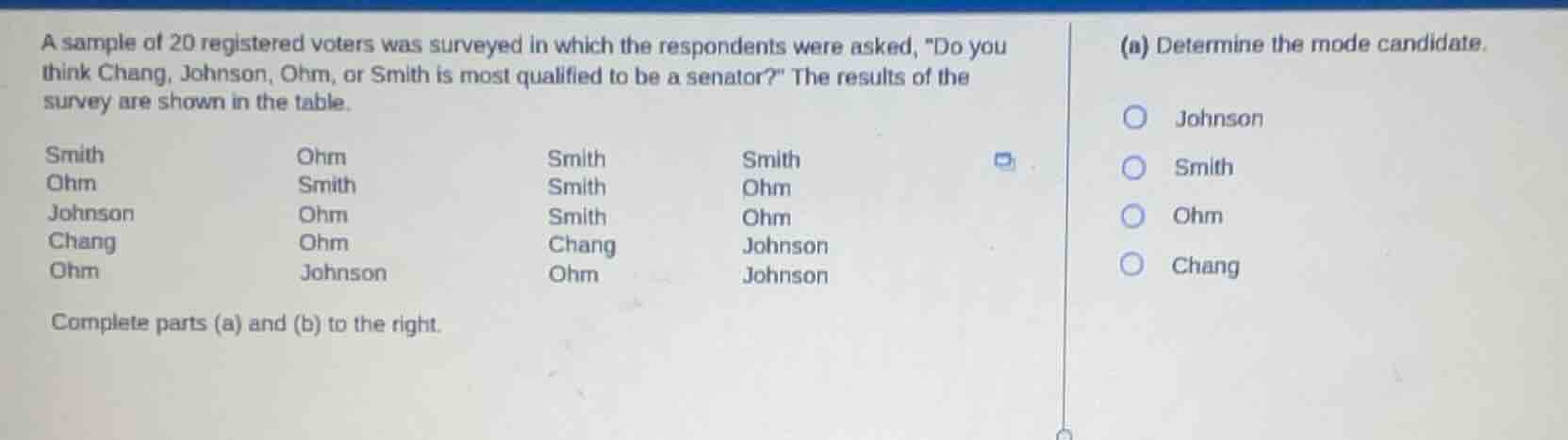
a sample of 20 registered voters was surveyed in which the respondents were asked, \do you think chang, johnson, ohm, or smith is most qualified to be a senator?\ the results of the survey are shown in the table.
smith\tohm\tsmith\tsmith
ohm\tsmith\tsmith\tohm
johnson\tohm\tsmith\tohm
chang\tohm\tchang\tjohnson
ohm\tjohnson\tohm\tjohnson
complete parts (a) and (b) to the right.
(a) determine the mode candidate.
\t○ johnson
\t○ smith
\t○ ohm
\t○ chang
Step1: Count votes for each candidate
- Smith: Let's count. The entries with Smith are: Smith, Smith, Smith, Smith, Smith, Smith. That's 6 times.
- Ohm: Entries with Ohm: Ohm, Ohm, Ohm, Ohm, Ohm, Ohm. Wait, let's count again. The list: Ohm (1), Ohm (from second row: Ohm), Ohm (third row: Ohm), Ohm (fourth row: Ohm), Ohm (fifth row: Ohm), Ohm (last row: Ohm). Wait, no, let's list all:
First column: Smith, Ohm, Johnson, Chang, Ohm
Second column: Ohm, Smith, Ohm, Ohm, Johnson
Third column: Smith, Smith, Smith, Chang, Ohm
Fourth column: Smith, Ohm, Ohm, Johnson, Johnson
Now let's count each:
Smith: First column (1), second column (1), third column (3), fourth column (1). Total: 1+1+3+1 = 6.
Ohm: First column (2), second column (2), third column (1), fourth column (2). Total: 2+2+1+2 = 7? Wait, maybe I made a mistake. Wait let's list all 20 entries:
- Smith
- Ohm
- Smith
- Smith
- Ohm
- Smith
- Smith
- Ohm
- Johnson
- Ohm
- Ohm
- Chang
- Ohm
- Chang
- Johnson
- Ohm
- Johnson
- Smith
- Ohm
- Johnson
Wait no, the table has 5 rows and 4 columns, so 5*4=20 entries. Let's list all 20:
Row 1: Smith, Ohm, Smith, Smith
Row 2: Ohm, Smith, Smith, Ohm
Row 3: Johnson, Ohm, Smith, Ohm
Row 4: Chang, Ohm, Chang, Johnson
Row 5: Ohm, Johnson, Ohm, Johnson
Now count each:
Smith: Row1 (3), Row2 (2), Row3 (1) → 3+2+1=6
Ohm: Row1 (1), Row2 (2), Row3 (2), Row4 (1), Row5 (2) → 1+2+2+1+2=8? Wait, no, let's count each entry:
- Smith
- Ohm
- Smith
- Smith
- Ohm
- Smith
- Smith
- Ohm
- Johnson
- Ohm
- Ohm
- Chang
- Ohm
- Chang
- Johnson
- Ohm
- Johnson
- Smith
- Ohm
- Johnson
Now let's count:
Smith: 1,3,4,6,7,18 → that's 6 times.
Ohm: 2,5,8,10,11,13,16,19 → 8 times? Wait 2 (Ohm), 5 (Ohm), 8 (Ohm), 10 (Ohm), 11 (Ohm), 13 (Ohm), 16 (Ohm), 19 (Ohm). That's 8 times.
Johnson: 9,15,17,20? Wait row 4: Johnson, row 5: Johnson, row 3: Johnson? Wait row 3: Johnson (first entry), row 4: Johnson (fourth entry), row 5: Johnson (second and fourth entries). So Johnson: 9 (row3), 15 (row4), 17 (row5), 20 (row5). Wait row 5: Johnson (second) and Johnson (fourth). So that's 4 times.
Chang: 12,14 → 2 times.
Wait now I'm confused. Let's do a systematic count:
List all 20 responses:
- Smith
- Ohm
- Smith
- Smith
- Ohm
- Smith
- Smith
- Ohm
- Johnson
- Ohm
- Ohm
- Chang
- Ohm
- Chang
- Johnson
- Ohm
- Johnson
- Smith
- Ohm
- Johnson
Now count each:
- Smith: positions 1,3,4,6,7,18 → 6 times.
- Ohm: positions 2,5,8,10,11,13,16,19 → 8 times.
- Johnson: positions 9,15,17,20 → 4 times.
- Chang: positions 12,14 → 2 times.
Wait but the mode is the most frequent value. Wait, but the options are Smith, Ohm, Johnson, Chang. Wait maybe I made a mistake in counting. Let's check again.
Wait the original table:
First column: Smith, Ohm, Johnson, Chang, Ohm → 5 entries.
Second column: Ohm, Smith, Ohm, Ohm, Johnson → 5 entries.
Third column: Smith, Smith, Smith, Chang, Ohm → 5 entries.
Fourth column: Smith, Ohm, Ohm, Johnson, Johnson → 5 entries.
Now count each column:
First column:
Smith: 1
Ohm: 2 (positions 2 and 5)
Johnson:1
Chang:1
Second column:
Ohm:2 (positions 1 and 3,4) Wait second column entries: Ohm, Smith, Ohm, Ohm, Johnson → Ohm appears 3 times (positions 1,3,4), Smith 1, Johnson 1.
Third column:
Smith:3 (positions 1,2,3), Chang 1, Ohm 1.
Fourth column:
Smith:1, Ohm:2 (positions 2,3), Johnson:2 (positions 4,5).
Now total for each:
Smith: first column (1) + second column (1) + third column (…

Snap & solve any problem in the app
Get step-by-step solutions on Sovi AI
Photo-based solutions with guided steps
Explore more problems and detailed explanations
Ohm (the third option: Ohm)