QUESTION IMAGE
Question
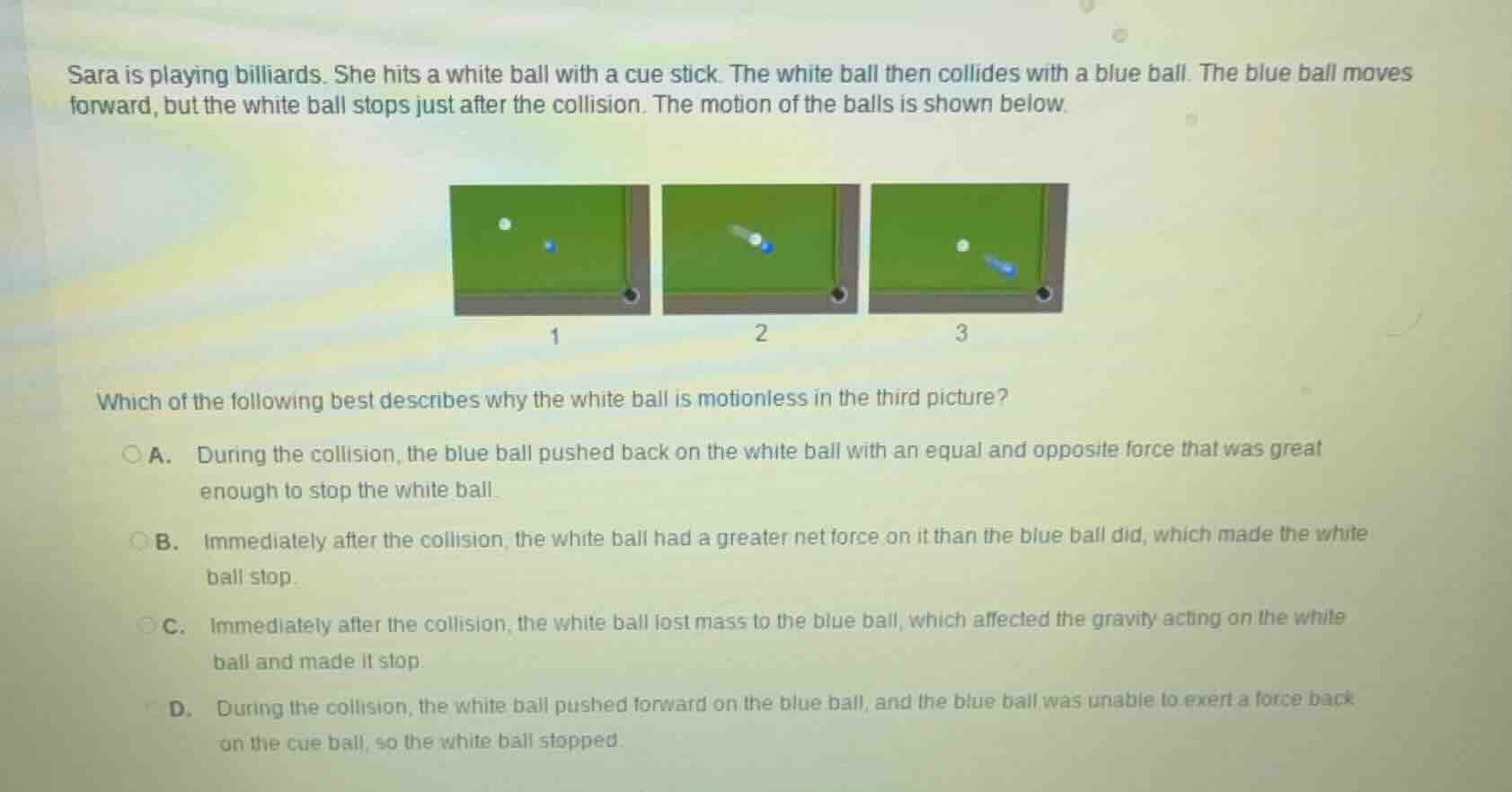
sara is playing billiards. she hits a white ball with a cue stick. the white ball then collides with a blue ball. the blue ball moves forward, but the white ball stops just after the collision. the motion of the balls is shown below. which of the following best describes why the white ball is motionless in the third picture? a. during the collision, the blue ball pushed back on the white ball with an equal and opposite force that was great enough to stop the white ball. b. immediately after the collision, the white ball had a greater net force on it than the blue ball did, which made the white ball stop. c. immediately after the collision, the white ball lost mass to the blue ball, which affected the gravity acting on the white ball and made it stop. d. during the collision, the white ball pushed forward on the blue ball, and the blue ball was unable to exert a force back on the cue ball, so the white ball stopped.
This aligns with Newton's third law of motion, which states that for every action force, there is an equal and opposite reaction force. When the white ball strikes the blue ball, the blue ball exerts an equal and opposite force on the white ball. In this case, this reaction force brings the white ball to a stop, while the action force from the white ball sets the blue ball in motion. The other options are incorrect: Option B is wrong because net force on the white ball is not greater post-collision; Option C is wrong as no mass transfer occurs between the balls; Option D is wrong because the blue ball does exert a reaction force on the white ball.

Snap & solve any problem in the app
Get step-by-step solutions on Sovi AI
Photo-based solutions with guided steps
Explore more problems and detailed explanations
A. During the collision, the blue ball pushed back on the white ball with an equal and opposite force that was great enough to stop the white ball.